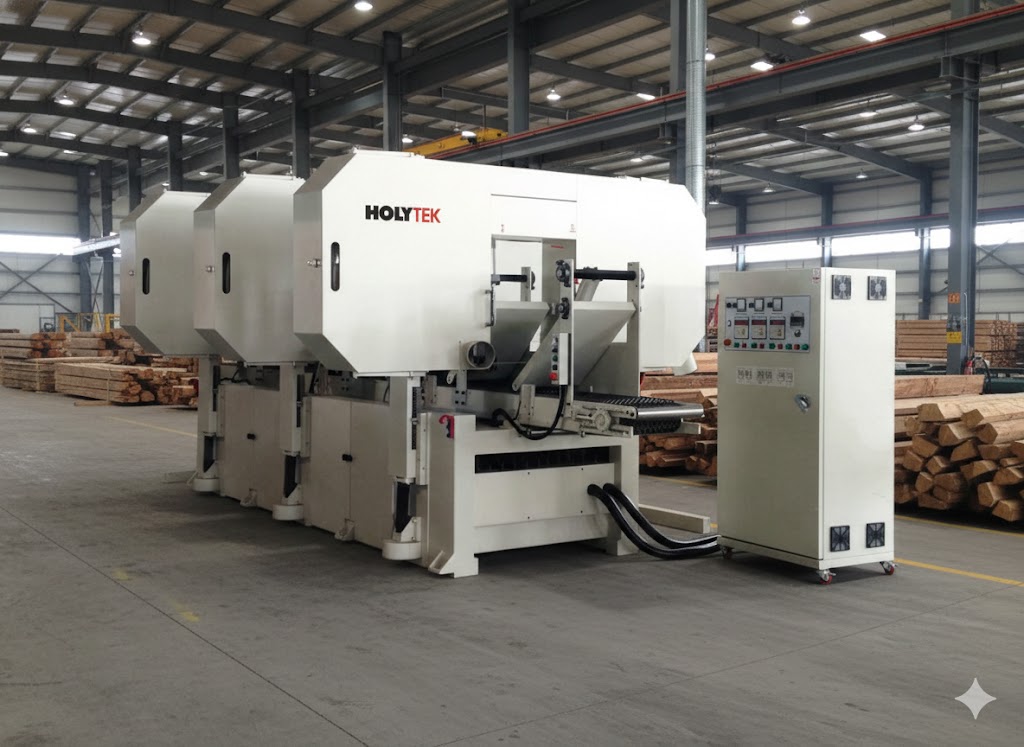
Understanding the Working Mechanism of Multiple Head Horizontal Band Resaws in Woodworking
The world of modern textiles, particularly within the manufacturing of knitted fabrics, involves intricate technical details that define the quality of every meter of fabric produced. For industry professionals, understanding the mechanical aspects of fabric structures is not merely about aesthetics; it is about understanding how machines operate to create specific physical characteristics. Three structures dominate the global knitwear market: RIB, Interlock, and the broad classification known as Double Jersey.
While these three structures all utilize two sets of needles, their configurations and synchronization methods differ significantly. These mechanical variations directly impact elasticity, fabric weight (GSM), and the dimensional stability of the final product.
The RIB Structure Mechanism: Prioritizing Lateral Elasticity
The RIB structure is one of the most fundamental forms of knitting that utilizes two sets of needles: the cylinder needles and the dial needles. Mechanically, this structure operates using a system called "rib-gaiting," where the needles on the cylinder are positioned in the gaps between the needles on the dial. This allows the machine to form face loops and back loops alternately within the same course of knitting.
The primary mechanical advantage of the RIB structure is its extraordinary elasticity in the transverse direction (width). When the fabric is stretched, these loops open up, and when released, they return to their original position due to the balanced internal tension between the front and back loops. In a manufacturing environment, production efficiency relies heavily on modern textile machinery technology that can maintain consistent yarn tension to prevent the RIB from becoming too loose or wavy.
The Interlock Structure Mechanism: Stability Through Double Locking
Although often confused with RIB, the Interlock structure possesses a much more complex mechanical configuration. Technically, Interlock is a combination of two 1x1 RIB structures knitted together in an interlocking fashion. The fundamental difference lies in the needle positioning, or "gaiting." In Interlock, the needles on the cylinder and the dial are positioned directly opposite each other, but they work alternately using a two-track cam system involving sets of long and short needles.
Mechanically, this creates a structure that is exceptionally dense and smooth on both sides of the fabric. Interlock does not possess the high elasticity of RIB, but it offers much better dimensional stability. This fabric does not curl at the edges and has a higher resistance to deformation. The density of this structure is heavily influenced by the precision of needle movement in high-speed circular knitting equipment, where the synchronization between long and short needles must be perfect to avoid mechanical interference.
Defining the Broad Category of Double Jersey
The term "Double Jersey" is actually a general category for all knitted fabrics produced using two sets of needles. Therefore, technically, both RIB and Interlock are members of the Double Jersey family. However, in a specific industrial context, Double Jersey often refers to more complex pattern variations such as Pique, Jacquard, or Milano Rib.
The Double Jersey mechanism allows for a rich variety of textures because the machine has the flexibility to determine whether specific needles will knit, miss, or tuck. These mechanical variations provide manufacturers with the ability to create fabrics that are thicker and heavier than Single Jersey. The most prominent characteristic of Double Jersey is its ability to hold its shape exceptionally well, making it the preferred choice for formal wear, blazers, or premium sportswear that requires high structural integrity.
Significant Differences in Yarn Consumption and Tension
From a mechanical standpoint, the cam settings on a knitting machine vary greatly when producing these three structures. For RIB production, the cam settings are usually simpler because the primary focus is on a constant up-and-down rhythm of the needles. However, in Interlock production, the cams must be precisely timed so that the long and short needles do not collide while working in a confined space.
Furthermore, yarn feeding is a major differentiator. The Interlock structure requires significantly more yarn consumption than a RIB structure for the same width of fabric because of its double-knit density. This makes Interlock fabric feel more "substantial" and provides better thermal insulation. On the other hand, other Double Jersey variations allow machine technicians to experiment with stitch density to achieve specific levels of softness or stiffness based on market demand.
Optimize Your Industry Today!
Achieve production efficiency and the highest quality standards with a trusted industrial machinery provider. Explore our wide selection of premium processing and testing equipment at:
Website : valtekindo.co.id
Website : distributormesin.com
Consult your technical needs with our expert sales team:
WhatsApp 1: +62 852-2211-0091
WhatsApp 2: +62 852-7711-0091

Admin
AuthorAdmin is a writer on the Valtekindo website, providing informative content about High Quality Industrial Machinery and Testing Machines.
Related post:
- Pharmaceutical Factory Production Escalation Strategy: Why Investing in an Automatic Capsule Filling Machine is the Most Crucial Business Decision
- High-Precision Wire Cut EDM Technology in 2026: The Ultimate Solution for Mold Making, Stamping Dies, and Automotive Component Fabrication Without Thermal Distortion
- 2026 Automated Carton Sealer & Erector Investment Guide: End-of-Line Automation Strategies for Industrial Plant Efficiency