High-Precision Wire Cut EDM Technology in 2026: The Ultimate Solution for Mold Making, Stamping Dies, and Automotive Component Fabrication Without Thermal Distortion
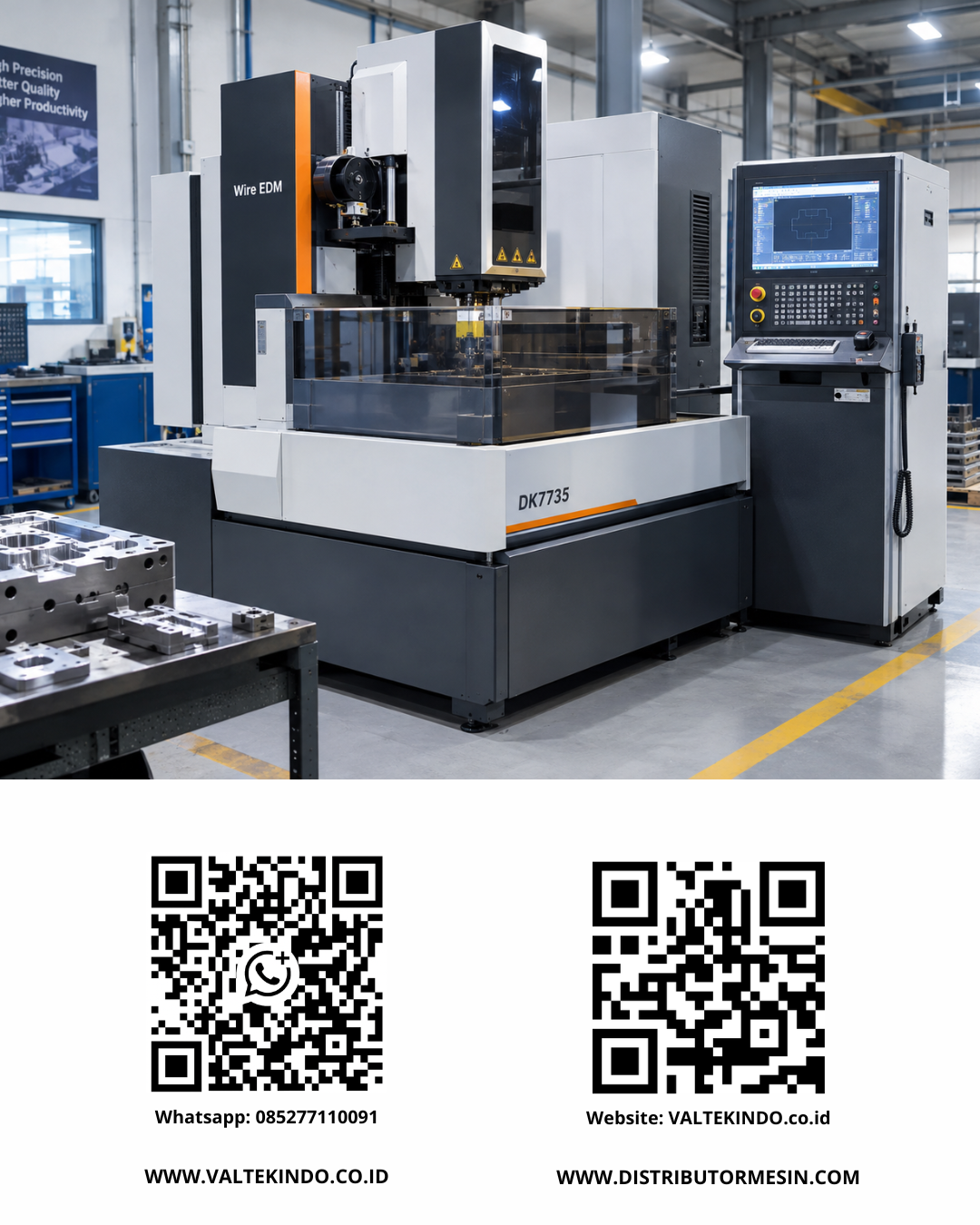
The rapid expansion of Indonesia’s manufacturing sector heading into the final quarter of 2026—driven heavily by Electric Vehicle (EV) battery and powertrain localization, medical device production, precision electronics, and strict Domestic Component Level (TKDN) mandates—has fundamentally reshaped quality standards on the factory floor. Manufacturers producing complex injection molds, progressive stamping dies, and high-precision machinery spare parts now face stringent geometric demands with tolerances measured in single-digit microns ($\pm 0.002\text{ mm}$ to $\pm 0.005\text{ mm}$). At this level of precision, conventional subtractive manufacturing processes such as CNC milling or turning frequently hit a wall, especially when processing hardened tool steels exceeding 60 HRC.
Why Conventional Machining Fails on Hardened Tool Steels
In industrial mold and die fabrication, high-grade alloys such as SKD11, D2, H13, DC53, Tungsten Carbide, Titanium, and Inconel must undergo heat treatment to achieve extreme hardness, ensuring they withstand millions of high-pressure production cycles. Attempting to cut these post-hardened materials using rotary cutters on a standard CNC milling center generates severe mechanical friction, resulting in rapid tool wear, cutter deflection, surface chatter, and micro-cracking along the workpiece edges.
Conversely, machining the component while the steel is still soft (prior to heat treatment) introduces an unavoidable risk: thermal distortion, warping, and dimensional shrinkage inside the quenching furnace. Engineering teams are then forced to spend days performing manual grinding and hand-polishing to correct distorted geometries—creating severe production bottlenecks and inflating labor costs.
How Modern Wire Cut EDM Eliminates Manufacturing Bottlenecks
Wire Cut EDM (Electrical Discharge Machining) bypasses every mechanical limitation of traditional cutting through non-contact electro-thermal erosion. A continuously fed, ultra-thin metallic wire electrode (typically $0.10\text{ mm}$ to $0.25\text{ mm}$ in diameter) made of brass, molybdenum, or zinc-coated alloy delivers high-frequency electrical discharges across a deionized dielectric fluid gap, vaporizing microscopic particles of conductive metal along a programmed CNC path.
Because the wire never physically touches the workpiece, zero mechanical cutting force is applied to the metal. This delivers four decisive competitive advantages to industrial toolrooms and production plants:
-
Distortion-Free Post-Hardening Machining: Workpieces can be fully heat-treated and tempered to their final hardness specification first, then finish-machined on the Wire Cut EDM to exact micron tolerances with zero risk of structural warping.
-
Ultra-Tight Internal Corners and Micro-Slots: The microscopic kerf of the EDM wire allows engineers to machine sharp internal corners, intricate gear teeth, narrow extrusion slits, and deep punch profiles that no rotary endmill could ever physically reach.
-
Simultaneous 4-Axis Taper Cutting: By independently controlling the upper and lower diamond wire guides across the X, Y, U, and V axes, modern Wire Cut EDM systems effortlessly execute complex tapered walls required for stamping die clearance angles and intricate extrusion profiles.
-
Mirror-Grade Surface Roughness ($Ra$): Advanced 2026 digital pulse generators minimize the recast layer (Heat Affected Zone) during multi-pass skimming cuts, achieving fine surface finishes down to $Ra\ 0.8\ \mu\text{m}$ or better—slashing manual bench polishing time by up to 70%.
Performance Comparison: Wire Cut EDM vs. Conventional Machining
For Engineering Managers and Production Planners preparing technical feasibility studies for workshop upgrades, the table below outlines key operational differences:
| Technical Parameter | Modern Industrial Wire Cut EDM | Conventional Hard CNC Milling | Industrial Laser / Plasma Cutting |
| Material Hardness Limit | Unlimited (any conductive metal >65 HRC) | Restricted (max ~55–60 HRC with costly CBN tools) | Unlimited, but causes severe thermal HAZ |
| Dimensional Accuracy | $\pm 0.002\text{ mm} - \pm 0.005\text{ mm}$ | $\pm 0.01\text{ mm} - \pm 0.02\text{ mm}$ | $\pm 0.05\text{ mm} - \pm 0.20\text{ mm}$ |
| Maximum Cutting Thickness | Up to $300\text{ mm} - 800\text{ mm}$ (Z-axis dependent) | Strictly limited by tool overhang & deflection | Effective mainly on thin/medium plates ($\le 30\text{ mm}$) |
| Mechanical Stress on Part | Zero (0%) – Non-contact spark erosion | High – Risk of flexing thin walls or micro-pins | Zero mechanical force, high thermal stress |
| Tooling Consumable Cost | Low & predictable (spool wire & filters) | Extremely high (rapid carbide/CBN cutter wear) | Moderate to high (assist gases & optical lenses) |
Machine Build Quality: The Foundation of Long-Term Accuracy
Not all Wire Cut EDM machines are engineered to survive 24/7 heavy industrial workloads. Over five to ten years of continuous operation, thermal stability and structural rigidity dictate whether a machine holds its micron repeatability or drifts out of tolerance.
When evaluating equipment specifications for your facility, it is vital to select a
Partnering with an Authorized Industrial Distributor in Indonesia
Procuring high-precision CNC machinery is not a one-off hardware purchase; it is a long-term commitment to production uptime. Across Indonesian industrial estates, factories frequently suffer millions of Rupiah in delayed delivery penalties because they purchased unbacked machinery lacking local engineers, spare parts inventory, and proper operator training.
As a trusted industrial machinery partner in Indonesia,
Request a Technical Consultation & Official Quotation (RFQ)
Is your mold shop or manufacturing plant planning to expand precision cutting capacity this quarter? Do not let outdated machining bottlenecks cost your company high-margin industrial contracts. Consult with our application engineering team today to match your material specifications, workpiece dimensions, and tolerance requirements with the ideal Wire Cut EDM configuration and receive a competitive Request for Quotation (RFQ).
Contact Our Sales Team Today
Looking for high-quality industrial machinery, factory automation solutions, or customized equipment for your business? Our experienced sales team is ready to help you find the right solution, provide technical consultation, and offer the best pricing.
Contact Our Official WhatsApp Sales Team:
- WhatsApp Sales 1: 085222110091
- WhatsApp Sales 2: 085277110091
Visit our official websites to explore our complete product catalog, machine operation videos, technical information, and exclusive offers:
PT. Valtekindo Global Intertek is your trusted partner for industrial machinery, processing equipment, recycling systems, laboratory instruments, and factory automation solutions. Contact us today for a free consultation and receive the best solution tailored to your business needs.

Admin
AuthorAdmin is a writer on the Valtekindo website, providing informative content about High Quality Industrial Machinery and Testing Machines.
Related post:
- Pharmaceutical Factory Production Escalation Strategy: Why Investing in an Automatic Capsule Filling Machine is the Most Crucial Business Decision
- 2026 Automated Carton Sealer & Erector Investment Guide: End-of-Line Automation Strategies for Industrial Plant Efficiency
- Modern Pipe Making Machine Technology: Optimizing Conical Twin-Screw Extruders for Zero-Defect SNI Standard PVC Pipe Production