The Importance of Petroleum Tester Accuracy in Guaranteeing Oil & Gas Product Quality
The Importance of Petroleum Tester Accuracy in Guaranteeing Oil & Gas Product Quality
The oil and gas industry serves as the backbone of modern civilization. From the fuels that power transportation and the lubricants that run industrial machinery to the petrochemical feedstocks for countless products, the quality of every oil and gas derivative directly impacts safety, efficiency, and environmental sustainability. Within this complex supply chain—from offshore rigs to refineries, storage terminals, and finally to consumer vehicles—one element plays a crucial role: Quality Assurance (QA).
At the heart of this QA process lies a suite of precision instruments known as petroleum testers. These are not mere auxiliary tools; they are the gatekeepers that determine if a product is fit for the market. However, simply possessing a tester is not enough. The single most vital factor is accuracy.
A seemingly trivial error of just 0.5% in a critical parameter reading—such as flash point, viscosity, or oxidation stability—may seem insignificant. Yet, when applied to volumes of millions of liters of fuel, this small discrepancy can escalate into massive financial losses, catastrophic engine damage, or even life-threatening accidents. Therefore, the importance of petroleum tester accuracy is non-negotiable; it is the very foundation of trust and safety in the oil and gas industry.
Why Quality and Accuracy Are One and the Same
Every oil and gas product, whether it's gasoline, diesel, jet fuel, or lubricating oil, is governed by a stringent set of technical specifications. International standards set by bodies like ASTM (American Society for Testing and Materials) and ISO (International Organization for Standardization), alongside national regulations, form the universal language of quality.
Failure to meet these standards carries layered consequences:
- Safety and Operational Risks: Off-specification fuel can cause severe damage. For instance, gasoline with poor oxidation stability will form deposits ("gum") that can clog fuel injectors and filters, leading to engine stalls or sudden power loss.
- Economic Losses: At a commercial level, inaccurate testing can mean an entire tanker cargo is rejected by a buyer, resulting in claims, penalties, and severe reputational damage. At the consumer level, low-quality fuel reduces efficiency (fewer miles per gallon) and shortens the lifespan of engine components.
- Environmental Impact: Fuel specifications also dictate emission limits, such as sulfur content. Inaccurate testing could inadvertently release harmful pollutants into the atmosphere, violating environmental regulations.
The accuracy of a petroleum tester is the bridge connecting refinery production to these on-paper standards. Without accurate and reliable instruments, all those standards become meaningless.
Case Study: Gasoline Oxidation Stability (ASTM D525)
To truly understand the critical nature of a petroleum tester's accuracy, let's examine one of the most vital tests for gasoline: Oxidation Stability (Induction Period Method).
Gasoline is not always consumed immediately after production. It can be stored for weeks or even months in refinery tanks, distribution terminals, gas stations, and, ultimately, in your vehicle's tank. During this storage period, gasoline is exposed to its greatest enemy: Oxygen.
The reaction between the hydrocarbons in gasoline and oxygen (oxidation) produces undesirable byproducts—sticky, varnish-like deposits commonly known as "gum". The formation of this gum is a disaster for modern engines. Gum can:
- Clog narrow fuel passages.
- Foul carburetors and fuel injectors.
- Stick to intake valves, disrupting airflow and fuel mixtures.
- Damage fuel pumps.
To prevent this, Quality Control (QC) laboratories must be able to predict how long gasoline can be stored before it begins to degrade. This is where the Induction Period Method comes into play, standardized globally by ASTM D525 and ISO 7536.
This test is essentially an "accelerated aging test." A sample of gasoline is placed in a high-pressure vessel called an oxygen bomb, filled with pure oxygen, and heated to a precise temperature (typically 100°C). For a time, the gasoline will resist oxidation. However, once the "induction period" is reached, the gasoline will begin to oxidize rapidly, indicated by a sharp, sudden drop in oxygen pressure within the vessel.
The time elapsed from the start of the test to this pressure drop "break-point" is the Induction Period—the longer the time, the more stable the gasoline.
The Role of Technology: Ensuring Accuracy Through Automation
The ASTM D525 method demands exceptionally controlled test conditions. Accuracy in controlling the temperature, managing the pressure, and detecting the pressure "break-point" is absolute. This is where modern instrumentation truly excels.
Manual testing, which relies on analog gauges and visual monitoring by an operator, is highly susceptible to human error. An operator might misread a pressure gauge, log the time incorrectly, or the temperature in a traditional water bath might fluctuate.
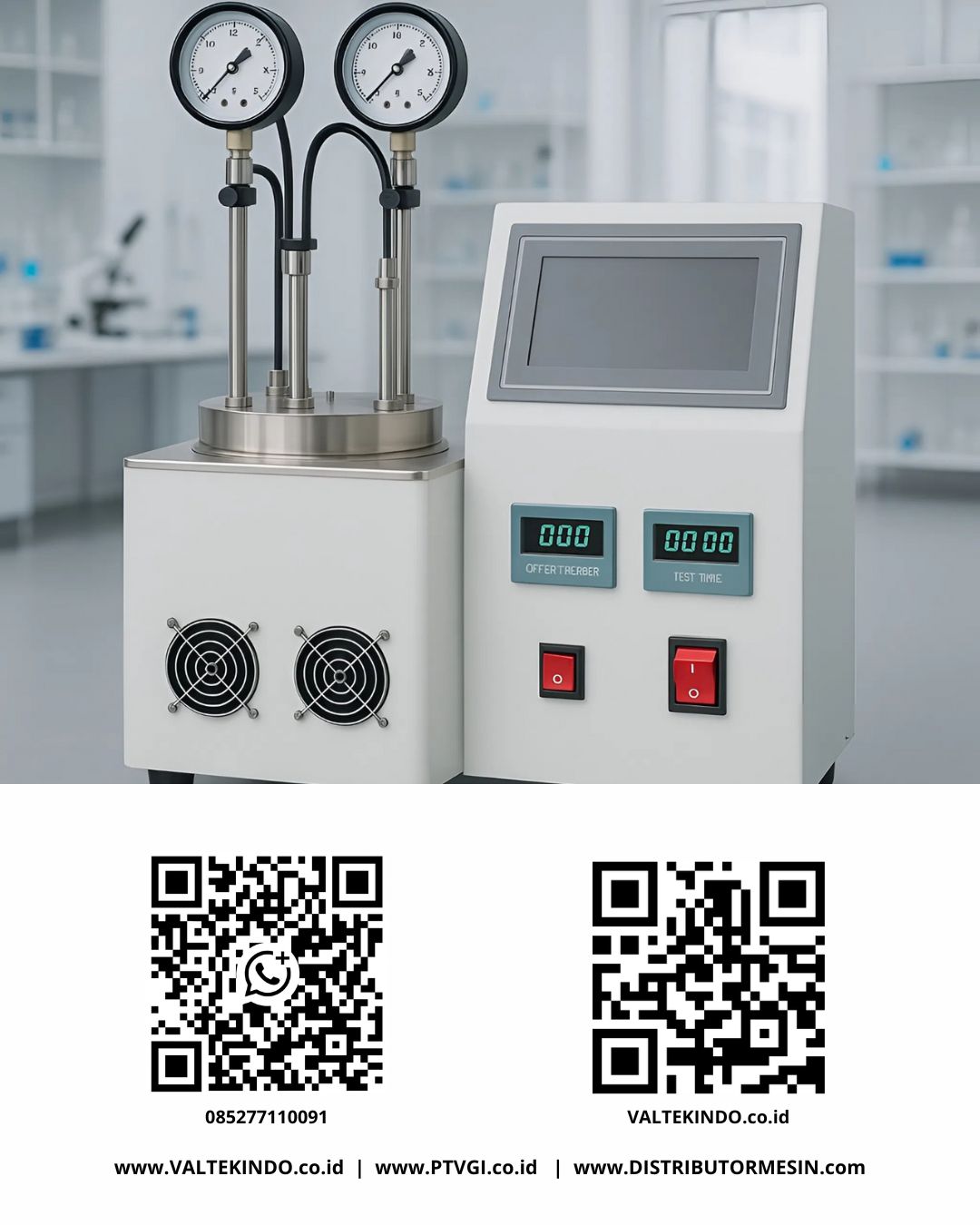
This is precisely why leading laboratories are shifting to automated solutions. For example, an Automatic Gasoline Oxidation Stability Tester (Induction Period Method) like the one distributed by PT. Valtekindo Graha Mandiri, is engineered to eliminate these variables.
The specifications of this advanced instrument demonstrate how accuracy is achieved:
- Precise Temperature Control: Instead of a cumbersome and often uneven water bath, this instrument utilizes a solid/metal bath (dry bath). This guarantees uniform heat transfer, highly precise temperature control, and is significantly safer for the operator (no risk of hot steam or fluid spills).
- Full Automation: The entire process—from oxygen filling, heating, pressure monitoring, to break-point detection—is managed automatically by PC software.
- Objective Break-Point Detection: The software continuously monitors the pressure curve. It can mathematically detect the significant pressure drop, removing all operator subjectivity in determining when the induction period has ended.
- Elimination of Human Error: With full automation, factors like fatigue, negligence, or different interpretations between operators are eradicated. The results become highly accurate, consistent, and repeatable—the very core of quality assurance.
When a refinery relies on data from an instrument like this, it can confidently certify that its gasoline product meets the ASTM D525 stability standard. They can guarantee to distributors and consumers that the fuel will remain in prime condition throughout its reasonable storage life.
Conclusion: An Investment in Accuracy is an Investment in Quality
In the high-stakes, high-value world of oil and gas, there is no room for guesswork. Accuracy is the currency of trust. A failure in quality testing is not just a laboratory problem; it is a serious business, safety, and reputational problem.
Modern, automated petroleum testers, such as the oxidation stability tester, are not an expense; they are a vital investment. This investment ensures that every liter of fuel produced is safe, efficient, and compliant with strict global standards. By adopting accurate testing technology, companies not only protect their assets and their consumers but also solidify their position in a competitive market.
Equipping your laboratory with the most accurate and reliable petroleum testing instruments is the first step in guaranteeing the quality of your final product.
Optimize Your Industry Today!
Achieve production efficiency and the highest quality standards with a trusted industrial machinery provider. Explore our wide selection of premium processing and testing equipment at:
Website : valtekindo.co.id
Wesbite : distributormesin.com
Consult your technical needs with our expert sales team:
WhatsApp 1: +62 852-2211-0091
WhatsApp 2: +62 852-7711-0091

Admin
AuthorAdmin is a writer on the Valtekindo website, providing informative content about High Quality Industrial Machinery and Testing Machines.
Related post:
- Pharmaceutical Factory Production Escalation Strategy: Why Investing in an Automatic Capsule Filling Machine is the Most Crucial Business Decision
- High-Precision Wire Cut EDM Technology in 2026: The Ultimate Solution for Mold Making, Stamping Dies, and Automotive Component Fabrication Without Thermal Distortion
- 2026 Automated Carton Sealer & Erector Investment Guide: End-of-Line Automation Strategies for Industrial Plant Efficiency