The Crucial Role of Mini Lab Blow Film Machines in Flexible Plastic Packaging Innovation
The flexible plastic packaging industry is currently facing a dual challenge: market demands for higher functionality and regulatory pressure to shift towards more sustainable materials. Consumers want packaging that is stronger, thinner, yet also environmentally friendly, such as biodegradable or compostable materials. For manufacturers, this challenge translates into one imperative: relentless innovation. However, innovation, especially in material science, is an expensive and high-risk endeavor.
The primary issue lies in scale. Testing a new resin formula, a novel biodegradable additive, or a new color masterbatch directly on a commercial production line is a logistical and financial nightmare. Halting a 24/7 production line, consuming hundreds of kilograms of material for a single trial, and the risk of failure that could damage machine components—all these factors create a massive barrier for Research & Development (R&D) departments.
This is precisely where the role of laboratory-scale blown film machines, or Mini Lab Blow Film Machines, becomes absolutely crucial. These devices are not about production volume; they are about validation speed, material efficiency, and risk mitigation.
What Exactly is a Mini Lab Blow Film Machine?
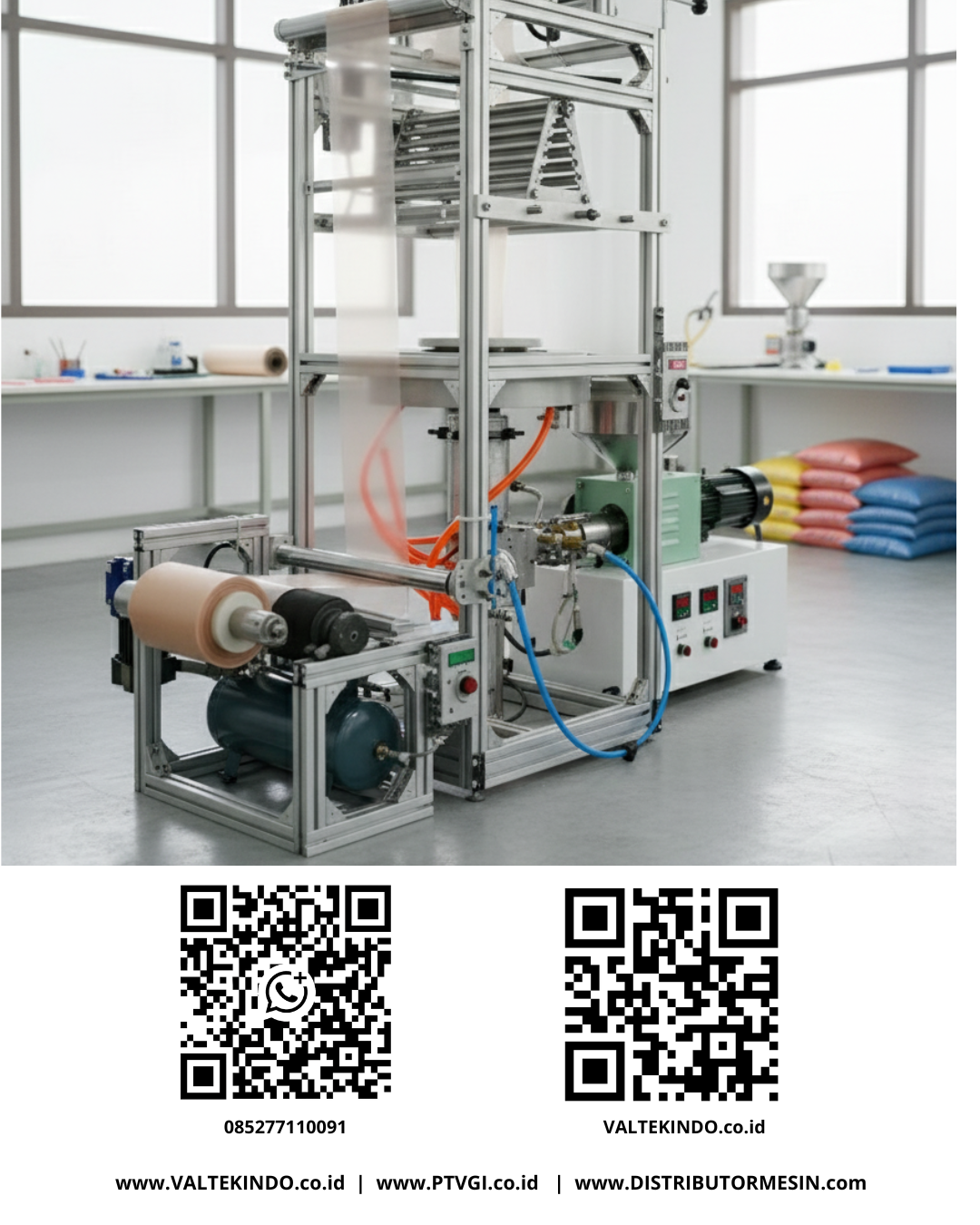
In simple terms, a Mini Lab Blow Film Machine is a compact, miniaturized version of an industrial blown film line. Instead of standing several stories high and spanning several meters, these machines are often designed for tabletop or benchtop use, as seen in the SJ-35 model. Their purpose is purely for research, development, and quality control (QC).
These machines are designed for simple operation, easy maintenance, and low cost. This empowers material scientists, process engineers, and R&D teams in factories or universities to conduct experiments without burdening production resources. Technology solution providers like PT Valtekindo Global Intertek understand that innovation in the plastics industry begins with these small, measurable steps in the laboratory.
The Crucial Role in the R&D and Innovation Cycle
The main function of a mini lab machine is not to precisely mimic production conditions—given the different scale and L/D (Length-to-Diameter) ratio—but to perform rapid, early-stage material screening. Based on its technical description, this machine excels in several vital R&D areas:
- Material Feasibility Testing This is the most fundamental question: "Can this new polymer even be blown into a film?" Before investing further, R&D teams need to know if a new resin, perhaps based on tapioca starch or PLA (Polylactic Acid), has sufficient processability to be extruded and blown. A mini lab machine provides a "yes" or "no" answer in minutes, not hours.
- Gel Condition Analysis "Gels," or clumps of unmelted material, are a critical defect in plastic film. They can be caused by incompatible resins, a poor masterbatch, or contamination. The mini lab machine allows an operator to extrude a small amount of material and visually inspect the resulting film (e.g., a 200mm wide film) for the presence of gels, long before that formula causes blockages in a production machine.
- Color and Additive Dispersion Testing How does a new color masterbatch disperse? Is the color even or streaky? What about an anti-static or UV-blocker additive? With a low capacity (e.g., 500-2000 grams per hour), testing this dispersion requires only a handful of material. This is a stark contrast to production machines that need tens of kilograms just to "purge" the screw of the previous color. To understand how one compact machine can perform all these tests, you can refer to the technical specifications in this brochure.
- Raw Material Quality Control (QC) Beyond R&D, this machine is a powerful QC tool. When a supplier sends a new batch of resin, a factory can take a 1-2 kg sample and run it through the mini lab machine to ensure its consistency matches the previous batch. This prevents nasty surprises on the production line.
Case Study: The SJ-35's Efficiency at Lab Scale
Let's dissect a specific model, the SJ-35, to understand how its specifications support the roles above. Efficiency is the keyword.
- Power and Voltage (1.5KW, 220V): This is an outstanding specification. With a power draw of just 1.5KW and operating on standard 220V (common household/office voltage), this machine can be placed anywhere in a lab without requiring complex and expensive 3-phase electrical installation.
- Capacity (500-2000 g/hr) & Film Width (200mm): This capacity is ideal for R&D. If a researcher has a newly synthesized polymer sample that is expensive and available only in limited quantities (e.g., only 2 kg), this machine can process it into a 200mm film sufficient for analysis, without consuming the entire sample.
- Screw L/D Ratio (12:1) and Speed (15 rpm): An L/D ratio of 12:1 is relatively short. This means the machine is not designed for high-intensity mixing or massive extrusion pressures. Instead, it is a gentle processing machine with a low screw speed (15 rpm). The advantages are extremely fast startup and shutdown, easy cleaning, and a stable process for basic material characterization.
Industrial machinery suppliers like PT Valtekindo Global Intertek provide tools like this to bridge the gap between idea and production. They understand that before talking about tonnage output, clients need to validate their formulas as cost-effectively as possible. Full details on its space-saving dimensions and efficient power requirements can be studied further on the product page.
From Laboratory to Mass Production: A Hypothetical Case Study
Imagine a plastic bag ("kresek") manufacturing company wants to switch to a more eco-friendly material, a blend of HDPE and a biodegradable resin.
- Without a Mini Lab Machine: The R&D team must order 1 ton of the blended material. They then stop one production line for 4-6 hours. During the trial, it turns out the new material is too sticky and causes the bubble to collapse. The result: 6 hours of production downtime, 500 kg of wasted material, and the machine's screw must be completely purged. A loss of thousands of dollars.
- With the SJ-35 Mini Lab Machine: The R&D team orders a 5 kg sample. They mix it and run it on the mini lab machine. Within 30 minutes, a 200mm film is produced. Visual analysis: "Too sticky, additive dispersion is uneven." They then adjust the formula, add a processing aid, and test it again. After 3 iterations (totaling 3 hours and 3 kg of material), they find the optimal formula. Only then is this validated formula tested on the production machine with high confidence.
The cost and time savings are tangible. Innovation that was once high-risk now becomes a controlled, iterative process. Having the right laboratory equipment is the first strategic step toward a competitive advantage.
Conclusion: A Small Investment for a Large Innovative Impact
The Mini Lab Blow Film Machine is the unsung hero behind the scenes of flexible packaging innovation. It may not produce thousands of tons of product, but it enables those products to be born. In an era where time-to-market and sustainable materials are king, this tool is no longer a luxury, but a strategic necessity.
It transforms R&D from a costly, high-stakes gamble into a fast, efficient, and iterative process. For any company serious about leading the flexible packaging market, investing in reliable laboratory equipment, such as that offered by PT Valtekindo Global Intertek, is the most logical step to accelerate innovation.
Optimize Your Industry Today!
Achieve production efficiency and the highest quality standards with a trusted industrial machinery provider. Explore our wide selection of premium processing and testing equipment at:
Website : valtekindo.co.id
Wesbite : distributormesin.com
Consult your technical needs with our expert sales team:
WhatsApp 1: +62 852-2211-0091
WhatsApp 2: +62 852-7711-0091

Admin
AuthorAdmin is a writer on the Valtekindo website, providing informative content about High Quality Industrial Machinery and Testing Machines.
Related post:
- Pharmaceutical Factory Production Escalation Strategy: Why Investing in an Automatic Capsule Filling Machine is the Most Crucial Business Decision
- High-Precision Wire Cut EDM Technology in 2026: The Ultimate Solution for Mold Making, Stamping Dies, and Automotive Component Fabrication Without Thermal Distortion
- 2026 Automated Carton Sealer & Erector Investment Guide: End-of-Line Automation Strategies for Industrial Plant Efficiency