Supporting BRIN Innovation: Valtekindo Solutions for Processing Coal Waste into EV Battery Materials
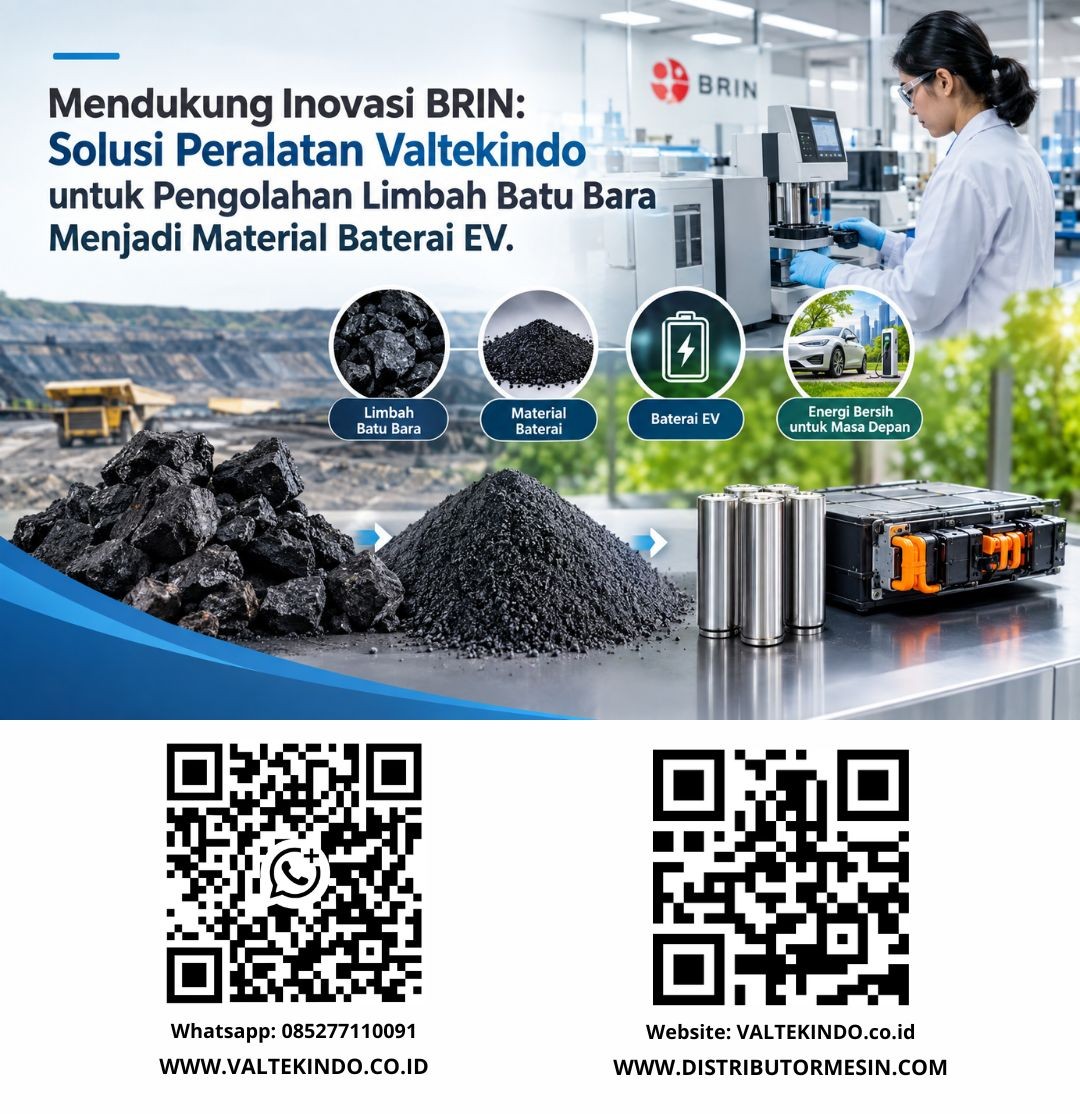
From Coal Waste to Strategic Materials for Electric Vehicle Batteries
The development of electric vehicles (EVs) in Indonesia requires not only innovation in vehicles and their propulsion systems, but also the strengthening of the domestic battery material supply chain. One notable development comes from the National Research and Innovation Agency (BRIN), which is currently developing artificial graphite from coal waste to be used as a raw material for electric vehicle batteries.
BRIN Head Arif Satria stated that BRIN is developing 5V lithium-ion batteries while also producing artificial graphite from coal waste. The graphite material being developed has reportedly achieved a structural similarity level of 96.8%. This development is aimed at supporting the establishment of a national electric vehicle ecosystem.
This development demonstrates that coal waste has the potential to generate significantly higher added value when processed using the appropriate material technologies. Materials that were previously viewed as residues can, through processing and purification, become carbon materials with strategic applications in energy storage technologies.
This is where material processing technology becomes particularly important. Transforming waste into battery materials is not a one-step process, but rather a long sequence that may include size reduction, grinding, classification, impurity separation, purification, thermal treatment, and electrode material formation.
As a company providing various industrial machines and processing equipment, Valtekindo can support equipment requirements across several of these stages.
Process Infrastructure Engineering and Machine Specifications
Transforming coal waste into carbon materials for battery applications requires a machinery architecture capable of handling materials at different scales. The initial stage generally involves relatively large-sized materials, while subsequent stages require much more precise control of particle size and purity.
1. Crushing: Preparing Material from the Initial Stage
If the raw material consists of coal gangue, mining waste rock, or coarse coal waste, the process may begin with crushing. Equipment such as Jaw Crushers or Cone Crushers is used to reduce the material size before it enters the subsequent grinding stage.
For material size reduction requirements in the mining sector, Valtekindo provides various crushing equipment solutions. One of its product references is the Cone Crusher.
The selection of a crusher must still be adjusted to the feed type, initial material size, production capacity, target output size, and material hardness characteristics.
It is important to note that not all coal waste requires crushing. Fly ash, for example, is generally already in a fine form, so its processing requirements may differ from those of coal gangue or bottom ash. Therefore, raw material characterization is an important stage before selecting the appropriate machine.
2. Grinding and Ball Mill: Controlling Particle Size
After size reduction, the next stage may involve grinding. Grinding is required to produce finer material so that subsequent separation, purification, and treatment processes can be carried out more effectively.
A Ball Mill operates based on impact and friction between the material and grinding media inside a rotating cylindrical chamber. This technology can be used in various mineral and material processing applications to achieve smaller particle sizes.
Valtekindo has a reference for Ball Mill, which is relevant to coal-based material grinding processes.
In battery material development, the final particle size should not be determined solely based on general assumptions. Specifications must be established based on the material characteristics, synthesis method, and requirements of the electrode material being developed.
3. Classification: Separating Particle Sizes
After grinding, the material may still have a relatively broad particle-size distribution. Therefore, classification can be used to obtain particle-size fractions that are more suitable for subsequent processing requirements.
An air classifier is one of the technologies that can be used to separate particles based on their aerodynamic characteristics. Particles with specific characteristics can be directed toward the product stream, while coarser fractions can be returned for regrinding.
This stage is particularly important when the process requires more consistent control of particle-size distribution.
4. Magnetic Separation: Reducing Metal Contaminants
Processed mineral materials may contain magnetic impurities, including iron particles or minerals containing iron elements. A magnetic separator can be used as part of the separation process to reduce such contaminants.
In the context of battery materials, impurity control is an important aspect because the chemical and physical characteristics of anode materials significantly influence their performance. However, the effectiveness of magnetic separation depends on the type of impurity and its magnetic properties.
Therefore, a magnetic separator should be positioned as one component of an overall purification strategy rather than as the sole method for achieving high-purity material.
5. Flotation: Separating Carbon and Ash Minerals
For materials such as fly ash or residues containing carbon fractions and inorganic minerals, flotation can be one possible separation approach.
The principle utilizes differences in the surface properties of the materials. Under specific process conditions, carbon particles can be made more likely to interact with air bubbles and rise toward the surface, while hydrophilic minerals tend to remain suspended.
Valtekindo provides a Flotation Machine as one type of equipment that can be associated with mineral-based material separation processes.
However, applying flotation to produce battery-material feedstock still requires optimization of reagents, slurry conditions, particle size, recovery, and raw material characteristics.
Purification and Thermal Treatment
After mechanical processing and separation, the material may enter the purification stage. For certain process routes, leaching can be used to dissolve or remove unwanted mineral components.
Equipment such as reactors, filter presses, centrifuges, and washing systems can form part of the process infrastructure. This stage is highly dependent on the chemical method being used and cannot be determined solely based on the type of waste.
Following purification, thermal treatment becomes one of the important stages in carbon material development.
A rotary kiln can be used for heating and thermal treatment of materials in continuous operations. Valtekindo has a reference for a Rotary Kiln, demonstrating equipment capabilities in the rotary kiln category.
For carbonization or material treatment processes requiring a controlled atmosphere, furnace technologies such as tube furnaces, carbonization furnaces, or high-temperature furnaces can be considered according to research and process requirements.
At a more advanced stage, carbon materials may undergo graphitization to transform the carbon structure toward a graphitic structure. However, temperature, atmosphere, holding time, catalysts, and furnace design must be determined based on the synthesis method being used. Therefore, it is not appropriate to equate all heating processes with graphitization.
From Carbon Materials to Battery Components
Once the material has been successfully processed and meets the targeted characteristics, the next stage may focus on developing electrode materials. At the research-to-pilot-plant scale, the process may involve mixing active material, conductive additives, binders, and solvents to form an electrode slurry.
Valtekindo also has a reference for a Mixing Machine for material mixing applications.
For battery electrode manufacturing specifically, the requirements for mixers, coating machines, drying systems, calendaring equipment, and other equipment must be determined based on the cell design and the specifications of the material being developed.
This means that waste-processing machinery is only one part of a much longer chain. Material produced through crushing or grinding cannot yet be considered battery material until it has undergone the appropriate purification, synthesis, characterization, and electrochemical validation processes.
Coal Waste Processing Matrix
Conceptually, different types of coal waste may require different utilization pathways. Coal gangue may require crushing and mineral extraction, while fly ash has different characteristics because it is already a fine material. Carbon-rich residues may be directed toward separation and thermal treatment processes.
Therefore, the most appropriate approach is:
Waste identification → characterization → process selection → machine selection → purification → material synthesis → characterization → battery validation.
This sequence is far more realistic than assuming that a single type of machine can directly transform coal waste into an EV battery.
Valtekindo Supports the Infrastructure of Future Material Processing
The development of artificial graphite from coal waste by BRIN demonstrates a new direction in the downstream development of Indonesian materials. Waste is no longer viewed merely as a residue, but can become a source of value-added materials when processed using the appropriate technologies.
For industries, universities, laboratories, and research institutions, equipment requirements in this sector may range from crushing, grinding, separation, flotation, filtration, and thermal processing to mixing, as well as various characterization and testing equipment.
Valtekindo can play a role as an equipment solution provider to support material processing and preparation stages, with machine selection tailored to the characteristics of the raw material and the targeted process.
Most importantly, EV battery material development should follow a material-to-machine approach rather than simply a machine-to-material approach. This means that the type and chemical composition of the waste must first be identified, after which the processing technology and machinery are determined based on those requirements.
With this approach, innovation in coal waste utilization can develop from simple residue management into a component of the strategic material supply chain for Indonesia's electric vehicle batteries.
Consult Your Material Processing Machine Requirements
Are you currently developing a process for processing coal waste, carbon materials, or raw materials for battery and energy-material research?
VALTEKINDO is ready to help you select machine solutions that match your process requirements, from crushing, grinding, separation, and thermal processing to mixing for laboratory, pilot plant, and industrial-scale development.
Consult your requirements with the VALTEKINDO team to receive equipment recommendations based on material characteristics, production capacity, particle size, process temperature, and target application.
Contact Our Official WhatsApp:
- WhatsApp Sales 1: 085222110091
- WhatsApp Sales 2: 085277110091
Or visit our official websites to explore our complete product catalog, machine operation videos, specifications, and latest quotation information:
PT. Valtekindo Global Intertek is ready to become your trusted partner for industrial machinery, processing equipment, recycling machines, laboratory equipment, and factory automation solutions throughout Indonesia. Contact us today and get a free consultation from our expert team

Admin
AuthorAdmin is a writer on the Valtekindo website, providing informative content about High Quality Industrial Machinery and Testing Machines.
Related post:
- Pharmaceutical Factory Production Escalation Strategy: Why Investing in an Automatic Capsule Filling Machine is the Most Crucial Business Decision
- High-Precision Wire Cut EDM Technology in 2026: The Ultimate Solution for Mold Making, Stamping Dies, and Automotive Component Fabrication Without Thermal Distortion
- 2026 Automated Carton Sealer & Erector Investment Guide: End-of-Line Automation Strategies for Industrial Plant Efficiency