Industrial Vacuum Packaging Machine Investment Guide for Modern Factories: Maximizing Shelf-Life, Export Compliance, and Production ROI
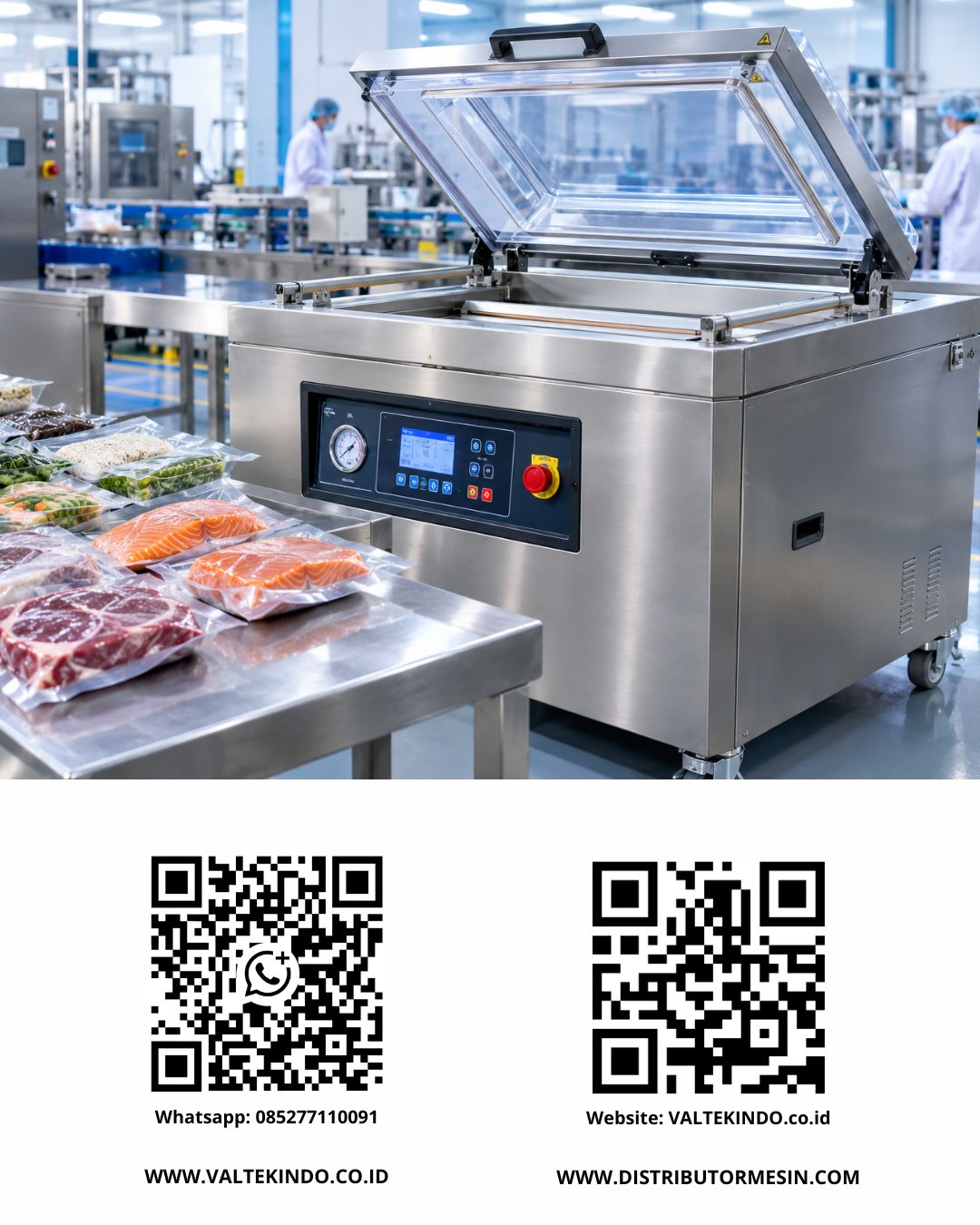
Industrial Vacuum Packaging Machine Investment Guide for Modern Factories: Maximizing Shelf-Life, Export Compliance, and Production ROI
Across Indonesia’s rapidly expanding Food & Beverage (F&B), seafood processing, poultry, and cold chain manufacturing sectors in late 2026, end-of-line packaging efficiency directly dictates corporate profitability. One of the most persistent bottlenecks faced by Operations Directors, Plant Managers, and Industrial Investors is product spoilage caused by oxidation, aerobic microbial growth, and freezer burn during domestic cold-chain transit or long-haul maritime export.
Relying on conventional packaging methods or light-duty commercial vacuum sealers becomes a critical liability when factory production targets reach thousands of packs per shift. Selecting a heavy-duty industrial vacuum packaging machine is therefore a strategic Capital Expenditure (CAPEX) decision. This comprehensive guide examines the technical engineering standards and financial metrics required to select the optimal vacuum packaging system to scale throughput and safeguard your factory’s profit margins.
Why Medium-to-Large Factories Must Transition to Heavy-Duty Vacuum Systems
In an industrial manufacturing environment, a vacuum packaging machine does far more than simply extract air from a plastic pouch. It serves as a precision quality-control instrument designed to evacuate atmospheric pressure inside a sealed chamber down to an ultimate vacuum level of 0.5 to 1.0 mbar before executing a hermetic, high-integrity heat seal.
For factory investors and procurement teams, upgrading to an industrial-grade vacuum system delivers four measurable impacts on the corporate balance sheet:
- Extending Shelf-Life by 3x to 5x: Depriving the package interior of oxygen halts the proliferation of aerobic spoilage bacteria, molds, and yeasts. Fresh prime cuts of meat, export-grade tuna loins, processed cheeses, and industrial marinades maintain peak freshness in cold storage without relying on artificial chemical preservatives.
- Eliminating Evaporative Weight Loss and Freezer Burn: In frozen meat and seafood processing, moisture evaporation (drip loss) during blast freezing can reduce billable product weight by 3% to 5%. High-pressure vacuum skin or pouch packaging locks in natural moisture, preserving texture, visual appeal, and net weight from the factory floor to the end buyer.
- Strict Compliance with Global Food Safety Standards (HACCP, ISO 22000, BPOM, and BRC): Indonesian manufacturers exporting to the United States, the European Union, Japan, and the Middle East face stringent regulatory audits. Industrial vacuum machines constructed from food-grade stainless steel eliminate dead zones and cross-contamination risks.
- Logistics and Cold Storage Space Optimization: Vacuum-sealed products occupy significantly less volume, allowing pallet configurations inside refrigerated containers (reefers) and cold storage racks to be packed 20% to 30% more densely.
Classifying Industrial Vacuum Packaging Machines by Production Throughput
The most costly mistake in industrial procurement is mismatching machine specifications with the plant’s actual duty cycle. For factories operating on 2 to 3 shifts (16–24 hours per day), procurement teams should evaluate three primary machine architectures:
1. Double Chamber Vacuum Packaging Machines
The workhorse of frozen food plants, slaughterhouses, and seafood processing facilities. Featuring two vacuum chambers and a single heavy-duty swing lid, this configuration enables continuous workflow. While Chamber A executes the vacuum extraction and heat-sealing cycle (typically 15–25 seconds), the operator loads pre-filled pouches onto the sealing bars of Chamber B. This alternating cycle eliminates operator idle time and doubles hourly output.
2. Continuous Belt Vacuum Packaging Machines
Engineered for high-speed production lines handling high volumes of uniform products—such as sausages, meatballs, poultry fillets, or cheese blocks. An automated conveyor belt indexes products directly under the vacuum hood and discharges sealed packs onto an outfeed conveyor, drastically reducing manual labor requirements and human handling errors.
3. Thermoforming Vacuum Packaging Machines (Rollstock Systems)
The pinnacle of automated packaging for large-scale enterprises. Thermoforming systems form rigid or flexible trays directly from a bottom film roll, travel through an automated or manual loading zone, and hermetically seal the packages with a top film roll after vacuum extraction or Modified Atmosphere Packaging (MAP), concluding with precision die-cutting.
Key Technical Specifications for Engineering & Procurement Audits
Before issuing a Purchase Order (PO) or Request for Quotation (RFQ), plant engineers must audit five core technical parameters to ensure maximum Overall Equipment Effectiveness (OEE):
- Vacuum Pump Capacity ($\text{m}^3/\text{h}$) and Reliability: The vacuum pump is the heart of the machine. For continuous multi-shift operation, specify heavy-duty rotary vane vacuum pumps with suction capacities ranging from $63\text{ m}^3/\text{h}$ and $100\text{ m}^3/\text{h}$ up to $300\text{ m}^3/\text{h}$. Pump displacement directly governs cycle speed and air evacuation efficiency.
- Material Metallurgy (SUS 304 vs. SUS 316): Verify that the entire chassis, worktable, and vacuum chamber are fabricated from heavy-gauge Stainless Steel 304 (minimum 3–5 mm plate thickness for the chamber) to withstand millions of pressure cycles without structural fatigue. For marine and high-salinity seafood environments, corrosion-resistant metallurgy is mandatory.
- Hygienic Washdown Design (IP65 Protection Rating): Food processing floors undergo rigorous daily sanitation. The machine must feature waterproof electrical enclosures, sealed PLC touch-screen panels, and seamless, rounded internal chamber corners that prevent bacterial harboring and allow rapid washdown.
- Sealing Bar Configuration and Seal Integrity: Evaluate sealing bar lengths (e.g., 600 mm, 800 mm, or 1000 mm) and usable spacing. Wide sealing elements (8 mm to 10 mm) or twin-seal configurations are essential for cutting through moisture or grease layers on the pouch interior to prevent micro-leaks.
- Modified Atmosphere Packaging (MAP) / Gas Flushing Readiness: For delicate products prone to crushing under high vacuum pressure (such as bakery goods, prepared meals, or fresh red meat), ensure the machine includes integrated gas-flushing nozzles to inject precise mixtures of $N_2$, $CO_2$, and $O_2$.
To satisfy these rigorous operational benchmarks, investing in an advanced industrial vacuum packaging machine proven across demanding manufacturing lines is essential to prevent costly unplanned downtime.
Financial ROI (Return on Investment) Simulation for Plant Investors
For Chief Financial Officers (CFOs) and factory owners, capital machinery must be justified by its payback period. Consider a conservative financial model for a meat or seafood processing plant handling 3,000 kg of product per day:
- Savings from Reduced Seal Failure and Spoilage: Upgrading to a heavy-duty industrial vacuum system typically reduces leaker and rework rates from 3% down to under 0.2%. At an average product value of IDR 80,000/kg, saving 2.8% of daily output preserves IDR 6,720,000 per operating day—translating to over IDR 168,000,000 per month in recovered revenue.
- Labor and Energy Consolidation: Replacing four small tabletop single-chamber units with one high-capacity double-chamber or continuous-belt machine reallocates 2 to 3 operators per shift while lowering energy consumption per sealed pack.
- Payback Verdict: Under active industrial production schedules, the capital investment in a heavy-duty vacuum packaging system typically achieves its Break-Even Point (BEP) within 3 to 6 months of commissioning.
The Strategic Value of Partnering with an Authorized National Distributor
Even the most sophisticated industrial machinery becomes a liability without immediate access to genuine consumable spare parts (heating elements, PTFE Teflon tapes, food-grade vacuum pump oil, silicone lid gaskets, and exhaust filters) and responsive field engineers. Factories that self-import unverified machinery frequently suffer weeks of catastrophic line stoppages when PLC controllers fail or pump pressure degrades.
As a trusted engineering and machinery partner for manufacturing plants across Indonesia, PT Valtekindo Global Intertek delivers end-to-end industrial solutions—encompassing production line capacity audits, supply of internationally certified vacuum packaging machinery, on-site installation and commissioning, operator training, and guaranteed spare parts availability backed by responsive technical support.
Contact Our Sales Team Today
Looking for high-quality industrial machinery, factory automation solutions, or customized equipment for your business? Our experienced sales team is ready to help you find the right solution, provide technical consultation, and offer the best pricing.
Contact Our Official WhatsApp Sales Team:
- WhatsApp Sales 1: 085222110091
- WhatsApp Sales 2: 085277110091
Visit our official websites to explore our complete product catalog, machine operation videos, technical information, and exclusive offers:
PT. Valtekindo Global Intertek is your trusted partner for industrial machinery, processing equipment, recycling systems, laboratory instruments, and factory automation solutions. Contact us today for a free consultation and receive the best solution tailored to your business needs.

Admin
AuthorAdmin is a writer on the Valtekindo website, providing informative content about High Quality Industrial Machinery and Testing Machines.
Related post:
- Pharmaceutical Factory Production Escalation Strategy: Why Investing in an Automatic Capsule Filling Machine is the Most Crucial Business Decision
- High-Precision Wire Cut EDM Technology in 2026: The Ultimate Solution for Mold Making, Stamping Dies, and Automotive Component Fabrication Without Thermal Distortion
- 2026 Automated Carton Sealer & Erector Investment Guide: End-of-Line Automation Strategies for Industrial Plant Efficiency