Industrial Extruder Machine Procurement Guide: Evaluating Technical Specifications, Output Capacity, and Manufacturing Investment Viability
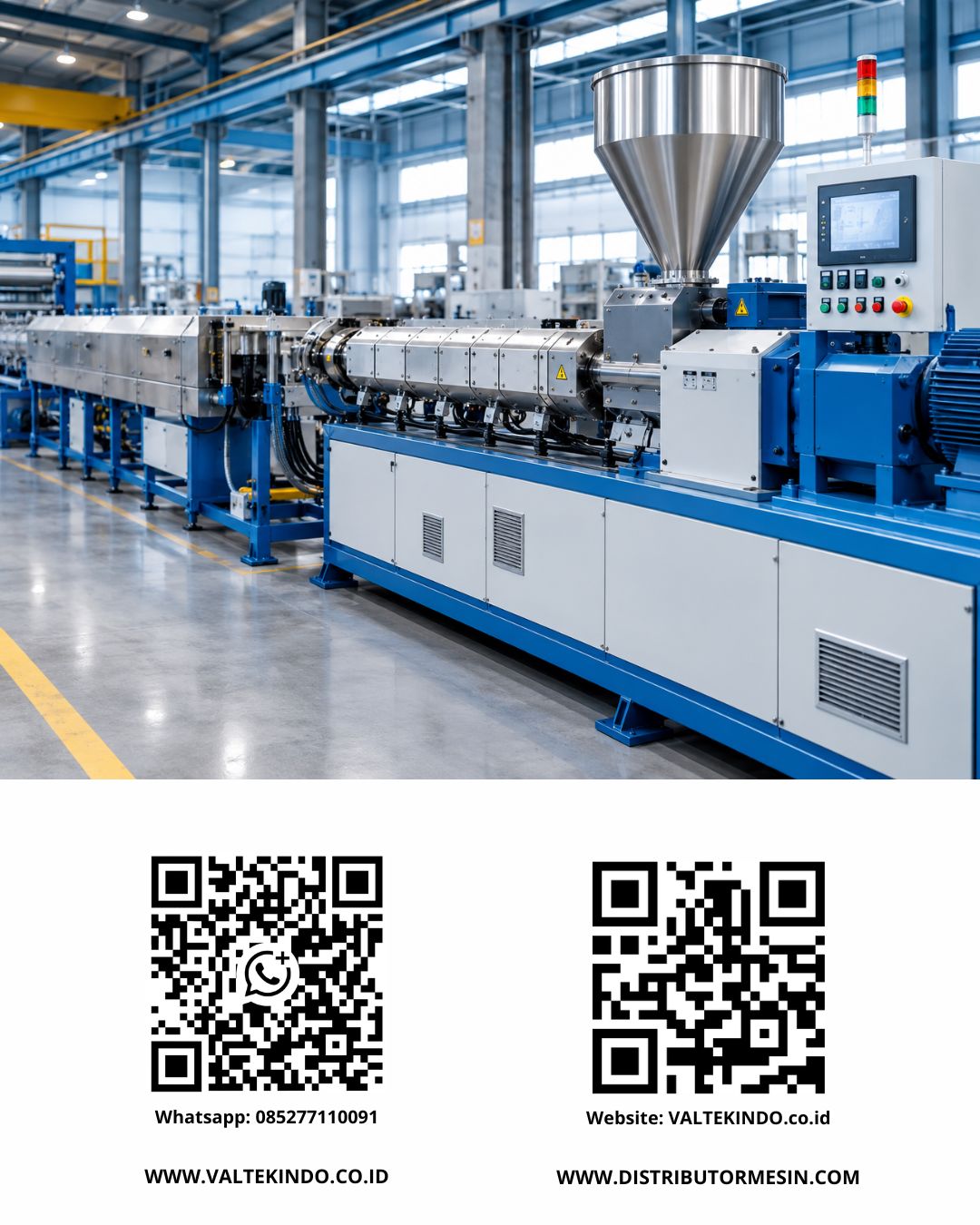
The growth of Indonesia's industrial manufacturing sector—particularly in polymer processing, infrastructure piping, construction profiles, and flexible packaging—demands unprecedented precision in production line efficiency. Within modern manufacturing facilities, the extruder machine serves as the central engine transforming raw polymeric resins into high-value finished and semi-finished goods. Procuring an industrial extrusion line is not merely an asset purchase; it represents a high-stakes capital expenditure decision that directly governs energy efficiency, dimensional product tolerances, and material scrap rates over an extended operational lifecycle.
For factory directors, plant managers, and industrial procurement professionals, acquiring a rigorous technical understanding of the extrusion process is essential prior to allocating capital expenditure. Processing different thermoplastic resins—ranging from high-density polyethylene (HDPE), polypropylene (PP), and polyvinyl chloride (PVC) to high-performance engineering plastics and post-consumer recyclates—requires strictly tailored mechanical configurations. Inadequate engineering assessments during preliminary feasibility phases frequently lead to material degradation, unstable melt pressure, high shear stress, and unacceptable operational energy overheads.
1. Critical Technical Parameters for Extruder Evaluation
When specifying industrial extrusion machinery, technical procurement committees must rigorously assess several key engineering metrics:
- Length-to-Diameter ($L/D$) Ratio: The $L/D$ ratio governs the plasticization quality and residence time of the resin within the processing cylinder. Standard polyolefin processing typically requires an $L/D$ ratio between 30:1 and 36:1 to achieve complete homogenization without causing thermal degradation induced by excessive shear.
- Screw Geometry and Metallurgy: The design of the screw—incorporating barrier flights, Maddock mixing sections, or dispersive pin elements—must strictly align with the polymer’s rheological behavior. Processing abrasive compounds such as high-loading calcium carbonate ($CaCO_3$) or glass fiber masterbatches requires bimetallic barrels and tungsten carbide-coated screw flights with surface hardness exceeding 65 HRC to mitigate mechanical wear.
- Thermal Management and Barrel Heating Zones: Accurate temperature regulation across multiple barrel zones stabilizes melt viscosity. High-density ceramic band heaters paired with localized blower-assisted air-cooling systems and closed-loop PID microprocessor controllers maintain precise thermal boundaries within tight ±1°C tolerances.
- Drive Train Efficiency: Utilizing permanent magnet synchronous servo motors or heavy-duty inverter-driven AC motors with high-torque gearboxes substantially lowers kilowatt-hour consumption per kilogram of extruded throughput relative to traditional induction drivetrains.
Gaining insight into historical engineering milestones clarifies the operational benefits of modern extrusion architecture. A detailed structural analysis of these advancements can be explored through the technical overview on Baina Extruder Development History: The Evolution of Extrusion Machine Technology for Modern Industry, which illustrates the design evolution from basic mechanical compounding units to responsive, automated systems built for modern continuous manufacturing.
2. Total Cost of Ownership (TCO) and Capital Risk Mitigation
In heavy manufacturing cost accounting, the initial purchase price of an industrial extrusion system accounts for only 15% to 20% of its total lifecycle cost across a standard ten-year operating window. The dominant cost factor remains electrical energy consumption (representing 60% to 70%), followed by mechanical maintenance, wear-part replacement, and unplanned plant downtime.
Consequently, industrial procurement evaluations must prioritize specific energy consumption metrics, calculated as electrical power consumed per kilogram of output ($kWh/kg$). Advanced extrusion units equipped with optimized thermal barrel insulation and high-efficiency drives achieve specific consumption figures below 0,25 kWh/kg for selected polymers. This operational efficiency yields major reductions in annual utility expenditures across continuous multi-shift production schedules.
Sustained operational reliability also depends upon rapid technical response, certified spare parts availability, and structured commissioning support. Partnering with an authorized industrial machinery distributor in Indonesia such as PT Valtekindo Global Intertek guarantees access to original components, professional site acceptance testing (SAT), and experienced technical engineering supervision that safeguards factory productivity.
Contact Our Sales Team Today
Looking for high-quality industrial machinery, factory automation solutions, or customized equipment for your business? Our experienced sales team is ready to help you find the right solution, provide technical consultation, and offer the best pricing.
Contact Our Official WhatsApp Sales Team:
- WhatsApp Sales 1: 085222110091
- WhatsApp Sales 2: 085277110091
Visit our official websites to explore our complete product catalog, machine operation videos, technical information, and exclusive offers:
PT. Valtekindo Global Intertek is your trusted partner for industrial machinery, processing equipment, recycling systems, laboratory instruments, and factory automation solutions. Contact us today for a free consultation and receive the best solution tailored to your business needs.

Admin
AuthorAdmin is a writer on the Valtekindo website, providing informative content about High Quality Industrial Machinery and Testing Machines.
Related post:
- Pharmaceutical Factory Production Escalation Strategy: Why Investing in an Automatic Capsule Filling Machine is the Most Crucial Business Decision
- High-Precision Wire Cut EDM Technology in 2026: The Ultimate Solution for Mold Making, Stamping Dies, and Automotive Component Fabrication Without Thermal Distortion
- 2026 Automated Carton Sealer & Erector Investment Guide: End-of-Line Automation Strategies for Industrial Plant Efficiency