Automatic Kinematic Viscosity Testing Solution for Oils & Lubricants
In the world of machinery, whether it's automotive engines, industrial turbines, or heavy equipment, oil and lubricants are the "lifeblood" that keeps everything running. Of all the properties a lubricant possesses, none is more fundamental or more critical than viscosity.
Viscosity is the measure of a fluid's resistance to flow. Simply put, it is the "thickness" of the oil. This property directly determines the oil's ability to form a protective film (film strength) between moving metal components, preventing destructive metal-to-metal contact.
For lubricant manufacturers, blending plants, and condition monitoring laboratories, precise measurement of kinematic viscosity isn't an option—it's a necessity. However, traditional manual methods are fraught with challenges.
This article will explore in-depth why kinematic viscosity testing is so crucial, the challenges in its measurement, and how an automatic kinematic viscosity testing solution emerges as the definitive answer for accuracy, efficiency, and standards compliance for your oils and lubricants.
Why is Kinematic Viscosity a Key Property?
A lubricant's viscosity must be in the "just right" range. If it's not, catastrophic machine failure is only a matter of time.
- If Viscosity is Too Low (Too Thin): The oil's protective film will break down under high pressure and temperature. This will cause direct component contact, leading to excessive friction, rapid wear, and overheating.
- If Viscosity is Too High (Too Thick): The oil will struggle to flow, especially during a cold start. This causes "oil starvation" in vital components. Furthermore, the high fluid drag forces the oil pump to work harder and decreases fuel efficiency.
Therefore, kinematic viscosity testing is essential in two primary scenarios:
- Production Quality Control (QC): Manufacturers must ensure every batch of oil they produce meets its specified grade (e.g., SAE 10W-40). A small error in blending can alter the viscosity, and an accurate tester is the only way to catch it before the product ships.
- Condition Monitoring (In-Use Oil Analysis): For fleet managers, factories, or industrial facilities, testing the viscosity of used oil is crucial. A change in viscosity in in-service oil can indicate serious problems like fuel contamination (thinning the oil), oxidation (thickening the oil), or the use of incorrect oil.
The Gold Standard of Testing: ASTM D445
To ensure viscosity data is reliable and comparable globally, the industry relies on one gold standard: ASTM D445.
ASTM D445 (Standard Test Method for Kinematic Viscosity of Transparent and Opaque Liquids) is the definitive test method. Its principle is simple yet precise: measuring the time it takes for a fixed volume of oil to flow under gravity through a calibrated glass capillary tube.
This test must be performed at a highly controlled and stable temperature (e.g., 40°C and 100°C), as viscosity is extremely sensitive to temperature changes. This flow time is then multiplied by the tube's calibration constant to produce the Kinematic Viscosity value, reported in centistokes (cSt) or mm²/s.
The Productivity-Killing Challenges of Manual Methods
Traditionally, ASTM D445 testing was performed manually. A lab technician had to:
- Prepare the sample and the capillary viscometer tube (like a Cannon-Fenske).
- Mount the tube in a transparent, precisely controlled temperature water bath.
- Manually draw the sample to the starting line.
- Use a stopwatch to time the flow from the start line to the finish line with the naked eye.
- Manually clean the capillary tubes with solvents, a time-consuming and hazardous process.
This method, while standard, has significant drawbacks in a modern laboratory:
- Labor-Intensive: Requires the full, undivided attention of a technician for every single sample.
- Prone to Human Error: Parallax errors when reading the meniscus, reaction time on the stopwatch, and procedural inconsistencies are common problems.
- Low Throughput: One technician can only handle a few samples at a time.
- Cleaning Bottleneck: The washing and drying process for the capillary tubes often takes longer than the test itself.
The Automatic Kinematic Viscosity Solution from PT Valtekindo Global Intertek
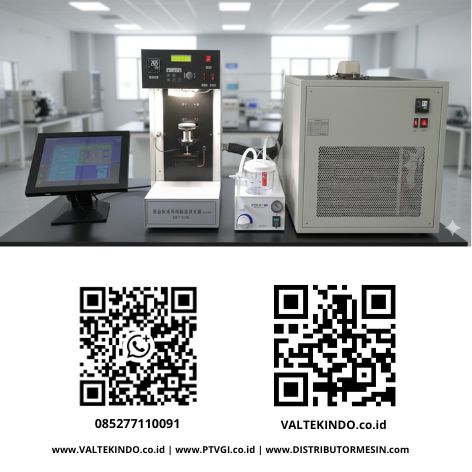
Answering all these challenges, the Oil Viscosity Tester (Automatic Kinematic Viscometer) arrives as a transformative solution. Based on the product specifications from PT Valtekindo Global Intertek, this instrument is designed to completely replace manual intervention and deliver precise, fast, and reliable results.
Here is why it is the superior solution for your laboratory:
1. Fully Automatic Process
As the name implies, the equipment takes over the entire workflow. From sample loading (if using an autosampler), flow time measurement, to the final calculation. The operator simply places the sample, and the machine does the rest.
2. Unmatched Accuracy and Precision
The machine eliminates human error. Advanced optical or infrared sensors detect the meniscus flow with a precision of a hundredth of a second, far more accurate than the human eye and a stopwatch. Furthermore, the integrated temperature bath system maintains stability with minimal fluctuation (often to ±0.01°C), which is an absolute requirement for ASTM D445 compliance.
3. Automatic Cleaning and Drying
This is one of the biggest advantages. After the test is complete, the machine will automatically wash the capillary tube with programmed solvents and dry it with compressed air. The viscometer tube is immediately clean, dry, and ready for the next sample in minutes. This drastically reduces laboratory bottlenecks and technician exposure to harmful chemicals.
4. Increased Efficiency and Throughput
With the manual process eliminated, lab technicians can focus on other value-added tasks. Many automatic viscometer models can accommodate an autosampler, allowing for dozens of samples to be tested sequentially (even overnight) with zero supervision. This multiplies laboratory productivity.
5. Digital Data Management
Say goodbye to manual logbooks. The automatic viscosity tester records all test parameters, flow times, and calculated results digitally. This data can be printed, stored, or exported to a Laboratory Information Management System (LIMS), ensuring complete data integrity and traceability.
Who Benefits Most from This Automatic Solution?
An automatic kinematic viscosity testing solution is designed for laboratories that demand high accuracy and throughput efficiency, including:
- Lubricant Manufacturers (Blending Plants): For strict quality control (QC) on raw materials and finished products.
- Commercial Testing Laboratories: For servicing clients from various industries with fast, certified results.
- Condition Monitoring Labs: For analyzing hundreds of used oil samples from truck fleets, heavy equipment, or industrial machinery daily.
- R&D Centers: For developing and testing new lubricant formulations with high-precision data.
Conclusion: Modernize Your Laboratory Now
In the oil and lubricant industry, the accuracy of viscosity data isn't a luxury—it's the foundation of quality and reliability. Relying on slow, error-prone manual methods is a risk to your productivity and your reputation.
The Automatic Kinematic Viscosity Testing Solution is a smart investment that provides an immediate return in time savings, error reduction, increased throughput, and full compliance with the ASTM D445 standard. It is the essential step to bringing your laboratory to the next level of precision and efficiency.
Optimize Your Industry Today!
Achieve production efficiency and the highest quality standards with a trusted industrial machinery provider. Explore our wide selection of premium processing and testing equipment at:
Website : valtekindo.co.id
Wesbite : distributormesin.com
Consult your technical needs with our expert sales team:
WhatsApp 1: +62 852-2211-0091
WhatsApp 2: +62 852-7711-0091

Admin
AuthorAdmin is a writer on the Valtekindo website, providing informative content about High Quality Industrial Machinery and Testing Machines.
Related post:
- Pharmaceutical Factory Production Escalation Strategy: Why Investing in an Automatic Capsule Filling Machine is the Most Crucial Business Decision
- High-Precision Wire Cut EDM Technology in 2026: The Ultimate Solution for Mold Making, Stamping Dies, and Automotive Component Fabrication Without Thermal Distortion
- 2026 Automated Carton Sealer & Erector Investment Guide: End-of-Line Automation Strategies for Industrial Plant Efficiency