Measuring Apparatus Of Surface Tension Coefficient Of Liquid
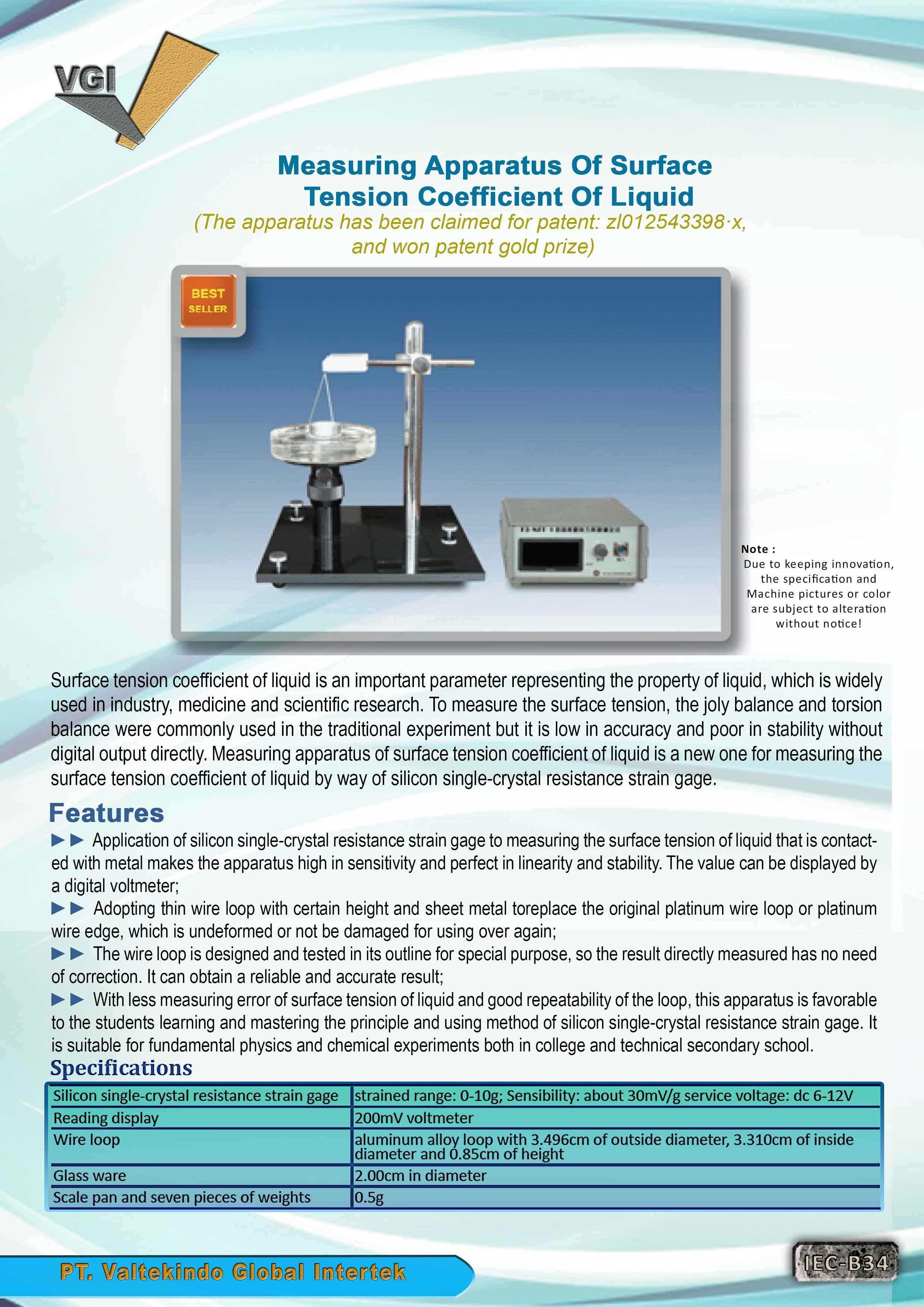 Click on the image to enlarge
FEATURE
DESCRIPTION / TECHNICAL SPECIFICATIONS
Introducing a breakthrough in the measurement of liquid properties a patent gold prize-winning apparatus designed to revolutionize how the surface tension coefficient is measured in educational laboratories This innovative instrument directly addresses the weaknesses of traditional methods like torsion balances which suffer from low accuracy poor stability and no direct digital output By adopting modern sensor technology this device provides highly accurate reliable and easy-to-read results
The core of this technological superiority is the application of an advanced silicon single-crystal resistance strain gage This high-precision sensor acts as a transducer converting the very small pulling force of a liquid's surface tension into an easily measurable electrical voltage signal This technology is renowned for its high sensitivity and perfect linearity ensuring that the data displayed by the digital voltmeter accurately represents the surface tension
The intelligent design of this apparatus also extends to its mechanical components Replacing fragile and expensive platinum rings this tool utilizes a thin wire loop made of a special aluminum alloy designed not to deform or get damaged with repeated use Most importantly the loop's design has been specially tested so that the directly measured result requires no correction factor a significant simplification that eliminates a common source of error and saves time in data analysis
The learning experience with this tool is invaluable With much smaller measurement error students can focus more on understanding the working principle and method of using a silicon single-crystal resistance strain gage a sensor technology widely used in industry The apparatus is perfectly suited for fundamental physics and chemical experiments at the college and technical secondary school levels providing a bridge between fluid theory and modern instrumentation applications
Overall this patented apparatus is a substantial upgrade for any laboratory It offers superior accuracy stability and ease of use that cannot be matched by older methods Its direct digital output and the absence of a need for correction make the experimental process more efficient and enjoyable It is an investment in accuracy and in the education of modern sensor technology for the next generation of scientists and engineers
 Download
 Video
Video
 Kontak Sales 1