Ferromagnetic Material Curie Temperature Measurement Laboratory
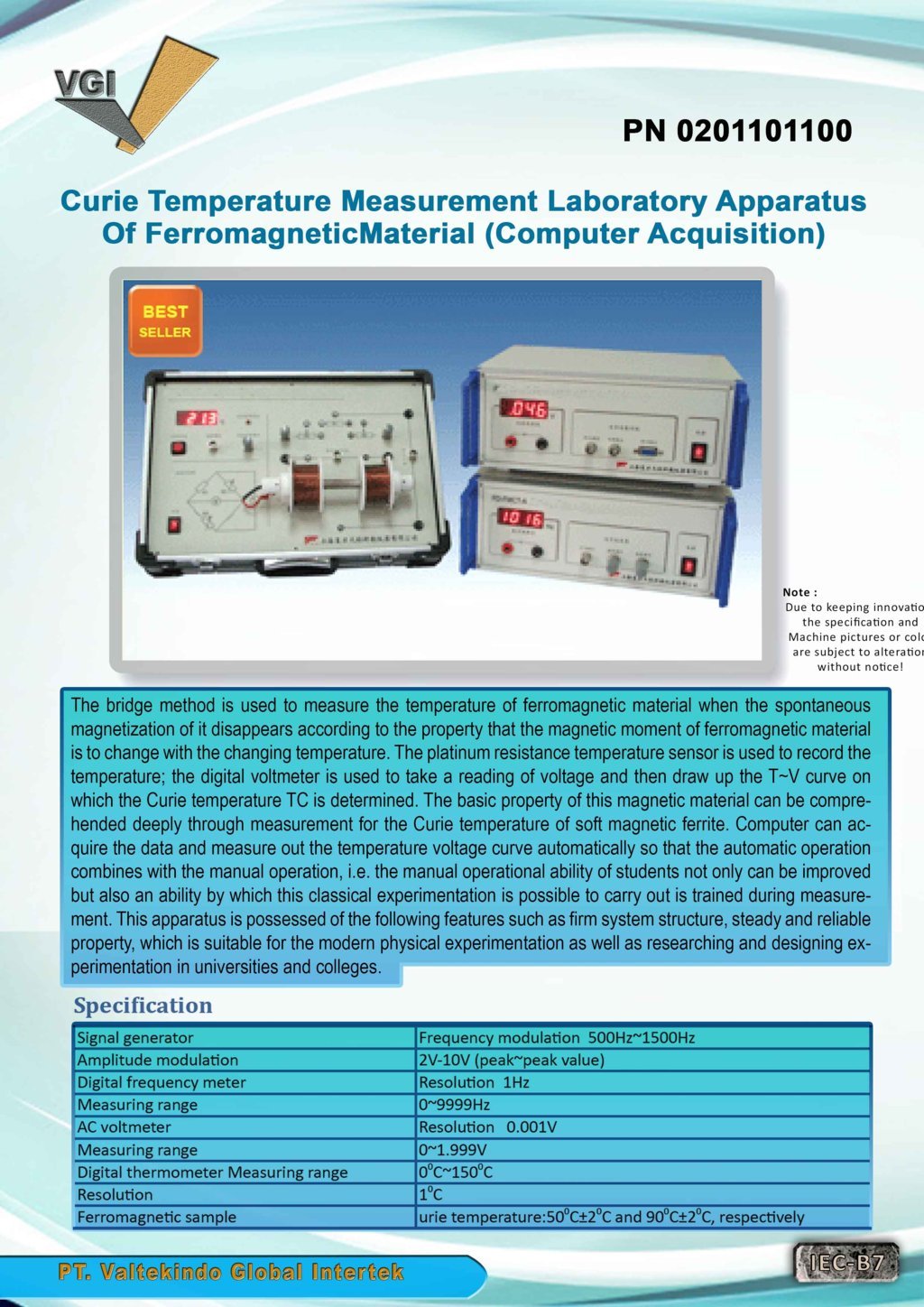 Click on the image to enlarge
FEATURE
DESCRIPTION / TECHNICAL SPECIFICATIONS
Introducing a modern experimental system designed to investigate one of the most fundamental concepts in materials science the Curie Temperature the critical point at which a ferromagnetic material loses its permanent magnetic properties and transitions to a paramagnetic state This apparatus combines the classic bridge method with modern digital instrumentation and computer-based data acquisition to provide a comprehensive learning experience
The working principle of this experiment is to detect the abrupt change in the magnetic moment of a soft magnetic ferrite sample as its temperature is gradually increased The device uses a precision platinum resistance temperature sensor to accurately monitor the temperature while the bridge method is employed to detect the point at which the material's spontaneous magnetization disappears which by definition is the Curie Temperature
One of the key pedagogical advantages of this apparatus is its dual-mode operation Students can perform the experiment manually by taking readings from the digital voltmeter and digital thermometer to plot the temperature-voltage (T-V) curve themselves This hands-on process builds a fundamental understanding of the experimental procedure and data analysis
Complementing the manual mode this device is also equipped with an advanced computer data acquisition interface In the automatic mode the computer can take over the data acquisition process and directly plot the temperature-voltage curve in real-time This feature not only improves the efficiency and precision of the measurement but also introduces students to the modern laboratory automation techniques used in scientific research today
To enrich the learning experience each set is equipped with two different soft magnetic ferrite samples each with a distinct Curie Temperature This allows students to conduct a comparative study repeating the experiment and observing how the intrinsic properties of the material affect its phase transition point
Overall with its firm system structure steady and reliable performance and its unique combination of manual and automated operation this apparatus is the ideal tool for modern physical experimentation as well as researching and designing experiments in universities and colleges It transforms the theoretical concept of magnetic phase transition into an experiment that can be measured analyzed and deeply understood
 Download
 Video
Video
 Kontak Sales 1