Scaling Geosynthetic Manufacturing Capacity An Investment Guide to High-Precision Ultrasonic GEOCELL Welding Machines
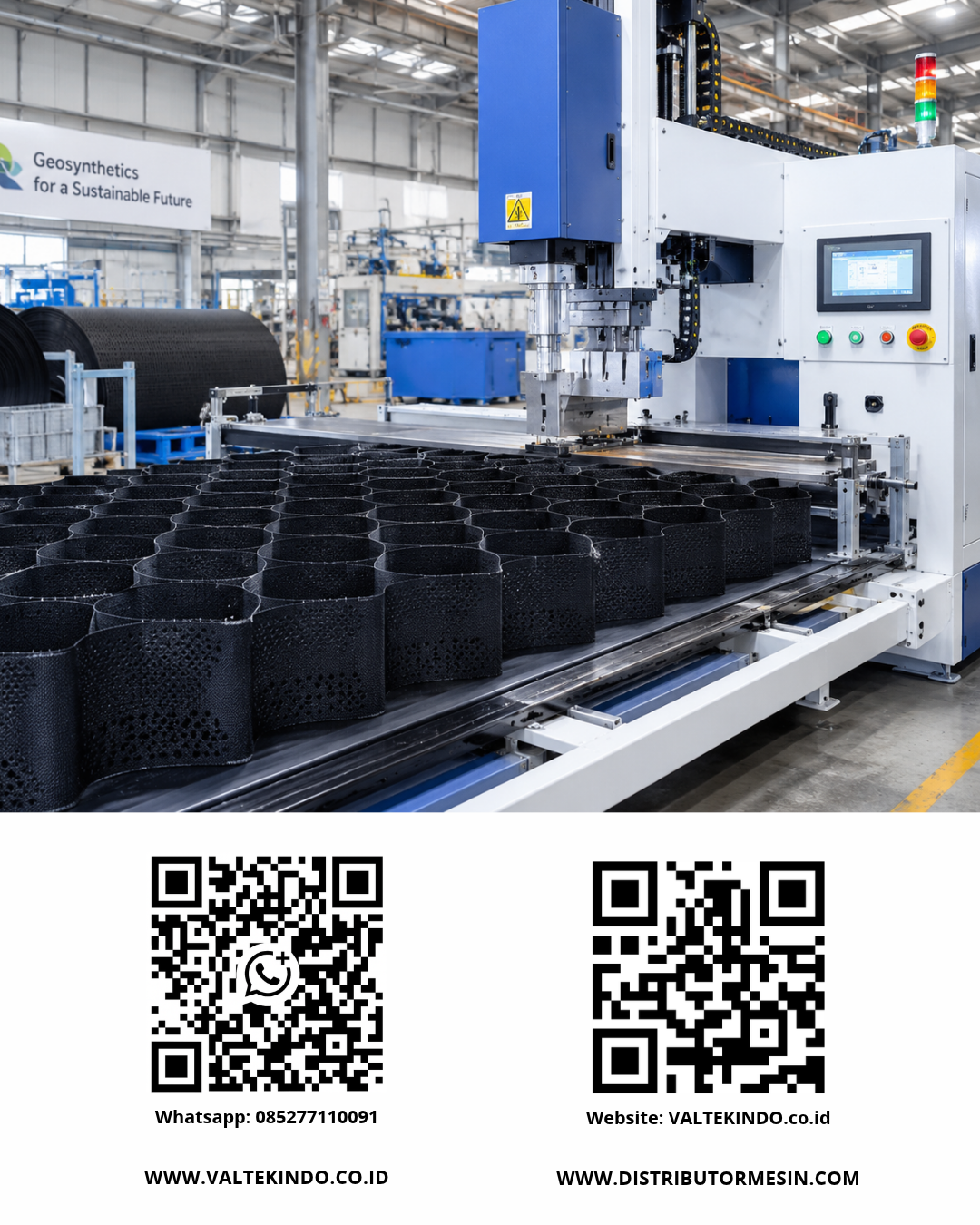
Large-scale infrastructure development across Indonesia continues to accelerate rapidly, spanning toll road expansions, mining slope stabilization, dam construction, and coastal reclamation projects. This surge in civil engineering activity directly fuels demand for geosynthetic materials, particularly High-Density Polyethylene (HDPE) cellular confinement systems, commonly known as geocells. For geosynthetic plant owners and manufacturing investors, the primary challenge today is no longer finding buyers, but rather scaling daily production output without compromising seam strength between polymer strips. In this competitive landscape, deploying a modern GEOCELL Welding Machine becomes the decisive factor for capturing both domestic infrastructure tenders and regional export markets.
Conventional joining techniques such as hot-plate welding or manual bonding frequently create severe production bottlenecks on the factory floor. Manual thermal processes require prolonged cycle times, consume excessive electrical power, and carry a high risk of inconsistent weld quality. When geocells are expanded and filled with heavy aggregate on-site, weak seams are prone to peel failure, leading to costly warranty claims and damaged credibility with major state-owned and private contractors. Consequently, transitioning to automated ultrasonic welding systems represents the most financially sound capital expenditure for modern geosynthetic manufacturing lines.
Ultrasonic welding technology in geocell machinery operates by converting high-frequency electrical energy into microscopic mechanical vibrations via a transducer and sonotrode. These vibrations generate localized frictional heat precisely at the interface of overlapping HDPE strips, melting the polymer within milliseconds and fusing them homogeneously under controlled pneumatic or servo pressure. The result is a high-integrity weld seam whose peel strength and shear resistance consistently exceed ASTM and Indonesian National Standard (SNI) geosynthetic benchmarks. When planning industrial equipment procurement, PT Valtekindo Global Intertek frequently serves as a technical consultation partner for manufacturers seeking to align machine line configurations with plant output targets and specific polymer resin grades.
From an operational efficiency standpoint, integrating an automated geocell welding system directly lowers the Cost of Goods Sold (COGS). First, welding cycle times per row are drastically reduced compared to semi-automatic setups, enabling a single production line to output thousands of square meters of finished geocell daily. Second, a Programmable Logic Controller (PLC) paired with a touchscreen Human-Machine Interface (HMI) allows operators to digitally calibrate vibration amplitude, clamping pressure, welding duration, and weld pitch spacing. This automation eliminates reliance on manual operator skill while driving material scrap rates down below one percent.
For investors planning to upgrade existing HDPE sheet extrusion facilities into high-margin finished product lines, selecting machinery with dimensional versatility is critical. Highway base stabilization projects typically require cell heights between 100 mm and 150 mm, whereas steep slope protection and retaining wall applications demand cell heights of 200 mm to 300 mm using sheet thicknesses from 1.2 mm to 1.8 mm. To accommodate these diverse project specifications without replacing core machinery, plant engineers can evaluate configurations through the precision GEOCELL welding machine for industrial geocell seam joining, which is engineered for rapid weld pitch adjustment and consistent polymer strip fusion.
Beyond welding speed and seam durability, the reliability of core components—such as digital ultrasonic generators, wear-resistant titanium or hardened alloy welding horns, and automated strip feeding and perforation units—must be prioritized during vendor evaluation. Machines equipped with automatic frequency tracking maintain stable ultrasonic resonance even amid ambient temperature fluctuations during continuous 24-hour operation. This operational stability is vital for manufacturing plants across industrial hubs like Cikarang, Karawang, Surabaya, and Medan running three-shift schedules to meet strict infrastructure delivery deadlines.
The Return on Investment (ROI) for acquiring a new ultrasonic geocell welding line is remarkably compelling. Because finished cellular confinement systems command significantly higher profit margins than raw extruded HDPE sheets, a 40 to 60 percent boost in daily output typically allows manufacturers to recover equipment capital costs within less than two years. Coupled with responsive after-sales engineering support, ready availability of spare transducers, and on-site commissioning assistance, your CAPEX investment remains protected against prolonged production downtime.
Contact Our Sales Team Today
Looking for high-quality industrial machinery, factory automation solutions, or customized equipment for your business? Our experienced sales team is ready to help you find the right solution, provide technical consultation, and offer the best pricing.
Contact Our Official WhatsApp Sales Team:
- WhatsApp Sales 1: 085222110091
- WhatsApp Sales 2: 085277110091
Visit our official websites to explore our complete product catalog, machine operation videos, technical information, and exclusive offers:
PT. Valtekindo Global Intertek is your trusted partner for industrial machinery, processing equipment, recycling systems, laboratory instruments, and factory automation solutions. Contact us today for a free consultation and receive the best solution tailored to your business needs.

Admin
AuthorAdmin is a writer on the Valtekindo website, providing informative content about High Quality Industrial Machinery and Testing Machines.
Related post:
- Enhancing High-Precision Manufacturing with Open Type CNC Milling Machines for Large Industrial Workpieces in Indonesia
- Industrial Flat Die Pellet Machine for Sale High-ROI Solution for Biomass & Animal Feed Production Efficiency
- PET Blow Molding Machine: Production Efficiency, Cycle Stability, and Operational Reliability Guide
Latest Articles:
- Enhancing High-Precision Manufacturing with Open Type CNC Milling Machines for Large Industrial Workpieces in Indonesia
- Industrial Flat Die Pellet Machine for Sale High-ROI Solution for Biomass & Animal Feed Production Efficiency
- PET Blow Molding Machine: Production Efficiency, Cycle Stability, and Operational Reliability Guide
- Automatic Labeling Machines for Production Efficiency in Indonesian Food, Beverage, and Pharmaceutical Plants
- Why Factories Are Switching to High-Precision PET Bottle Blow Molding Machines in 2026