Investment Feasibility Analysis of Commercial AAC Lightweight Block Plant Packages: CAPEX Efficiency and Accelerated ROI Strategies in Modern Construction
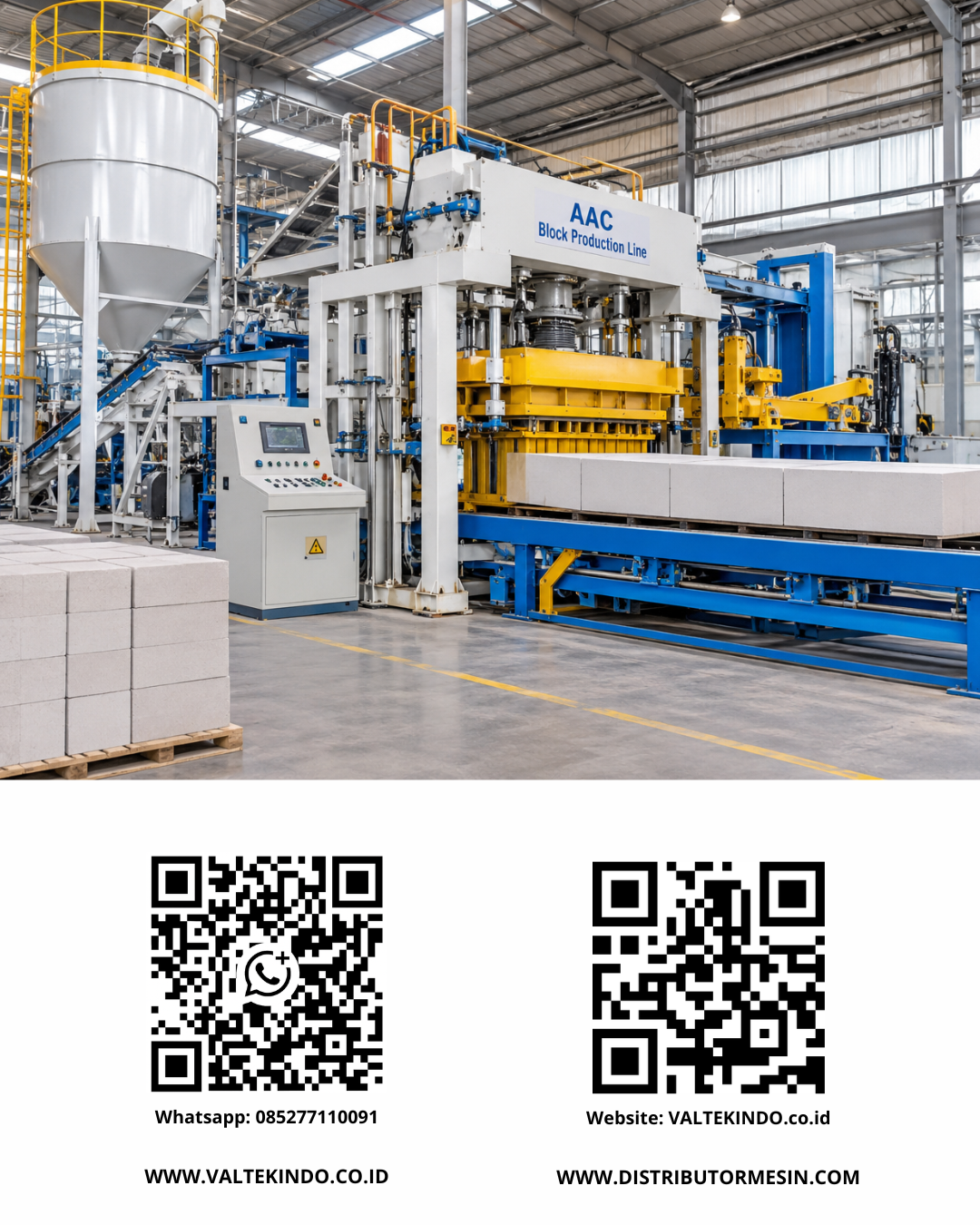
The massive expansion of national infrastructure, integrated industrial estates, high-rise commercial buildings, and residential housing developments across Indonesia has permanently transformed the demand landscape for walling materials. Main contractors and property developers are systematically phasing out conventional clay red bricks and dense cement blocks due to structural dead-load penalties, slow installation speeds, and dimensional inconsistencies. This aggressive market transition toward Autoclaved Aerated Concrete (AAC) lightweight blocks has created a lucrative, large-scale manufacturing investment opportunity for industrial investors and building material conglomerates. However, successfully establishing an AAC block manufacturing plant capable of dominating regional supply chains depends heavily on selecting the right machinery configuration, optimizing thermal energy consumption, and ensuring robust production line engineering from the initial Capital Expenditure (CAPEX) planning phase.
Fundamentally, AAC lightweight blocks hold an absolute structural and commercial advantage over non-autoclaved Cellular Lightweight Concrete (CLC) methods because their curing process relies on hydrothermal synthesis inside high-pressure steam autoclaves operating at approximately 185 to 200 degrees Celsius under saturated steam pressures of 1.2 to 1.3 MPa. The chemical reaction between finely ground silica sand slurry, active quicklime, ordinary Portland cement, gypsum, water, and aluminum paste generates a stable crystalline tobermorite structure that delivers exceptional compressive strength despite its remarkably low dry density. The resulting building blocks feature millimeter-level dimensional accuracy, superior thermal and acoustic insulation, and international-grade fire resistance. Consequently, manufacturing facilities operating genuine AAC production lines command premium market pricing and immediately qualify for state-owned enterprise tenders, national private developments, and multinational construction projects.
When structuring plant investment budgets, investors frequently fall into the trap of procuring fragmented, low-cost machinery components that ultimately inflate Operational Expenditure (OPEX) due to high product reject rates and excessive boiler fuel consumption. A modern, profitable production line requires seamless mechanical synchronization and full automation starting from raw material preparation in the Ball Mill to produce silica slurry of exact specific fineness, followed by a PLC-controlled digital dosing and mixing tower that guarantees chemical batching accuracy down to the gram. Inaccurate proportioning or mixing during this initial stage causes uneven expansion of the green cake inside the molding boxes, which compromises the microporous structure of the concrete and degrades the final compressive strength below national industrial standards.
The next critical stage governing plant profit margins is the high-precision automated cutting line. Once the rising cake exits the pre-curing heating chamber and achieves optimal semi-solid green strength, a heavy-duty tilting crane rotates the mold by 90 degrees to demold the green cake onto a specialized cutting carriage. High-speed steel wire cutting technology featuring six-sided pneumatic oscillation enables vertical slicing, horizontal cutting, and the profiling of interlocking tongue-and-groove joints or ergonomic hand-grips within seconds, maintaining dimensional tolerances under one millimeter. Furthermore, premier industrial production lines incorporate an automated bottom and side crust recycling system, where trimmings and green waste are immediately pulped back into recovery slurry and returned to the mixing tower. This zero-waste engineering approach saves up to eight percent in raw material consumption every single month.
Thermal steam efficiency across the autoclave battery also plays a decisive role in accelerating the Break-Even Point (BEP). An integrated turnkey plant utilizes automated steam distribution manifolds that enable cross-autoclave steam recovery, transferring residual high-pressure steam from an autoclave completing its curing cycle directly into an adjacent autoclave beginning its heating phase. This thermal engineering mechanism slashes coal, natural gas, or biomass fuel consumption in the steam boiler by up to thirty percent per cubic meter of finished product. With scalable plant capacities ranging from 100,000 to over 300,000 cubic meters annually, these daily energy cost reductions translate directly into substantial net profit gains on corporate financial statements.
For investors and board directors currently drafting a feasibility study for a construction material manufacturing facility, partnering with a credible industrial machinery provider is the single most important risk-mitigation strategy. The presence of PT Valtekindo Global Intertek as a strategic industrial machinery partner guarantees end-to-end engineering excellence, encompassing custom factory layout design, heavy-duty machinery supply, mechanical and electrical installation supervision, and full production commissioning until the facility produces export-grade AAC blocks. To streamline project budgeting and review comprehensive equipment configurations, corporate decision-makers can examine the complete technical specifications through our dedicated page for a complete AAC lightweight block machine package for smart investment with maximum profit and fast ROI, specifically engineered to meet modern industrial efficiency demands.
Competitive advantage in the AAC block manufacturing sector is determined not only by hardware sophistication, but also by guaranteed spare parts availability, on-site operator training, and localized raw material chemical formulation support. Because the mineral composition of silica sand and lime varies across different provinces in Indonesia, fine-tuning the production recipe with experienced chemical engineers during the trial run phase is vital to ensuring consistent block quality exiting the autoclave. Backed by a solid after-sales engineering infrastructure, plant owners can maintain machinery utilization rates above ninety percent year-round without risking prolonged operational downtime that could jeopardize supply contracts with distributors and major construction projects.
Contact Our Sales Team Today
Looking for high-quality industrial machinery, factory automation solutions, or customized equipment for your business? Our experienced sales team is ready to help you find the right solution, provide technical consultation, and offer the best pricing.
Contact Our Official WhatsApp Sales Team:
- WhatsApp Sales 1: 085222110091
- WhatsApp Sales 2: 085277110091
Visit our official websites to explore our complete product catalog, machine operation videos, technical information, and exclusive offers:
PT. Valtekindo Global Intertek is your trusted partner for industrial machinery, processing equipment, recycling systems, laboratory instruments, and factory automation solutions. Contact us today for a free consultation and receive the best solution tailored to your business needs.

Admin
AuthorAdmin is a writer on the Valtekindo website, providing informative content about High Quality Industrial Machinery and Testing Machines.
Related post:
- Optimizing Pharmaceutical Production Lines Through High Speed cGMP Compliant Automatic Blister and Strip Packaging Machine Integration
- Modern Manufacturing Efficiency Strategy: Optimizing Production Lines with Modular Product Systems to Boost Factory Flexibility in Indonesia
- The New Standard in Material Testing: Why a Precision Lab Pulverizer Machine is a Critical Investment for Modern Factories in Indonesia
Latest Articles:
- Optimizing Pharmaceutical Production Lines Through High Speed cGMP Compliant Automatic Blister and Strip Packaging Machine Integration
- Modern Manufacturing Efficiency Strategy: Optimizing Production Lines with Modular Product Systems to Boost Factory Flexibility in Indonesia
- The New Standard in Material Testing: Why a Precision Lab Pulverizer Machine is a Critical Investment for Modern Factories in Indonesia
- Factory Investment Strategy: The Advantages of Automatic In-line Cup Sealing Machines to Boost B2B Production Capacity
- Best Industrial Automatic Labeling Machine for Mass Production PlantsContact Our Sales Team Today