Melt Flow Rate Tester | MFR & MVR Tester
 Click on the image to enlarge
FEATURE
DESCRIPTION / TECHNICAL SPECIFICATIONS
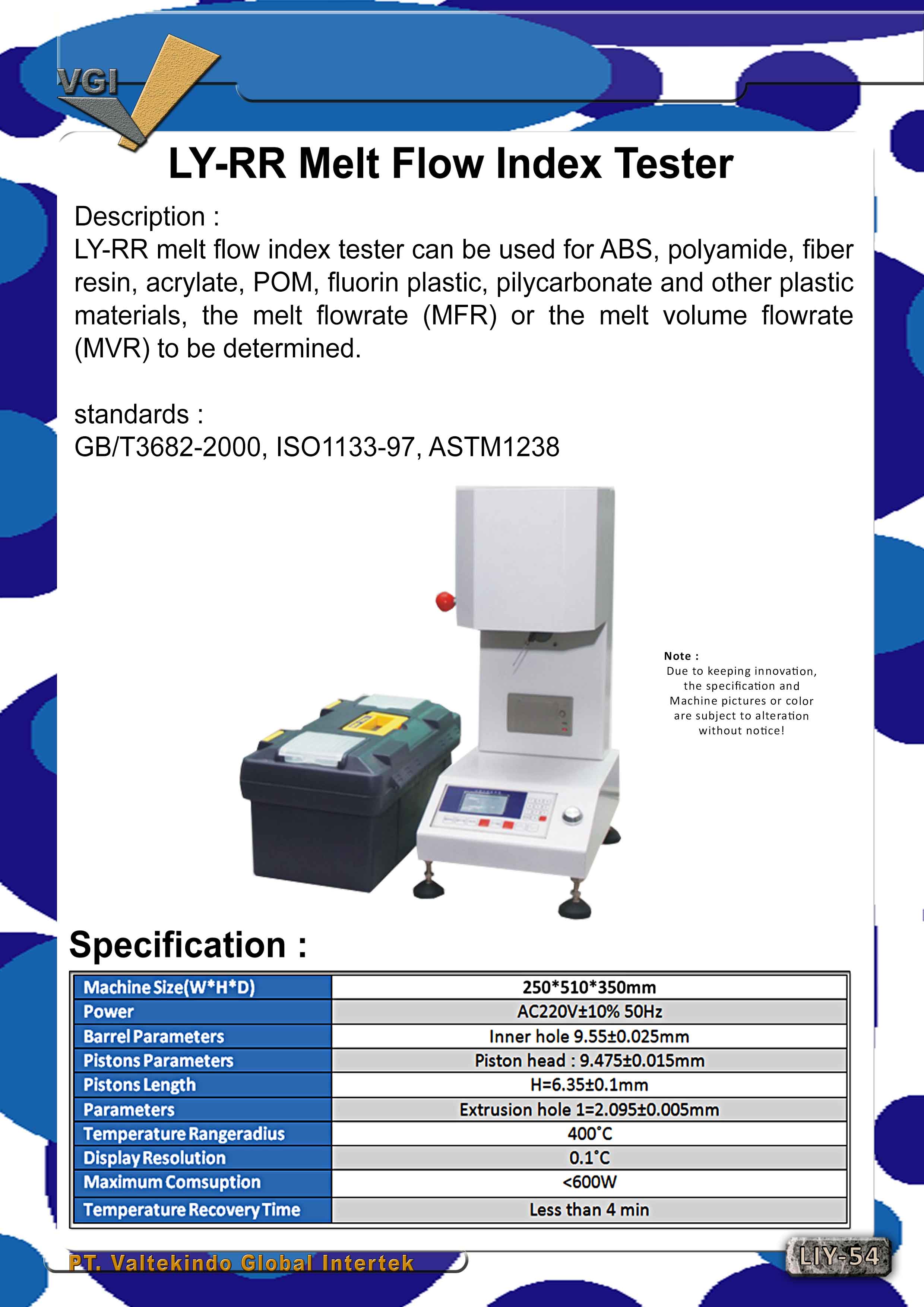
In the world of precision plastics manufacturing, raw material consistency is everything. The flow properties of a thermoplastic polymer in its molten state are the most critical parameters determining its processability and the quality of the final product. We present an essential laboratory instrument, the Melt Flow Index Tester, designed to provide accurate and repeatable data on the Melt Flow Rate (MFR) and Melt Volume Rate (MVR). This device is your first line of defense in verifying the quality of raw material batches, optimizing machine parameters, and preventing costly production failures.
Data credibility is paramount, and this machine is built on a foundation of the most recognized international standards. It fully complies with the test methods outlined in ISO 1133, ASTM D1238, and GB/T3682. This multi-standard compliance ensures that the results you obtain are not only internally accurate but are also comparable and accepted by suppliers and customers worldwide. Whether you are testing ABS, polyamide, polycarbonate, POM, or other engineering resins, this instrument provides a reliable quality benchmark for a vast range of thermoplastic materials.
Precision engineering is at the core of this instrument's performance. With key components like the barrel, piston, and extrusion die manufactured to extremely tight dimensional tolerances, every test is guaranteed to be consistent. Superior temperature control with a range up to 400°C and a resolution of 0.1°C enables testing of a wide polymer spectrum, from commodities to high-performance engineering plastics. A key advantage is its rapid temperature recovery time of less than 4 minutes, which dramatically improves testing efficiency and throughput in your lab, while ensuring the test temperature remains stable for maximum accuracy.
This instrument is more than a measuring device; it is a risk management tool. By validating the MFR/MVR of every incoming raw material lot, you can avoid issues like incomplete mold fillings (short shots), inconsistent surface gloss, or material degradation from incorrect processing parameters. For R&D departments, it is invaluable for characterizing new materials. For production, it is the key to maintaining a stable and efficient process. Make this fundamental testing instrument the cornerstone of your quality assurance program to ensure consistency and excellence in every plastic product you create.
 Download
 Video
Video
 Kontak Sales 1