Magnetoresistance Transducer and Earth's Magnetic Field Laboratory Equipment
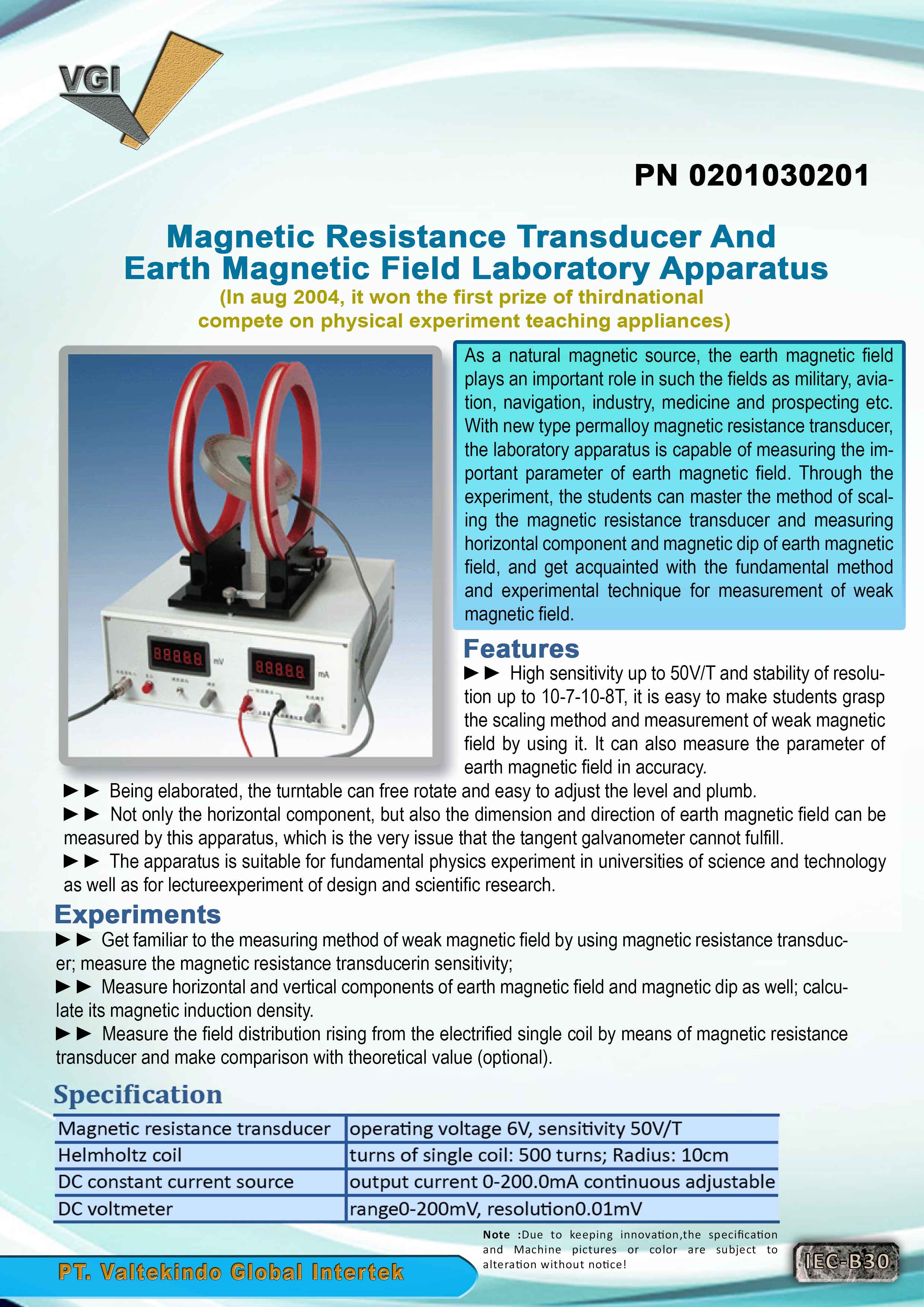 Click on the image to enlarge
FEATURE
DESCRIPTION / TECHNICAL SPECIFICATIONS
Introducing a first-prize award-winning experimental system specifically designed for the high-precision measurement of the Earth's magnetic field This laboratory apparatus utilizes a new-type high-sensitivity permalloy magnetic resistance transducer to enable students to master the measurement methods of weak magnetic fields and understand the important parameters of the geomagnetic field which has wide applications in navigation geophysics and industry
The primary experiment with this device is the comprehensive mapping of the local Earth's magnetic field Unlike limited traditional instruments students can use the easily adjustable rotating platform to accurately measure not only the horizontal component but also the vertical component of the magnetic field This hands-on experience provides a complete vector picture of our planet's invisible protective shield
From the measured horizontal and vertical component data students can go a step further to perform critical analysis They can calculate the total magnetic induction density and most importantly the magnetic dip or inclination angle The ability to accurately determine the full direction and magnitude of the magnetic field at their location is a profound and invaluable learning experience in experimental physics
The exceptional accuracy of this apparatus is made possible by the permalloy magnetic resistance transducer which has a very high sensitivity of up to 50V/T and outstanding resolution stability specifically designed to detect extremely weak magnetic fields Additionally the set includes a pair of Helmholtz coils which can be used for sensor calibration or as part of an optional experiment to map the field distribution of a single coil and compare it with theory
Overall this award-winning apparatus is a superior teaching tool that far surpasses the capabilities of traditional tangent galvanometers It provides students with practical experience using modern transducer technology to perform an important real-world scientific measurement Its well-elaborated design and ability to produce accurate data make it an indispensable instrument for any university physics or geophysics laboratory
 Download
 Video
Video
 Kontak Sales 1