Magnetic Damping And Coefficient Of Kinetic Friction Testing Laboratory Apparatus
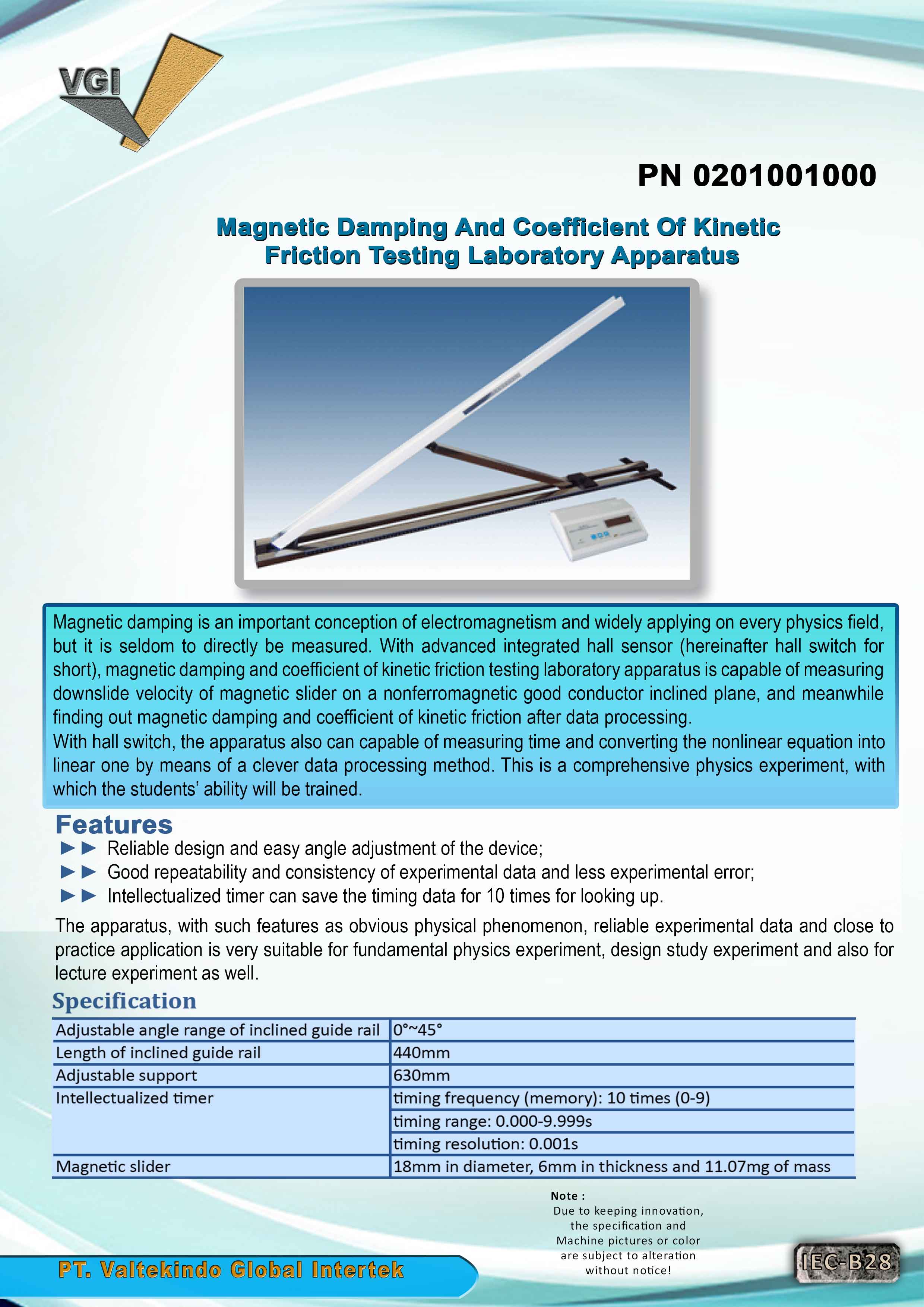 Click on the image to enlarge
FEATURE
DESCRIPTION / TECHNICAL SPECIFICATIONS
Introducing an innovative and comprehensive experimental system designed to elegantly integrate the study of two fundamental concepts from different branches of physics classical mechanics and electromagnetism This apparatus provides a direct method for measuring magnetic damping an important phenomenon that is seldom directly measurable in a teaching laboratory while simultaneously determining the coefficient of kinetic friction with high accuracy
The experiment is centered on observing the motion of a magnetic slider as it moves down an inclined plane made of a non-ferromagnetic conducting material The angle of inclination of the guide rail is easily adjustable providing full flexibility to investigate how the motion is affected by gravitational force frictional force and most importantly the electromagnetic drag force or magnetic damping that arises from eddy currents
Modern technology is at the heart of this device's accuracy An advanced integrated Hall sensor and an intellectualized timer with a resolution of up to 0 001 seconds are used to measure the slider's transit time with high precision This automated measurement system eliminates the inaccuracies inherent in manual timing and ensures the generated data has excellent consistency and repeatability
One of the highest pedagogical values of this apparatus is its ability to train students in advanced data analysis The experiment is designed to guide students through a clever data processing method transforming the nonlinear equation that describes the motion into a linear form that is easier to analyze and interpret The timer is also equipped with a memory function that can save up to ten timing data points facilitating data collection and verification
Overall this apparatus is more than just a simple inclined plane it is a powerful integrated physics laboratory It is the ideal tool for fundamental physics experiments design study projects and lecture demonstrations effectively showcasing the interplay between mechanical and electromagnetic forces in one clear and reliable setup preparing students with solid experimental and data analysis skills
 Download
 Video
Video
 Kontak Sales 1