Complete Guide to Mesh Sieve Tables: The Secret to International Standard Precision Sorting Results
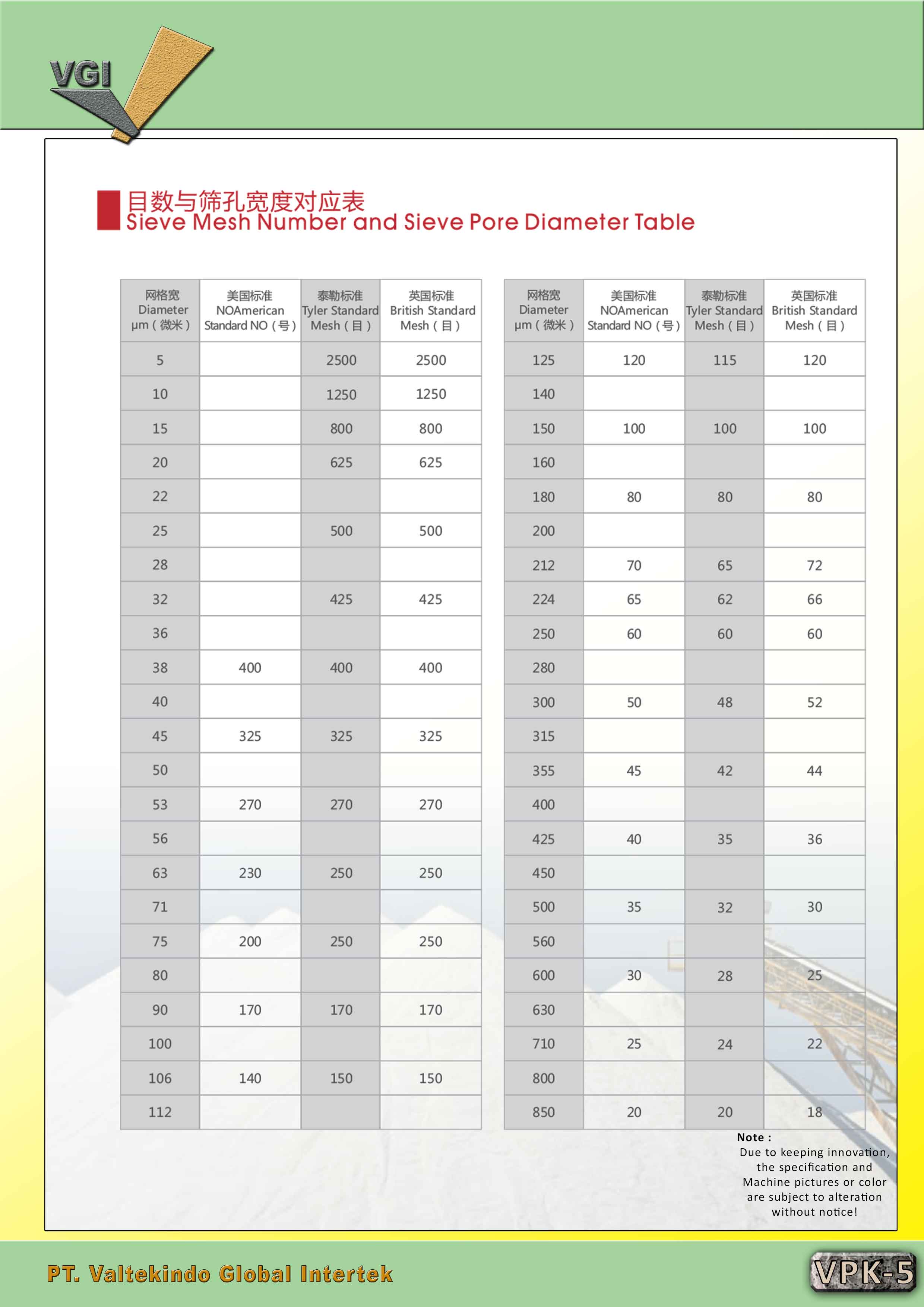 Click on the image to enlarge
FEATURE
DESCRIPTION / TECHNICAL SPECIFICATIONS
Industrial material classification success relies heavily on a precise understanding of sieve pore sizes. Selecting the appropriate sieve mesh is not just a routine task but the key to achieving international quality standards. A comprehensive sieve mesh table provides an accurate correlation between the number of openings per linear inch and the pore diameter in micrometers, ensuring every produced particle meets stringent technical specifications. With references to American, Tyler, and British standards, you can guarantee production consistency across various global markets.
Modern screening technology has now integrated these precise mesh tables with high-performance vibrating screens. Efficient operation involves electric motors driving eccentric weights to produce stable vibration on the screen decks, allowing materials to flow and separate systematically based on their size. For high-viscosity materials or mineral pulp, utilizing high-frequency screens with small amplitudes is crucial. This high frequency effectively breaks the pulp's surface tension, accelerating the separation of high-density minerals and ensuring fine materials pass through the sieve pores without obstruction.
Furthermore, operational efficiency can be massively boosted through the integration of fine sand recovery systems. This technology can reclaim valuable particles from wash wastewater via hydrocyclone processes and dehydration on linear vibrating screens, achieving weight concentration levels of 70 to 80 percent. For long-term protection, modular designs featuring self-aligning damping ensure the machine remains balanced during operation, protecting the structure from excessive vibration and minimizing production downtime. This is a total solution that converts waste into added value while maintaining sorting accuracy at the highest level.
 Download
 Video
Video
 Kontak Sales 1