Want to Start an Industrial-Scale Noodle Business? This is the Machine You Must Have
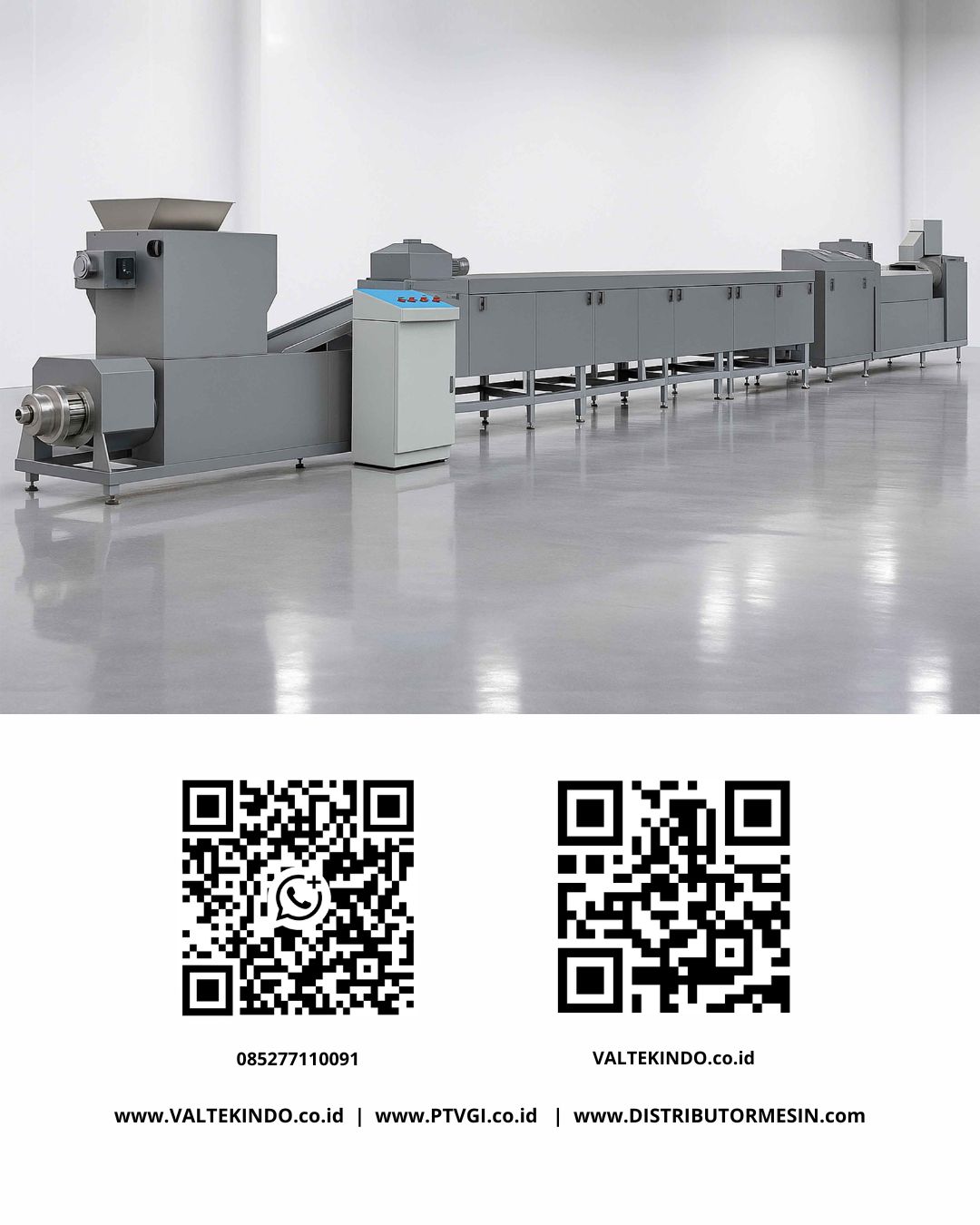
The demand for noodles in Indonesia never dies. From Sabang to Merauke, noodles have become a secondary staple food after rice, deeply ingrained in our culinary culture. From cart-based chicken noodle vendors, coffee shops serving instant noodles, to premium noodle restaurants, the market seemingly never gets saturated. Many entrepreneurs start this business on a home scale or as an MSME (Micro, Small, and Medium Enterprise), relying on inherited recipes and manual labor.
However, every successful business owner will eventually arrive at a crucial crossroads: how to "level up"?
How do you go from producing dozens of packs a day to thousands? How do you penetrate the modern retail market, supply large distributors, or even meet export standards? The answer lies in one word: industrialization.
Many think that shifting to an industrial scale is just a matter of adding more employees or increasing the number of boiling pots. This is a fundamental mistake. An industrial scale demands four non-negotiable things: Speed, Consistency, Hygiene, and Efficiency.
When you're still producing 50 portions a day, customers might tolerate it if today's noodle texture is slightly different from yesterday's. However, when you're supplying 5,000 packs to a supermarket, a one-gram difference in salt can ruin your brand's reputation. This is where the biggest challenge lies: manual production can never guarantee standardization.
The Trap of Mid-Scale Production: Bottlenecks Everywhere
Let's break down the problems that a growing noodle business inevitably faces:
- Quality Inconsistency: Human hands are not precise. The way the dough is kneaded, the thickness of the dough when rolled, and the length of boiling or frying time will always vary. The result? Noodles that are sometimes too hard, sometimes too soft. On an industrial scale, inconsistency is the primary enemy.
- Hygiene and Standards (BPOM) Issues: The more hands that touch the product, the higher the risk of contamination. To obtain distribution permits from BPOM (Indonesian FDA) or Halal certification, the production process must have minimal human contact, use food-grade materials, and be easy to clean.
- Limited Production Speed: You just landed a large Purchase Order (PO) from a national supermarket chain requesting 20,000 packs of noodles within a week. How many employees do you need to manually make, fry, and pack that many noodles? Production speed is the bottleneck limiting your revenue.
- Swelling Labor Costs: Paying 30 employees for repetitive processes (rolling, cutting, frying) is not only expensive but also inefficient. Your operational costs will explode, your profit margins will erode, and you'll be burdened with managing employee turnover.
If you are facing any of these problems, it's a sign that you must switch from human labor to machine power. Not just a regular cutter or roller, but an integrated system.
The Mandatory Solution: Automatic Noodle Processing Line
To win the competition on an industrial scale, you need a "factory" in one unified machine. This is called an Automatic Instant Noodle Processing Line. It's not a single machine, but an automated workflow that handles the entire process from raw materials to finished products.
An instant noodle production line—whether fried or steamed—has a precise workflow that must be followed. Let's break down each stage and why automation at every point is so critical:
- Stage 1: Dough Maker This process isn't just about mixing flour, water, and salt. On an industrial scale, it's about precise hydration. An automatic mixer ensures every flour particle is hydrated evenly, activating the gluten perfectly. Benefit: Consistent and chewy noodle texture in every batch.
- Stage 2: Shape Former (Pressing and Rolling) The well-kneaded dough enters an automatic press and roller machine. This machine gradually rolls the dough, folds it (laminating process), and thins it to the desired thickness—adjustable down to a fraction of a millimeter. Benefit: The resulting noodles are smooth, strong, not easily broken, and have a mature gluten structure.
- Stage 3: Boiling/Steaming Machine The raw noodle strands travel on a conveyor belt into a steamer tunnel or boiler. The temperature and duration are precisely controlled. Benefit: This process is called starch gelatinization. It's the key to cooking the noodles perfectly and evenly, ensuring the noodles will "easily rehydrate and cook" when the consumer prepares them.
- Stage 4: Cutting Machine Once cooked, the noodles are automatically cut to the desired length and (for instant noodles) folded into the familiar square blocks. Benefit: Portion standardization. Each noodle block has an identical weight and size, which is crucial for standardizing the net weight on the packaging.
- Stage 5: Fryer (or Dryer) This is the crucial step to make the noodles "instant" and shelf-stable. The noodles enter a continuous industrial fryer with a stably maintained oil temperature. This process drastically reduces the moisture content. Benefit: This very low moisture content (<5%) is what gives instant noodles a shelf life of months without preservatives.
- Stage 6: Cooler Noodles coming out of the fryer are extremely hot. They must not be packaged hot as this will create water vapor inside the packaging (condensation), which can lead to mold. A cooling machine will blow clean air to rapidly lower the noodle temperature before they enter the packaging machine.
The Right Machine for Your Business: XBF-Series from Valtekindo
Looking at the six stages above, it's clear this is a technology-intensive process. Buying the wrong or non-integrated machines will just waste your investment. This is where the Automatic Instant Noodle Processing Line (XBF-Series) from Valtekindo comes in as your "mandatory" solution.
This machine is specifically designed as a bridge for entrepreneurs who want to level up. Based on its specifications, the XBF-Series production line is a new-generation technology with a compact structure, original design, and stable performance.
Why is this production line a must-consider for you?
- Highly Efficient Investment: Valtekindo states that the investment in this line is only 10% of the cost of a large-scale processing line. This is the perfect solution for small-sized or self-owned enterprises looking to move to an industrial scale without risking a massive investment.
- Industrial Production Capacity: Don't be fooled by its compact size. The XBF-III model (Steam/Electrical) has a throughput (production capacity) of up to 11,000 pcs per 8 hours. That's over 1,300 packs of noodles per hour! This capacity is more than enough to fulfill POs from large distributors.
- Guaranteed Product Quality: This production line is designed to produce corrugated instant noodles that have a "strength, smooth and transparent" texture. This quality is essential so the noodles are easy to be saturated by water (rehydrate) when prepared by the end consumer.
- Full Support (Not Just Selling a Machine): This is a crucial point. Valtekindo doesn't just sell you a machine and leave. They provide complete after-sales service: sending technicians for installation and training your local workers until the product is satisfactory.
- Basic Formula Included: As an outstanding added value, Valtekindo even provides the basic formula and flavorings. This is extremely helpful if you are still in the R&D (Research & Development) phase of finding the perfect taste.
Conclusion: Stop Being a Laborer, Start Being an Industrialist
Making the leap from an MSME to an industrial scale is challenging, but not impossible. The key is to stop relying on manual labor for core production processes and switch to an automated system that guarantees speed, hygiene, and consistency.
The Automatic Instant Noodle Processing Line XBF-Series is a smart investment designed specifically for entrepreneurs like you. It is the "mandatory" machine that frees you from the complexities of daily production, allowing you to focus on more strategic things: building your brand, expanding your distribution network, and creating new flavor variants.
Optimize Your Industry Today!
Achieve production efficiency and the highest quality standards with a trusted industrial machinery provider. Explore our wide selection of premium processing and testing equipment at:
Website : valtekindo.co.id
Wesbite : distributormesin.com
Consult your technical needs with our expert sales team:
WhatsApp 1: +62 852-2211-0091
WhatsApp 2: +62 852-7711-0091

Admin
AuthorAdmin is a writer on the Valtekindo website, providing informative content about High Quality Industrial Machinery and Testing Machines.
Related post:
- Pharmaceutical Factory Production Escalation Strategy: Why Investing in an Automatic Capsule Filling Machine is the Most Crucial Business Decision
- High-Precision Wire Cut EDM Technology in 2026: The Ultimate Solution for Mold Making, Stamping Dies, and Automotive Component Fabrication Without Thermal Distortion
- 2026 Automated Carton Sealer & Erector Investment Guide: End-of-Line Automation Strategies for Industrial Plant Efficiency