Understanding the Function of Every Cement and Concrete Testing Equipment: Ensuring World-Class Infrastructure Quality
The quality and durability of modern structural buildings—from magnificent bridges and towering skyscrapers to expressways—heavily rely on their primary materials: cement and concrete. Without thorough and precise testing, the risk of structural failure increases sharply, threatening public safety and project investment.
In the construction world, a materials laboratory serves as the frontline to ensure that every mix of cement and concrete meets the required strength and durability standards. The technological revolution has brought testing equipment into the digital and computerized era, promising unparalleled accuracy and significantly higher operational efficiency.
This article will thoroughly examine the fundamental functions of every cement and concrete testing tool, focusing on the sophisticated digital and computerized systems that have become the industry standard. We will refer to the specifications of modern equipment from Valtekindo, which guarantee military-grade precision, as featured in their digital computerized cement and concrete lab equipment package digital computerized cement and concrete lab equipment.
The Heart of the Laboratory: Digital Compressive Strength Tester
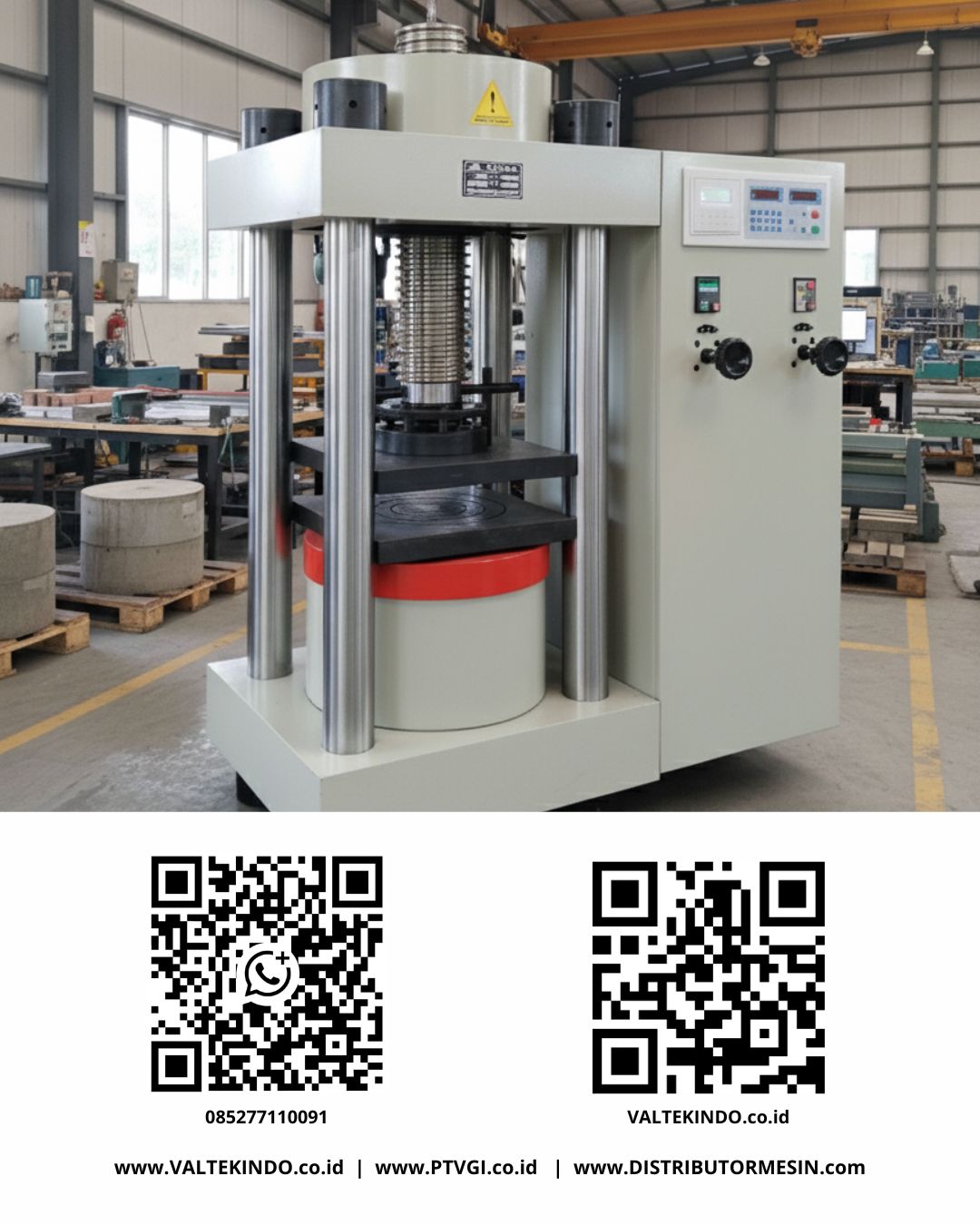
If concrete is the backbone of construction, then compressive strength testing is the primary determinant of its health. This is why the Universal Testing Machine (WAW/WEW) is the most vital device in the laboratory.
Primary Function:
The Compressive Testing Machine is used to determine the maximum compressive strength of concrete specimens (cubes or cylinders) or cement specimens. This test result is the main benchmark for whether the concrete used in the project has achieved its specified quality (e.g., K-300, fc' 30 MPa, etc.).
Advantages of Computerized Digital Systems:
The latest generation of equipment, such as the WAW/WEW series with capacities up to 3000kN, is equipped with Computer Control and a Digital Display. These advantages include:
- Absolute Accuracy: With an accuracy reaching ±1% and reading resolution up to 0.01kN, this machine eliminates the uncertainty commonly associated with manual readings.
- Total Automation: The loading process and rate can be automatically set and controlled by the computer system. This ensures the loading rate complies with SNI or ASTM standards, which is crucial for valid results.
- Data Logging: Testing data—including stress-strain curves, maximum load, and time—is recorded and stored directly on the computer, facilitating reporting and analysis.
- Multi-Functionality: Beyond concrete, this machine can also test the compressive strength of other materials like bricks, blocks, cement, and even perform flexural and tensile tests on metal or asphalt materials (depending on the fixture).
The presence of a computerized Compressive Testing Machine ensures that concrete quality decisions are based on validated and high-precision data.
Key Tools for Cement Characteristic Testing
Cement is the magical binder in concrete. Concrete quality will be compromised if the cement itself is flawed. Below are some essential tools for testing cement characteristics:
1. Impact Tester XJS-50 (50J)
- Function: This device is used to test the resistance and strength of materials, often cement or mortar specimens, against impact or shock. With a 50 Joule impact energy capacity, this tool simulates the material's durability against dynamic loads.
2. Blaine Apparatus (Permeability Test Tool)
- Function: Determines the fineness of cement. The fineness of cement is measured by its Specific Surface Area. Fineness significantly affects the rate of cement hydration: the finer the cement, the faster it reacts with water, and the faster it achieves its early strength.
3. Steam Tank (31L)
- Function: This tool is a Rapid Curing Tank. In urgent projects, concrete compressive test results must be obtained quickly. The Steam Tank accelerates the cement/concrete maturation process by curing in a controlled steam and temperature environment. A process that ideally takes 28 days can have its quality predicted in a matter of hours, while maintaining the proper data correlation.
Practical Equipment for Fresh Concrete Quality in the Field
Testing is not only done after the concrete hardens. The quality and ease of pouring fresh concrete at the project site (workability) are crucial factors tested with the following practical tools:
1. Slump Test Apparatus
- Function: This device is the industry standard for measuring the workability or consistency of fresh concrete. The slump value (subsidence) indicates how easily the concrete can be compacted without segregation. If the slump value is too low, the concrete is difficult to pour; if too high, the concrete may be too fluid, and its components might separate.
2. Concrete Resilometer (Rebound Hammer / Schmidt Hammer)
- Function: A Non-Destructive Test (NDT) tool. The Resilometer is used to estimate surface hardness and predict the compressive strength of concrete in situ (on site) without damaging the structure. This hammer fires a spring onto the concrete surface, and the rebound number is measured to be converted into an estimated compressive strength.
3. Air Entrainment Meter (0-10%)
- Function: Measures the content of trapped air (air entrainment) in the fresh concrete mix. Intentional air (using an air-entraining agent) is essential to increase the concrete's resistance to the freeze-thaw cycle, especially in cold climates. This tool ensures the air content is within the ideal 0-10% limits.
Why Choose Digital and Computerized?
The use of Digital Computerized Cement and Concrete Lab Equipment is no longer a luxury, but a necessity. Accuracy is the currency in the construction world, and digital systems guarantee it. This equipment offers:
- Military Precision: Testing accuracy for temperature up to ±1°C and load up to 0.01kN eliminates all margins for manual error.
- Data Efficiency: All test results are directly integrated into the computer database, reducing the time spent on manual recording and the risk of transcription errors.
- All-in-One Solution: With Multi-Function capabilities to test cement, concrete, bricks, metal, and asphalt, investing in one set of digital lab equipment provides a much higher economic value.
- Durability: Industrial materials like Corrosion-Resistant Stainless Steel ensure a long service life for the tools, even in harsh lab environments.
Understanding the specific function of each tool and integrating them into an automated digital lab system is the key to producing reliable, safe, and internationally compliant construction materials. Investing in digital computerized cement and concrete lab equipment is an investment in the future of quality infrastructure.
Optimize Your Industry Today!
Achieve production efficiency and the highest quality standards with a trusted industrial machinery provider. Explore our wide selection of premium processing and testing equipment at:
Website : valtekindo.co.id
Wesbite : distributormesin.com
Consult your technical needs with our expert sales team:
WhatsApp 1: +62 852-2211-0091
WhatsApp 2: +62 852-7711-0091

Admin
AuthorAdmin is a writer on the Valtekindo website, providing informative content about High Quality Industrial Machinery and Testing Machines.
Related post:
- Pharmaceutical Factory Production Escalation Strategy: Why Investing in an Automatic Capsule Filling Machine is the Most Crucial Business Decision
- High-Precision Wire Cut EDM Technology in 2026: The Ultimate Solution for Mold Making, Stamping Dies, and Automotive Component Fabrication Without Thermal Distortion
- 2026 Automated Carton Sealer & Erector Investment Guide: End-of-Line Automation Strategies for Industrial Plant Efficiency