Understanding the Differences Between Horizontal and Vertical Bandsaws in the Manufacturing Industry
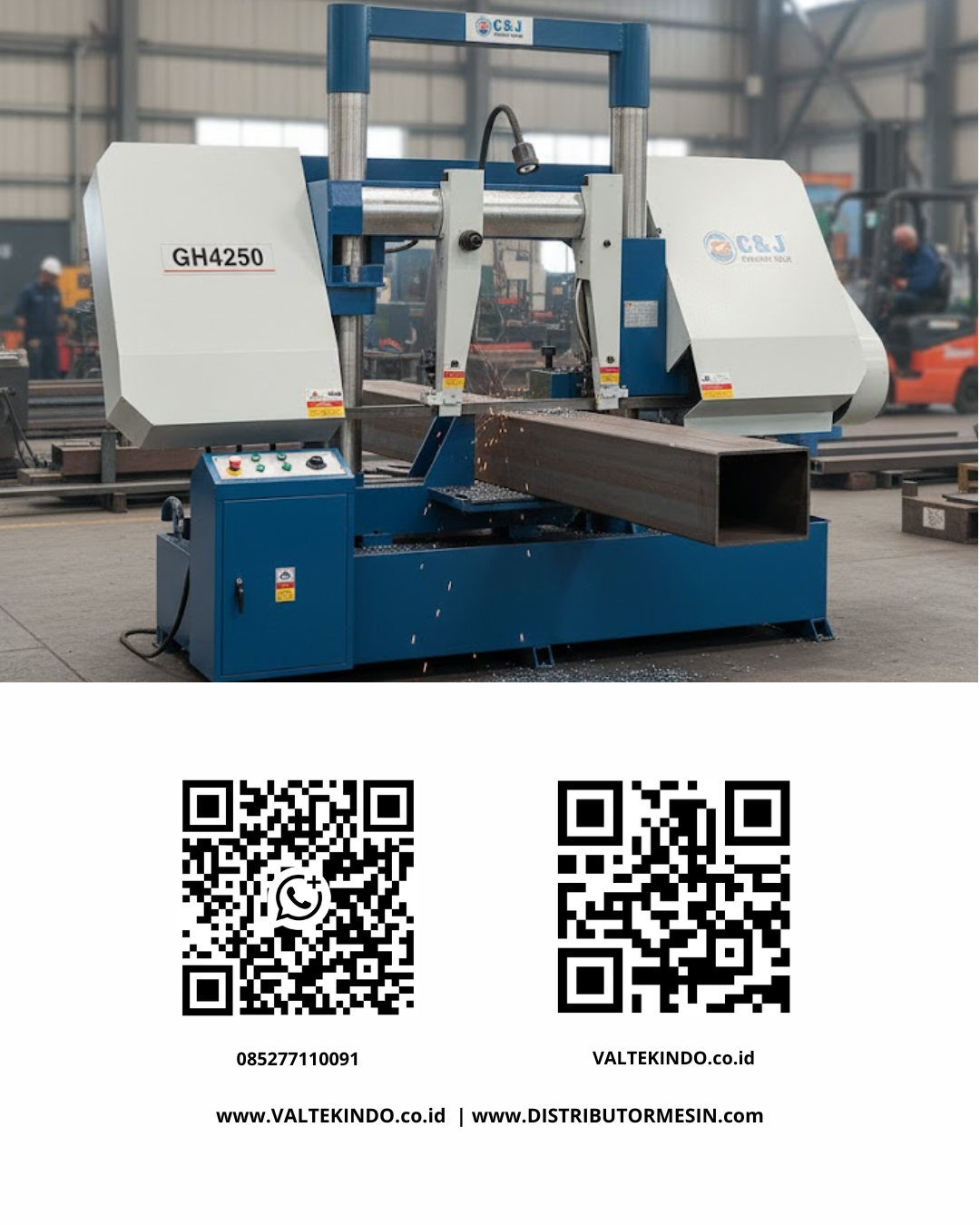
In a manufacturing ecosystem that demands high precision and efficiency, choosing the right cutting machine is the cornerstone of production success. Two devices that frequently spark functional debate are the Horizontal Bandsaw and the Vertical Bandsaw. Although both utilize a continuous saw blade loop, their operational mechanics and applications are polar opposites.
Operating Mechanisms and Key Characteristics
The most fundamental difference lies in the blade orientation and the movement of the material during the cutting process.
1. Horizontal Bandsaw: The Heavy-Duty Specialist
In a horizontal model, the saw blade is mounted on an arm that moves downward toward the material. The workpiece is typically held stationary using a heavy-duty vice. This machine is designed to handle massive and long materials such as steel pipes, bar stock, or structural profiles. Its ability to perform extremely accurate straight cuts on large volumes makes it an industrial favorite. For large-scale needs, implementing a horizontal bandsaw double column is often the preferred choice due to its superior stability.
2. Vertical Bandsaw: Flexibility and Detail
Unlike its counterpart, a vertical bandsaw features a blade that remains in a fixed upright position while the operator manually feeds the material. This provides full control to create curves, intricate angles, or contour cuts. It is regarded as a "multitool" because of its capability to perform ripping tasks and detailed contouring that would be impossible for a horizontal machine.
Efficiency and Safety Factors
In terms of production efficiency, horizontal bandsaws are much easier to automate for bulk cutting, making them ideal for preparing raw materials before they reach CNC machines. On the other hand, vertical bandsaws excel in manual modifications and cleaning up casting flashes.
Accuracy in metal cutting relies heavily on blade stability. In a horizontal design, gravity and hydraulic pressure help maintain consistent cutting force, minimizing blade deflection when penetrating thick metal. From a safety perspective, horizontal machines are generally safer for beginners because the material is securely clamped. Vertical machines require higher skill and concentration, as the operator's hands work in close proximity to the high-speed blade.
It is vital to ensure that every unit is sourced from a trusted industrial machinery distributor that guarantees spare part availability. High-quality machinery reduces the frequency of blade breakage caused by unstable vibrations.
Optimize Your Industry Today!
Achieve production efficiency and the highest quality standards with a trusted industrial machinery provider. Explore our wide selection of premium processing and testing equipment at:
Website : valtekindo.co.id
Website : distributormesin.com
Consult your technical needs with our expert sales team:
WhatsApp 1: +62 852-2211-0091
WhatsApp 2: +62 852-7711-0091

Admin
AuthorAdmin is a writer on the Valtekindo website, providing informative content about High Quality Industrial Machinery and Testing Machines.
Related post:
- Pharmaceutical Factory Production Escalation Strategy: Why Investing in an Automatic Capsule Filling Machine is the Most Crucial Business Decision
- High-Precision Wire Cut EDM Technology in 2026: The Ultimate Solution for Mold Making, Stamping Dies, and Automotive Component Fabrication Without Thermal Distortion
- 2026 Automated Carton Sealer & Erector Investment Guide: End-of-Line Automation Strategies for Industrial Plant Efficiency