Optimizing Polymer Recycling Lines in 2026: Why Double-Stage Plastic Extrusion Machines with European Compactor Technology Are the New Standard for PE/PP Pelletizing Plants
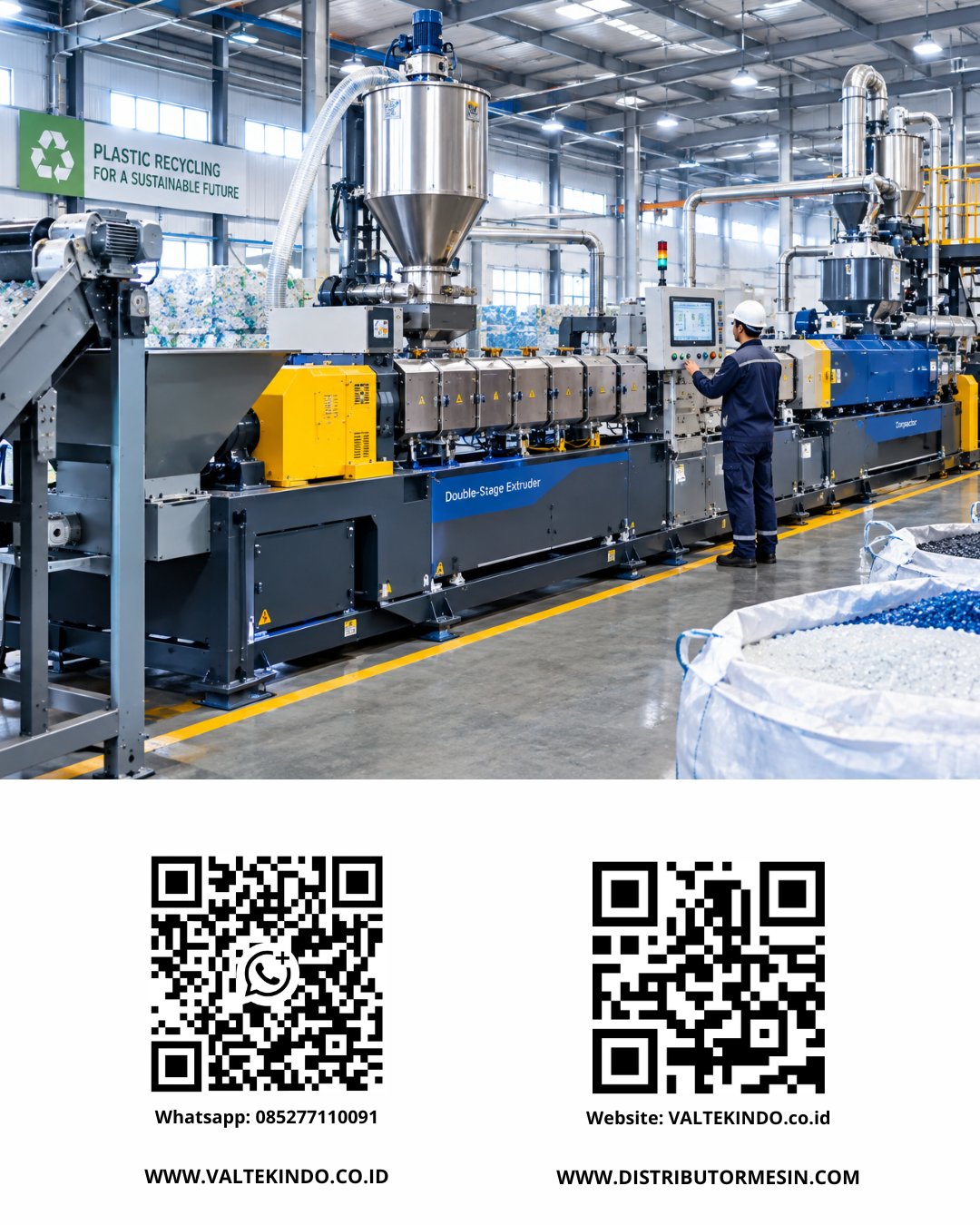
Margin Pressures and Energy Efficiency Challenges in Indonesia’s Plastic Extrusion Sector
Entering the fourth quarter of 2026, Indonesia’s plastic processing and recycling landscape is undergoing a profound structural shift. Rising industrial electricity tariffs, stringent quality benchmarks for Post-Consumer Recycled (PCR) and Post-Industrial Recycled (PIR) resins, and the relentless demand for consistent feedstock from injection molding and blown film manufacturers are forcing plant owners to re-evaluate their machinery assets. For factory directors, industrial investors, and chief engineers, operating legacy single-screw plastic extrusion machines without thermal pre-conditioning is no longer merely a capacity bottleneck—it represents a severe operational expenditure (OPEX) leak that erodes profit margins every operating hour.
The core engineering challenge when processing low bulk density plastic materials—such as shredded HDPE shopping bags, LDPE/LLDPE flexible packaging film, raffia, or PP woven sacks—is feeding instability. In conventional extrusion setups, lightweight, fluffy film flakes frequently cause bridging inside the feed hopper throat, leaving the extruder screw running partially starved. The impact on the production balance sheet is severe: hourly throughput drops by up to 35%, specific energy consumption (kWh/kg) spikes, and unmitigated mechanical friction triggers thermal degradation that breaks down polymer molecular chains.
Inside the 3-in-1 Plastic Extrusion Machine Architecture: European Cutter-Compactor Integration
To eliminate feeding bottlenecks and stabilize melt pressure, modern plastic extrusion engineering has converged on the European-standard integrated Cutter-Compactor system. Unlike standalone agglomerators that require extra floor space, secondary operators, and wasted thermal energy, an integrated compactor mounts directly onto the main extruder barrel in a vertical or tangential configuration.
Inside the compactor drum, high-speed rotary rotor knives and stationary stator knives cut, mix, and densify PE/PP film flakes through controlled centrifugal force and mechanical friction. This friction generates precise thermal energy that raises the material temperature just below its softening point without causing premature melting. This pre-conditioning stage delivers three immediate operational advantages for plastic pelletizing plants:
- Pre-Extrusion Moisture Evaporation: Residual moisture from the washing line (up to 5–8% water content) is rapidly flashed off through the compactor’s dedicated exhaust system before the polymer ever enters the extruder screw.
- Instant Bulk Density Multiplication: The apparent bulk density of lightweight film flakes increases threefold, guaranteeing that the extruder screw’s feeding zone remains 100% crammed and pressurized at all times.
- Reduced Heater and Motor Load: Because the polymer enters the extruder barrel pre-heated (at approximately 80°C–100°C), the electrical load on ceramic band heaters and the main drive motor torque drops by 20% to 25%.
When designing high-capacity production lines engineered for continuous 24/7 industrial operation, selecting the right technology partner is the single most critical factor for investment security. As a premier industrial machinery distributor in Indonesia, PT Valtekindo Global Intertek consistently supports polymer processing plants nationwide in transitioning from outdated equipment to high-efficiency, automated extrusion lines tailored to local industrial demands.
The Superiority of Double-Stage (Mother-Baby Extruder) Systems for High-Contamination Feedstock
When a recycling facility processes post-consumer plastic waste carrying high moisture levels, heavy surface printing (full-ink film), or micro-contaminants such as soil, paper fibers, and aluminum residues, a single-stage extruder frequently fails to produce dense, void-free pellets. This is precisely where the double-stage plastic extrusion machine (mother-baby extruder configuration) delivers unmatched value.
A double-stage system decouples the plasticizing and secondary filtration workloads across two serially connected extruders:
- First-Stage Extruder (Mother Extruder): Engineered with an extended Length-to-Diameter (L/D) ratio (typically 32:1 to 36:1) to ensure homogeneous melting. It features a high-efficiency double vacuum degassing zone that extracts trapped steam and volatile gases generated by decomposing printing inks. Immediately following degassing, the polymer melt passes through the primary hydraulic screen changer to trap coarse contaminants.
- Second-Stage Extruder (Baby Extruder): Receives the degassed, pre-filtered polymer melt and re-stabilizes both melt pressure and thermal uniformity before pushing the material through an ultra-fine secondary filtration unit (up to 80–120 mesh).
For investors and plant managers targeting near-virgin recycled pellet quality completely free of gas bubbles and black spots, we strongly recommend reviewing the comprehensive technical specifications of the European compactor technology double PE PP plastic pellet making machine with unmatched extrusion performance. This advanced architecture empowers recycling plants to upcycle low-cost, heavily printed raw waste into high-margin, industrial-grade plastic pellets.
Critical Engineering Components That Dictate Machine Lifespan and Pellet Quality
Before issuing a Purchase Order (PO) for an industrial plastic extrusion machine, a factory’s engineering and procurement committee must audit four essential metallurgical and automation parameters:
1. Screw and Barrel Metallurgy (Bimetallic vs. Nitrided Steel)
Recycled PE/PP feedstock frequently contains abrasive mineral fillers such as silica or calcium carbonate (CaCO3). Standard gas-nitrided steel (38CrMoAlA) barrels typically wear down within 12 to 18 months, widening the flight clearance and causing severe output loss. Heavy-duty industrial applications require bimetallic alloy linings (tungsten carbide and nickel-cobalt matrix) across the compression and metering zones, extending wear resistance to 3–5 years under abrasive conditions.
2. Non-Stop Hydraulic Screen Changer (Dual-Piston / Backflush)
Unscheduled downtime during mesh screen replacements destroys shift productivity. A dual-piston or dual-plate non-stop hydraulic screen changer enables operators to replace clogged filter screens in seconds on one channel while polymer melt continues flowing seamlessly through the active secondary channel without halting the extruder.
3. Die-Face Water-Ring Pelletizing System
For polyolefin materials (PE and PP) with fluctuating Melt Flow Index (MFI) values, a die-face water-ring pelletizer drastically outperforms conventional strand pelletizing lines. Inverter-controlled rotary blades slice the molten polymer directly against the die face under automated pneumatic pressure. The hot pellets are immediately quenched in a circulating water ring and conveyed to a vertical centrifugal dryer, producing uniform, lenticular pellets with zero risk of strand breakage.
4. Smart PLC Integration and Automated Load Balancing
Modern extrusion lines utilize touchscreen Programmable Logic Controller (PLC) cabinets that synchronize belt feeder speed, compactor RPM, and main extruder motor amperage. If main extruder current surges due to dense feedstock, the PLC automatically throttles back the conveyor feeder and injects a calibrated mist of cooling water into the compactor drum to maintain optimal agglomeration temperatures.
B2B Return on Investment (ROI) Projection for Medium-to-Large Plants
From a capital expenditure (CAPEX) standpoint, deploying a European-compactor double-stage plastic extrusion machine yields a significantly faster payback period than purchasing low-cost, legacy machinery:
- Higher Net Throughput: Delivering stable outputs ranging from 500 kg/hr to 1,000 kg/hr (depending on screw diameter), a single line generates 300 to 600 metric tons of finished pellets per month (based on 25 working days, 20 effective hours/day).
- Minimal Reject Rates: Double vacuum degassing and two-stage filtration keep pellet reject rates (caused by foaming, moisture voids, or odor) below 1%.
- Labor Optimization: Fully automated conveying with integrated metal detection right through to the pneumatic storage silo requires only 2 operators per shift, slashing direct labor costs.
With healthy processing spreads between washed plastic flakes and Grade-A recycled pellets, Indonesian manufacturing facilities typically achieve full machine Break-Even Point (BEP) within 10 to 14 months of commissioning.
Technical Consultation, Plant Audits, and Request for Quotation (RFQ)
Is your manufacturing facility planning to expand its plastic recycling capacity, replace energy-draining legacy extruders, or conduct a feasibility study for a new PE/PP pelletizing plant in 2026? Protect your capital investment by selecting machinery engineered for long-term industrial reliability. Our senior engineering consultants are ready to assist you in calculating production throughput, electrical load requirements (kVA), plant floor layouts, and exact screw geometries tailored to your raw materials.
Contact Our Sales Team Today
Looking for high-quality industrial machinery, factory automation solutions, or customized equipment for your business? Our experienced sales team is ready to help you find the right solution, provide technical consultation, and offer the best pricing.
Contact Our Official WhatsApp Sales Team:
- WhatsApp Sales 1: 085222110091
- WhatsApp Sales 2: 085277110091
Visit our official websites to explore our complete product catalog, machine operation videos, technical information, and exclusive offers:
PT. Valtekindo Global Intertek is your trusted partner for industrial machinery, processing equipment, recycling systems, laboratory instruments, and factory automation solutions. Contact us today for a free consultation and receive the best solution tailored to your business needs.

Admin
AuthorAdmin is a writer on the Valtekindo website, providing informative content about High Quality Industrial Machinery and Testing Machines.
Related post:
- Pharmaceutical Factory Production Escalation Strategy: Why Investing in an Automatic Capsule Filling Machine is the Most Crucial Business Decision
- High-Precision Wire Cut EDM Technology in 2026: The Ultimate Solution for Mold Making, Stamping Dies, and Automotive Component Fabrication Without Thermal Distortion
- 2026 Automated Carton Sealer & Erector Investment Guide: End-of-Line Automation Strategies for Industrial Plant Efficiency