Operational Standards of Plastic Granulator Machines in Factory-Scale PVC and HDPE Waste Processing
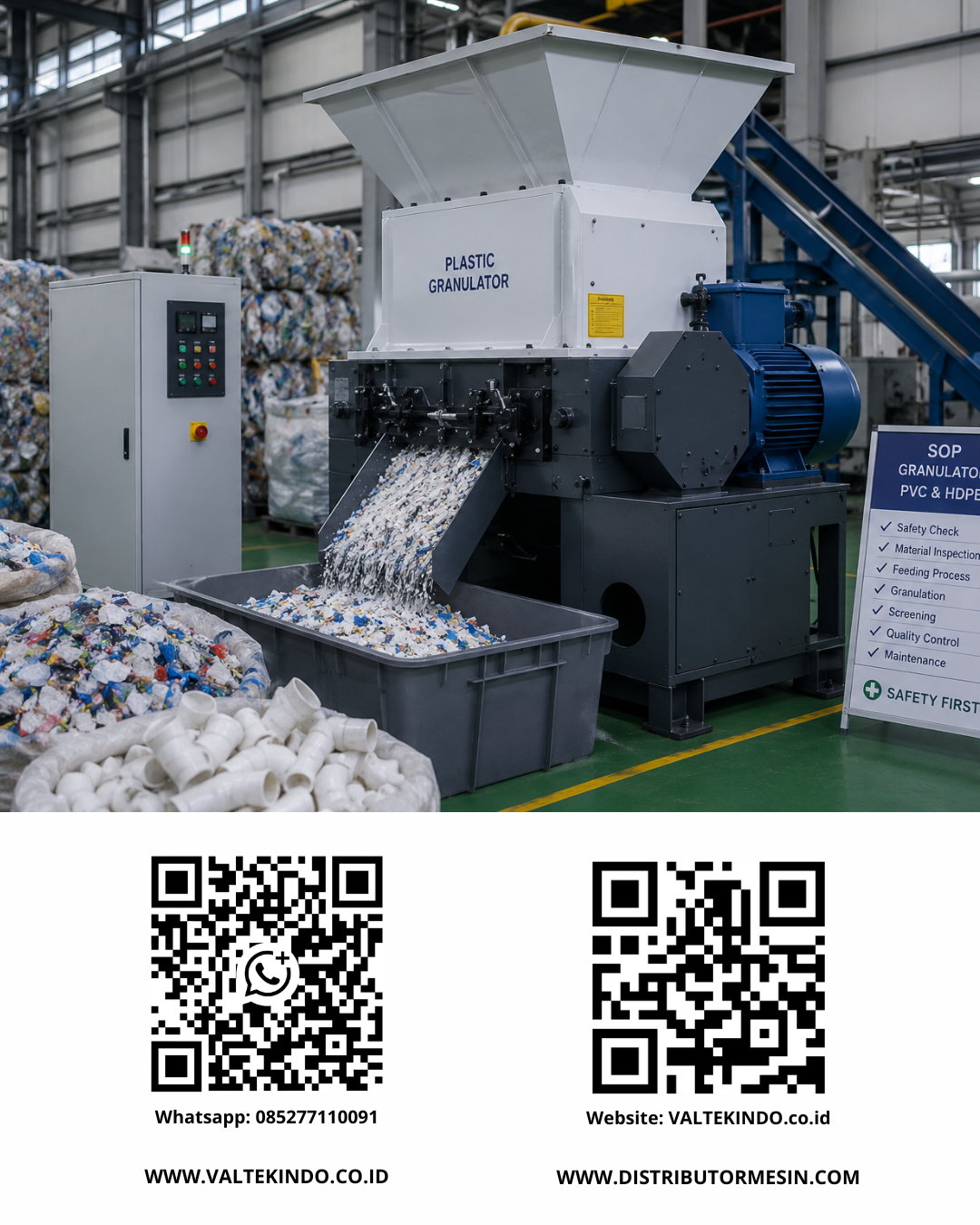
Introduction In the operational management of plastic manufacturing facilities, handling production scraps and rejects requires a highly efficient reprocessing system to suppress raw material costs. Industrial-capacity plastic granulator (crusher) machines serve as the backbone of this material reclamation process. Unlike small-scale shredders, granulators implemented for B2B requirements must adhere to strict tolerance standards to ensure the resulting regranulate particles have uniform (homogeneous) geometric sizes and are free from fine dust contamination. This technical article will discuss operational standards, cutting parameter optimization, and preventive maintenance procedures required to ensure machines operate at maximum Overall Equipment Effectiveness (OEE) reliability, particularly in processing rigid polymers.
Rotor Speed (RPM) Dynamics and Torque The most critical operational parameter in running an industrial granulator machine is the balance between rotor rotational speed (RPM) and the torque output from the drive motor. For rigid and thick materials like structural thermoplastic polymers, running the machine at excessively high RPM is actually counterproductive. Speeds that are too high will generate centrifugal forces that cause materials to bounce around inside the cutting chamber, significantly increasing noise levels (decibels), and generating a high percentage of plastic dust.
Conversely, technical standard approaches recommend a low-speed, high-torque operation that ensures a stable shredding process, more efficient power consumption per kilogram of throughput, and produces regranulate with clean-cut qualities. The transmission system calibration—whether direct drive or via a V-belt pulley system—must be periodically inspected using tachometers and vibration analyzers to prevent main shaft unbalance.
Optimizing Industrial HDPE and PVC Pipe Processing When production facilities deal with waste materials in the form of long profiles or large-diameter pipes (such as high-pressure HDPE or PVC pipes), standard hopper architectures are often inadequate and risk endangering operators (the flyback effect). Operational standards mandate the use of hoppers with horizontally elongated designs or automated infeed systems equipped with hydraulic pushers.
This design ensures material is pushed constantly toward the cutting rotor without suddenly overloading the motor. For infrastructure references that comply with mechanical standards for processing these long lengths, production facilities can adopt the specifications of this industrial plastic pipe granulator for PVC/HDPE. This system is engineered to accept entire pipe lengths, utilizing a heavy-duty rotor that eliminates the need for manual pre-cutting with saws, thereby drastically reducing man-hours and occupational hazard risks on the factory floor.
Preventive Maintenance and Blade Gap Precision A decline in regranulate quality is frequently caused by imprecise clearance gaps between the rotor and stator blades. To process thin films (like LDPE), this clearance gap might need to be set as tight as 0.1 mm, whereas to process rigid PVC pipes, the ideal gap falls within the range of 0.2 mm to 0.4 mm. Installing blades with the incorrect gap will cause the material to not be cut cleanly, but rather torn or crushed through compressive force. This not only shortens the blade's lifespan but also increases the thermal load on the motor. Technicians must utilize feeler gauges when executing blade reinstallation following the sharpening process.
Safety Standards and Industrial Partnerships Beyond mechanical reliability, operator safety factors (OHS) cannot be compromised. Industrial granulator machines must be equipped with interlock switches featuring dual magnetic or mechanical sensors, which prevent the rotor from turning if the hopper or screen chamber is open. In provisioning equipment with high operational compliance standards, companies require assurance from dedicated procurement entities. This is where PT Valtekindo Global Intertek acts as a strategic B2B partner, distributing industrial machinery that is not only structurally robust but also adheres to stringent operational safety guidelines for heavy industries.
Conclusion Implementing a granulator machine in a recycling or plastic manufacturing facility requires more than just basic operations. It demands a comprehensive understanding of mechanical torque, blade gap calibration, specialized architecture for large pipe handling, and interlock safety protocols. By adhering to operational standards and conducting strict preventive maintenance, companies can optimize throughput capacity while suppressing energy consumption and mechanical wear, turning the crusher machine into an asset that delivers maximum Return on Investment (ROI) in the long term.
Contact Our Sales Team Today
Looking for high-quality industrial machinery, factory automation solutions, or customized equipment for your business? Our experienced sales team is ready to help you find the right solution, provide technical consultation, and offer the best pricing.
Contact Our Official WhatsApp Sales Team:
- WhatsApp Sales 1: 085222110091
- WhatsApp Sales 2: 085277110091
Visit our official websites to explore our complete product catalog, machine operation videos, technical information, and exclusive offers:
PT. Valtekindo Global Intertek is your trusted partner for industrial machinery, processing equipment, recycling systems, laboratory instruments, and factory automation solutions. Contact us today for a free consultation and receive the best solution tailored to your business needs.

Admin
AuthorAdmin is a writer on the Valtekindo website, providing informative content about High Quality Industrial Machinery and Testing Machines.
Related post:
- Pharmaceutical Factory Production Escalation Strategy: Why Investing in an Automatic Capsule Filling Machine is the Most Crucial Business Decision
- High-Precision Wire Cut EDM Technology in 2026: The Ultimate Solution for Mold Making, Stamping Dies, and Automotive Component Fabrication Without Thermal Distortion
- 2026 Automated Carton Sealer & Erector Investment Guide: End-of-Line Automation Strategies for Industrial Plant Efficiency