Manufacturing Export-Quality Charcoal Briquettes: Production Process Stages and the Function of Each Machine
The global demand for clean and sustainable alternative energy sources has positioned charcoal briquettes, particularly those from coconut shells, as a prime export commodity. Markets in Europe, the Middle East (especially for shisha), and the Americas demand products with exceptionally high-quality standards. Producing briquettes can no longer be done using traditional methods if the goal is to penetrate the international market.
Producing export-quality briquettes is a process of industrial precision. It's not just about good raw materials; it's about consistency, efficiency, and the ability to meet strict technical parameters. Each production stage plays a crucial role, and every machine used serves to lock in a specific quality parameter.
This article will detail the stages of the charcoal briquette production process, from raw material to packaging, and explain the vital function of each machine in the production chain, referencing the specifications of industrial machinery available in the market.
Export Quality Parameters: What Are Buyers Really Looking For?
Before discussing the process, it's essential to understand what defines "export quality." International buyers are extremely strict about this. Failure to meet even one of the following parameters can result in the rejection of an entire container.
- Calorific Value: High, ideally above 7,000 kcal/kg. This determines how hot the briquette burns.
- Ash Content: Very low, ideally below 2.5%. The less ash, the cleaner the burn. Shisha briquettes even demand ash that is pure white.
- Moisture Content: Very low, ideally below 7% (some buyers even request below 5%). High moisture content makes briquettes difficult to ignite and causes smoke.
- Volatile Matter: Low, ideally below 15%. This determines the amount of smoke produced when the briquette is first lit.
- Hardness: The briquette must be dense and not break easily (must pass a drop test), indicating a perfect compaction process.
- Burning Time: Long-lasting, ideally over 2 hours for a shisha briquette (2.5cm cube) without stopping.
- Physical-Appearance: No cracks, a smooth surface, no strong odor, and does not emit sparks when burned.
Achieving all these parameters consistently is impossible without a standardized production line and reliable machinery.
Production Process Stages and the Function of Each Machine
Here are the 6 main stages in the production of export-quality charcoal briquettes and the machines involved in each step.
1. The Crushing Stage
Process: The primary raw material, coconut shell charcoal (or other hardwood charcoal), is still in coarse lump form from the pyrolysis process (burning without oxygen). The first stage is to crush these lumps into a fine powder.
Machine: Charcoal Crushing Machine (Diskmill or Hammer Mill)
- Vital Function: This machine is the initial determinant of the powder's fineness (mesh). Export quality demands a very high and uniform fineness. Why? Finer particles will produce briquettes with a smoother surface and much higher density. Coarse powder will create air pockets inside the briquette, making it fragile and causing it to burn out faster.
2. The Sieving Stage
Process: After being crushed, the resulting charcoal powder has varying particle sizes. This powder must be filtered to separate the coarse particles from those that are fine enough to meet the standard.
Machine: Sieving Machine (Rotary Sieve / Vibrating Screen)
- Vital Function: This machine acts as a quality control (QC) for powder fineness. The export standard typically uses a screen size of 80 to 100 mesh. Powder that does not pass the sieve will be returned to the crushing machine to be re-crushed. Without this precise sieving stage, briquette consistency will never be achieved. Some briquettes will be dense, while others will be brittle.
3. The Mixing Stage
Process: This is the "kitchen" stage where the briquette formula is created. The fine charcoal powder is mixed with a binder (usually food-grade tapioca starch) and water.
Machine: Mixer Machine (Paddle Mixer / Ribbon Mixer)
- Vital Function: The key to export quality is homogeneity. The mixer machine must be able to thoroughly mix the dough until every charcoal particle is evenly coated with the binder. If the mixing is not homogenous, several fatal problems will occur:
- The briquettes will crack during the drying process (due to uneven shrinkage).
- The briquettes will break easily (there are weak spots where the binder was not distributed).
- The calorific value will not be uniform within a single production batch.
4. The Forming / Extrusion Stage
Process: This is the heart of the entire production line. The well-mixed and consistent dough is fed into the machine to be compacted and formed into the shape demanded by the market (commonly cubes for shisha or hexagonal for BBQ).
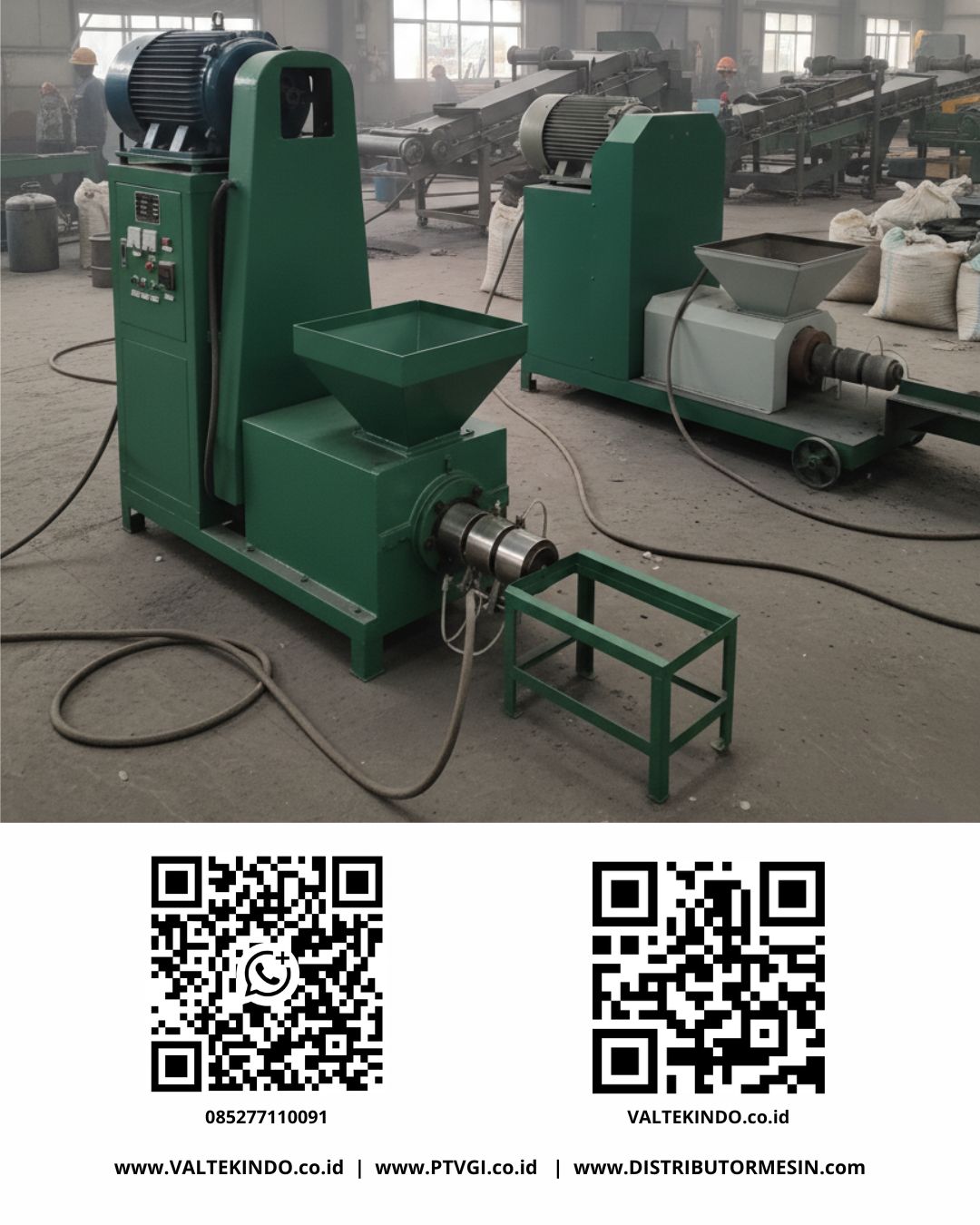
Machine: Main Charcoal Briquette Forming Machine (Extruder)
- Vital Function: This is where the density and burning time parameters are determined. This machine uses extremely high pressure (either a screw/extruder system or hydraulic) to "force" the dough into a very dense form.
- Referring to industrial machine specifications, such as the Main Charcoal Briquette Forming Machine, we can see the technical parameters being targeted. A good machine (like models WTPA-1 or WTPA-2) is designed to produce a raw briquette density of up to 1.4 g/cm3.
- This high density is directly proportional to the burning time. The denser the briquette, the less oxygen is trapped inside, and thus the longer it takes to burn completely. Low-quality forming machines will be unable to achieve this density, resulting in light briquettes that burn out quickly. This machine also determines the production capacity (e.g., 150-300 kg/h), which is crucial for business scale.
5. The Drying Stage
Process: Briquettes that have just come out of the forming machine ("wet" briquettes) have a moisture content of around 30-40%. This stage aims to reduce that moisture content to below 7% (to meet export standards).
Machine: Oven (Dryer) Machine
- Vital Function: For the export market, sun-drying is not an option. Sun-drying is inconsistent, takes days, is highly weather-dependent, and is prone to dust contamination.
- An industrial oven (using gas, electric, or biomass heating) with controlled hot air circulation (blowers) is required. An industrial oven ensures even drying from the briquette's outer surface to its core. Imperfect drying (where the core is still wet) is a disaster: the briquette will be smoky when burned, difficult to light, and worst of all, will grow mold inside the container during shipping.
6. The Cooling & Packing Stage
Process: Briquettes coming out of the oven are at a very high temperature. They must be cooled down to ambient temperature before being packaged.
Machine: (Usually a Cooling Conveyor / Cooling Tunnel and Packing Machine)
- Vital Function: Hot briquettes that are immediately sealed in plastic will cause condensation. This water vapor will be reabsorbed by the briquettes, causing their moisture content to rise again and triggering mold growth. Briquettes must be completely cooled before being placed in the inner plastic and master box (cardboard box). The packaging must also be airtight to protect the briquettes from humidity during storage and shipping.
Conclusion: Investing in Machinery is Investing in Quality
The export market for charcoal briquettes is highly lucrative, but it has zero tolerance for low-quality products. Every stage, from crushing to packaging, is an interlocking link in a chain to create a final product that meets the standards for high calories, low ash, low moisture, and long burning time.
Investing in the right line of machinery—from the crusher, sieve, mixer, high-density forming machine, to the industrial oven—is not a cost. It is an absolute requirement to be able to compete on the global stage.
Ready to build your export-quality charcoal briquette production line? Don't choose the wrong technology. Consult your machinery needs with experts who understand the technical specifications for the global market.
Contact us for consultations, machine specifications, and the best price quotes via WhatsApp at 085222110091 or 085277110091today!

Admin
AuthorAdmin is a writer on the Valtekindo website, providing informative content about High Quality Industrial Machinery and Testing Machines.
Related post:
- Pharmaceutical Factory Production Escalation Strategy: Why Investing in an Automatic Capsule Filling Machine is the Most Crucial Business Decision
- High-Precision Wire Cut EDM Technology in 2026: The Ultimate Solution for Mold Making, Stamping Dies, and Automotive Component Fabrication Without Thermal Distortion
- 2026 Automated Carton Sealer & Erector Investment Guide: End-of-Line Automation Strategies for Industrial Plant Efficiency