Industrial Flat Die Pellet Machine for Sale High-ROI Solution for Biomass & Animal Feed Production Efficiency
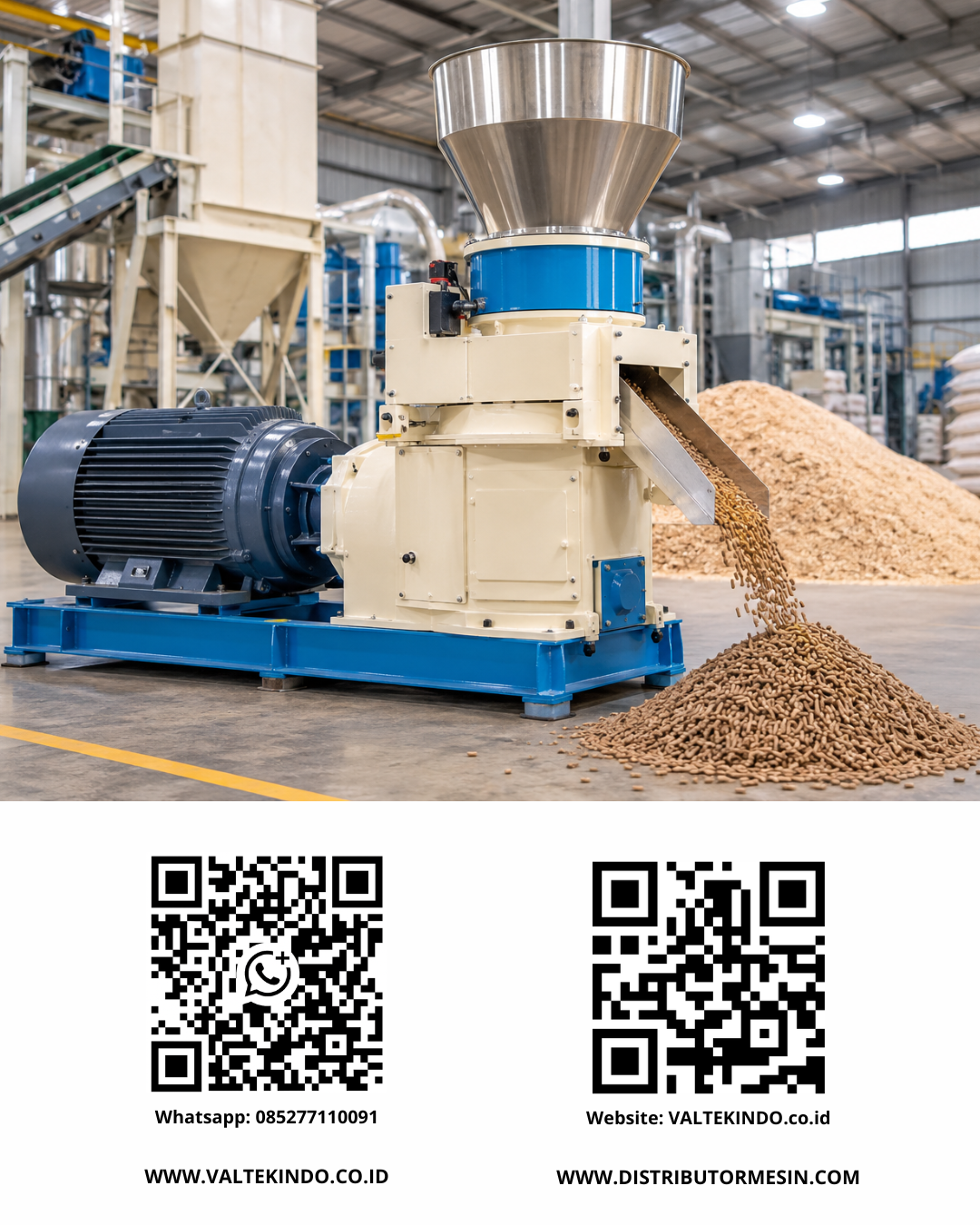
The accelerating transition toward renewable energy and the rising demand for self-sufficient animal feed production in Indonesia have prompted manufacturing plants, timber processing facilities, and agribusiness investors to adopt advanced material densification technologies. Wood sawdust, rice husks, empty fruit bunches (EFB) from palm oil mills, and custom livestock feed formulations are no longer viewed as costly disposal liabilities, but rather as high-value export commodities and viable fossil fuel substitutes. The primary key to converting bulky raw materials into dense, high-value cylindrical pellets lies in selecting a pelletizing machine engineered for precision, mechanical durability, and energy efficiency.
In medium- to large-scale industrial operations, the Flat Die Pellet Machine stands out as an essential piece of capital equipment due to its mechanical stability, straightforward maintenance, and versatility in processing both high-fiber biomass and lipid-rich feed ingredients. Unlike ring die systems that typically demand substantial initial capital expenditure and complex calibration tailored to a single narrow material profile, the flat die architecture offers a superior operational cost-to-output ratio for facilities producing wood pellets, agro-waste fuel pellets, or commercial animal feed continuously.
Understanding the Working Mechanism and Engineering Advantages
Technically, a Flat Die Pellet Machine operates on a vertical mechanical compression principle driven by the interaction between rotating pressure rollers and a precision-drilled stationary or rotating flat die plate. Raw materials—previously pulverized via a hammer mill and conditioned to an optimal moisture content (typically between 12% and 15% for biomass)—are fed into the compression chamber via an overhead hopper. Gravity assists in distributing the material evenly across the entire die surface, while the heavy-duty rollers force the feedstock through the die channels under intense mechanical pressure and frictional heat.
This high-pressure extrusion process triggers the release of natural lignin in lignocellulosic wood fibers or starch gelatinization in grain-based animal feed. Both lignin and gelatinized starch act as natural binding agents, eliminating the need for chemical adhesives. Consequently, the pellets sliced by the adjustable cutter emerge with high bulk density, smooth surfaces, minimal fines during long-distance logistics, and superior calorific value for industrial boilers.
A major structural advantage of this industrial pelletizer lies in its heavy-duty gearbox design, engineered to withstand continuous high-torque loads without overheating during multi-shift factory operations. Furthermore, reversible flat die plates allow operators to flip the die once one face reaches its wear limit, effectively doubling component lifespan and significantly reducing annual maintenance budgets.
Why Indonesian Factories and Investors Choose Flat Die Pelletizers
Driven by Indonesia’s expanding biomass sector—fueled by power plant co-firing mandates and surging international demand for wood pellets from Japan, South Korea, and Europe—the procurement of reliable pelletizing machinery has grown substantially. Timber mills and palm oil estates across Sumatra, Kalimantan, and Java are increasingly integrating in-house pellet lines to capture higher profit margins from their agricultural and forestry residues.
For industrial investors and corporate procurement managers, equipment selection cannot rely solely on the lowest upfront purchase price. Machines fabricated from unhardened standard steel suffer rapid wear on rollers and die channels, leading to costly unplanned downtime and frequent spare part replacements. Partnering with an established industrial machinery distributor such as PT Valtekindo Global Intertek provides manufacturing enterprises with proven equipment reliability, engineering validation, and dependable after-sales support.
Beyond biomass energy, Indonesia's poultry, ruminant, and aquaculture sectors face ongoing volatility in commercial feed prices. By operating an on-site feed pelletizing line using industrial-grade flat die equipment, livestock enterprises gain full control over nutritional formulations, reduce feed expenditure by 20% to 30%, and ensure daily availability of fresh, pathogen-reduced pellets independent of external supply chain disruptions.
Key Technical Criteria Before Submitting an Equipment RFQ
Before your engineering or procurement team issues a Request for Quotation (RFQ), several critical technical parameters must be evaluated to ensure the machinery aligns seamlessly with your plant’s production targets:
- Feedstock Characteristics and Moisture Profile: Hardwood sawdust requires a different die compression ratio compared to rice husks, corn cobs, or poultry feed mash. Ensure the die thickness and hole geometry are matched precisely to your primary raw material density.
- Hourly Throughput Capacity (Kg/Hour): Align the machine’s rated output with your daily raw material supply and factory shift schedules to prevent bottlenecks across upstream crushing and downstream cooling lines.
- Drive System and Power Efficiency: Evaluate the main drive motor specifications (industrial 3-phase electric motor or heavy-duty diesel engine), automated bearing lubrication systems, and transmission efficiency to maintain low kilowatt-hour consumption per ton of pellets produced.
- Spare Parts Availability and Technical Support: Verify that your supplier maintains local inventory of critical wear components—including flat dies, roller shells, and heavy-duty bearings—to minimize downtime during scheduled preventive maintenance.
To examine detailed technical specifications, available capacity models, and drive configurations tailored for industrial production lines, review the complete product specifications for the pelletizer series flat die pellet machine high quality pellet mill for biomass industry to match the technical parameters with your facility's capital investment plan.
Return on Investment (ROI) and Operational Cost Efficiency
Investing in an industrial Flat Die Pellet Machine line delivers a measurable and rapid Return on Investment. Wood shavings and agricultural residues that previously generated minimal revenue or required disposal costs can be upgraded into standardized biomass pellets commanding strong domestic and export pricing. Combined with low specific energy consumption per kilogram of output and minimal labor requirements due to automated feeding and cutting mechanisms, factories typically achieve full capital payback within less than twelve months of continuous operation.
Contact Our Sales Team Today
Looking for high-quality industrial machinery, factory automation solutions, or customized equipment for your business? Our experienced sales team is ready to help you find the right solution, provide technical consultation, and offer the best pricing.
Contact Our Official WhatsApp Sales Team:
- WhatsApp Sales 1: 085222110091
- WhatsApp Sales 2: 085277110091
Visit our official websites to explore our complete product catalog, machine operation videos, technical information, and exclusive offers:
PT. Valtekindo Global Intertek is your trusted partner for industrial machinery, processing equipment, recycling systems, laboratory instruments, and factory automation solutions. Contact us today for a free consultation and receive the best solution tailored to your business needs.

Admin
AuthorAdmin is a writer on the Valtekindo website, providing informative content about High Quality Industrial Machinery and Testing Machines.
Related post:
- Enhancing High-Precision Manufacturing with Open Type CNC Milling Machines for Large Industrial Workpieces in Indonesia
- PET Blow Molding Machine: Production Efficiency, Cycle Stability, and Operational Reliability Guide
- Automatic Labeling Machines for Production Efficiency in Indonesian Food, Beverage, and Pharmaceutical Plants
Latest Articles:
- Enhancing High-Precision Manufacturing with Open Type CNC Milling Machines for Large Industrial Workpieces in Indonesia
- PET Blow Molding Machine: Production Efficiency, Cycle Stability, and Operational Reliability Guide
- Automatic Labeling Machines for Production Efficiency in Indonesian Food, Beverage, and Pharmaceutical Plants
- Why Factories Are Switching to High-Precision PET Bottle Blow Molding Machines in 2026
- Precision Inspection Strategy: Why Your Factory Needs a Coordinate Measuring Machine (CMM)