How to Use a Flammability Tester for Material Testing Laboratories: A Comprehensive Guide & Safety Standards
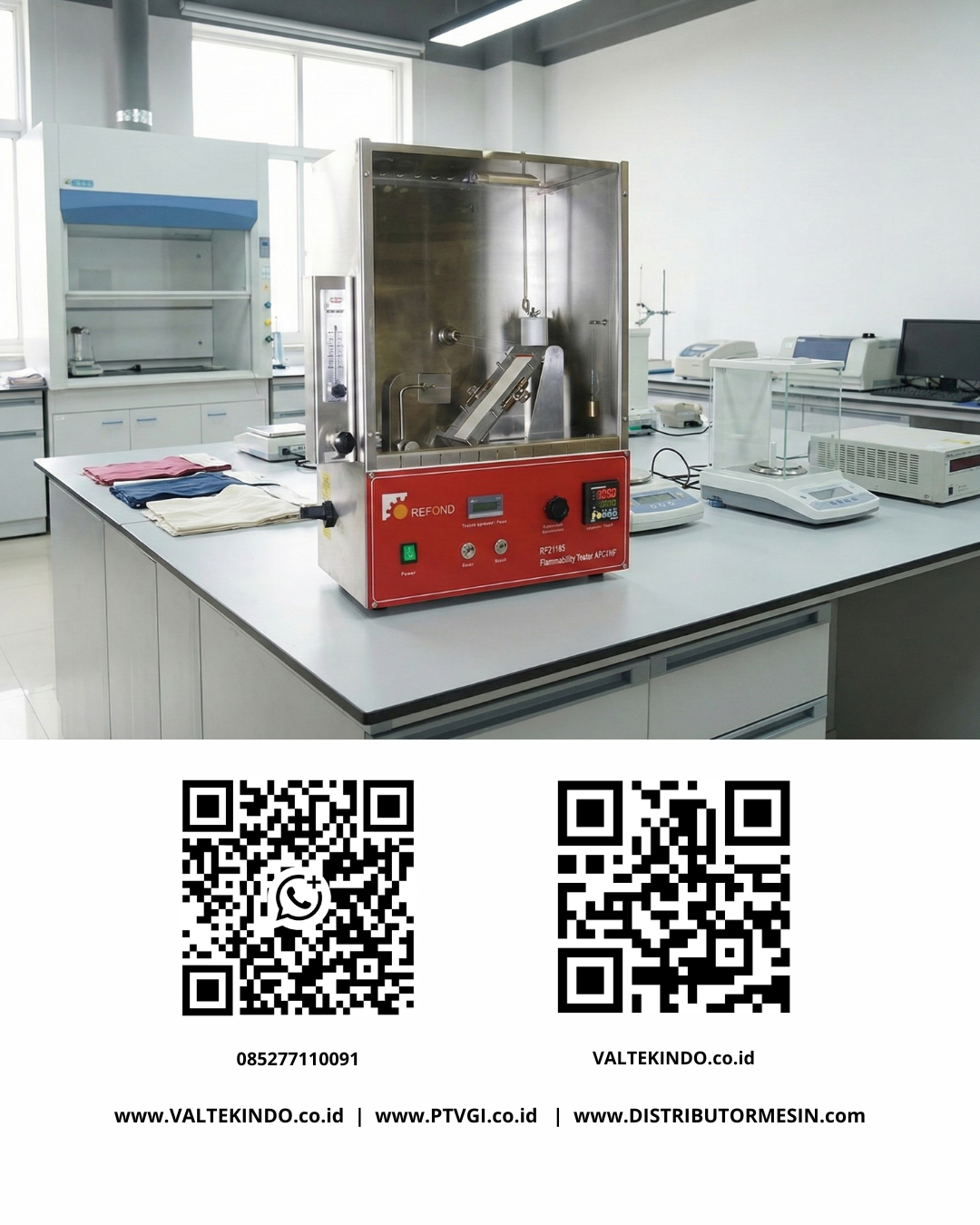
In the realm of manufacturing and material engineering, safety is a non-negotiable parameter. The risk of fire caused by material failure, particularly in plastic components, textiles, and electronics, poses a real threat that can cost billions in damages and endanger lives. Therefore, compliance with international standards such as UL 94, IEC 60695, and ASTM D635 is an absolute obligation for manufacturers aiming to compete in the global market.
This is where the role of a material testing laboratory becomes crucial. However, merely having a laboratory is not enough; you require precise equipment and the correct usage methods. As PT Valtekindo Global Intertek , we understand that the accuracy of flammability test data determines the validity of your product in the eyes of international certification bodies. An error as small as a millisecond in recording burn time or a deviation in flame angle can lead to biased results.
This article will deeply discuss how to use a Flammability Tester, dissect the necessary technical specifications, and explain why this equipment is a vital investment for your laboratory's credibility.
Technical Specifications Analysis: What Makes a Flammability Tester Reliable?
Before diving into usage, it is essential to understand the anatomy of this machine. A modern Flammability Tester is not just a Bunsen burner inside a glass box. It is a precision instrument designed to simulate extreme fire conditions in a controlled environment.
Based on the specifications found in our product catalog for this burning test equipment, this machine is designed with superior features that guarantee data reliability. One of its main components is the Combustion Chamber. This chamber must have a sufficiently large volume (generally above 0.5 cubic meters) with anti-corrosion and heat-resistant coating, as well as an intelligent ventilation system to exhaust combustion residue smoke without disturbing the stability of the flame during testing.
Furthermore, the gas control system and burner are the heart of this device. High-quality testing equipment must be capable of precise flame calibration—whether it is 50W, 500W, or other standards—according to the regulation being tested. Burner angle settings (0, 20, or 45 degrees) must be mechanically adjustable with high accuracy to ensure flame impingement on the sample occurs exactly on target.
Step-by-Step Guide to Using a Flammability Tester
Operating this equipment requires discipline and technical understanding. Here is the standard procedure for using a Flammability Tester to obtain valid results:
1. Sample Conditioning The first step often overlooked is sample conditioning. Test materials must be conditioned at a specific temperature and humidity (usually 23°C ± 2°C and 50% ± 5% humidity) for at least 48 hours before testing. This is to ensure that the moisture content in the material does not affect the burning rate.
2. Flame Calibration Before inserting the sample, the operator must verify the flame. In accordance with the instructions you might find when viewing the detailed technical specifications of this machine, adjust the flow of methane or propane gas until it reaches the flame height required by the standard (e.g., 20mm for UL 94 V vertical test). Use a thermocouple to measure the core temperature of the flame to ensure consistent heat energy.
3. Sample Mounting Clamp the sample onto the specimen holder inside the combustion chamber. Ensure the sample position is perpendicular (for vertical tests) or horizontal (for horizontal tests) according to the selected method. The distance between the burner tip and the bottom edge of the sample must be measured with extreme precision. A distance error of just 1-2 mm can alter the material classification result.
4. Ignition Process Activate the automatic burning mechanism. The burner will move forward to burn the sample for a set duration (usually 10 seconds), then retract automatically. This is where the role of automation technology provided by PT Valtekindo Global Intertek becomes very important, as it eliminates the human error factor in counting the flame exposure duration.
5. Observation and Data Recording Observe the phenomena that occur: Does the sample continue to burn after the flame is withdrawn (after-flame)? Is there any remaining glowing ember (after-glow)? Are there material drips that ignite the cotton placed underneath (drip ignition)? Record these times down to fractions of a second.
Strategic Advantages of Using Modern Flammability Testers
Why should you switch to the burning test equipment distributed by PT Valtekindo Global Intertek ? The answer lies in data integrity and efficiency.
First, Real-Time Precision. Our machines are equipped with automatic digital timers connected to sensors. When the flame retracts, the after-flame recording timer activates immediately. This is far more accurate than using a manual stopwatch.
Second, Integrated Safety Systems. Burning tests involve open flames and hazardous gases. Modern machines are equipped with automatic gas shut-off solenoid valves in case of leakage or if the flame accidentally extinguishes, as well as tempered glass observation windows that protect operators from material explosions.
Third, Ease of Reporting. For those who want to see the data reporting capabilities of this machine, please check the advanced features in this product link. This machine facilitates laboratories in compiling auditable compliance reports, increasing client trust in your test results.
Comparison: Manual Method vs. Valtekindo Flammability Tester
Many older laboratories still use manual makeshift methods. Let's compare this with a professional solution. In manual methods, the operator holds the burner by hand. This causes flame angle instability (hand tremors) and constant distance variations. Additionally, combustion smoke is often inhaled by the operator due to poor ventilation systems.
Conversely, by using machines from PT Valtekindo Global Intertek, all variables are controlled. The burner movement is driven by a smooth servo motor, integrated ventilation keeps the air clean, and combustion chamber lighting is adjusted to facilitate critical visual observation. The result is high Repeatability (consistency within the lab) and Reproducibility (consistency between labs).
Case Studies & Industrial Application
The application of this tool is vast. In the automotive industry, for example, every car interior component from the dashboard to the seat upholstery must pass a burn test to prevent fire spread during accidents. Electric cable manufacturers also rely heavily on this tool to determine VW-1 classification on their cable insulation.
One of our clients in the electronics manufacturing sector uses this tool to test server device plastic casings. With the accurate data generated, they successfully obtained UL certification faster and penetrated the European export market. This proves that investing in the right testing equipment is an investment in market expansion.
Conclusion
A Flammability Tester is not just supplementary laboratory equipment; it is the frontline in quality assurance and product safety. The use of precise tools, correct procedures, and reliable technical support are key to the success of material testing.
As an industry partner committed to quality, PT Valtekindo Global Intertek is ready to help you elevate your laboratory standards to an international level. Do not let your product quality be questioned simply because of invalid testing methods.
Optimize Your Industry Today!
Achieve production efficiency and the highest quality standards with a trusted industrial machinery provider. Explore our wide selection of premium processing and testing equipment at:
Website : valtekindo.co.id
Wesbite : distributormesin.com
Consult your technical needs with our expert sales team:
WhatsApp 1: +62 852-2211-0091
WhatsApp 2: +62 852-7711-0091

Admin
AuthorAdmin is a writer on the Valtekindo website, providing informative content about High Quality Industrial Machinery and Testing Machines.
Related post:
- Pharmaceutical Factory Production Escalation Strategy: Why Investing in an Automatic Capsule Filling Machine is the Most Crucial Business Decision
- High-Precision Wire Cut EDM Technology in 2026: The Ultimate Solution for Mold Making, Stamping Dies, and Automotive Component Fabrication Without Thermal Distortion
- 2026 Automated Carton Sealer & Erector Investment Guide: End-of-Line Automation Strategies for Industrial Plant Efficiency