Fundamental Differences: Air, Water, and Water Vapor Permeability Testing
In the world of materials science, packaging, textiles, and construction, the term "permeability" is one of the most crucial factors determining a product's performance and success. A material's ability to act as a barrier against external elements is its primary function. However, this is where confusion often arises.
Many mistakenly equate "waterproof" with "air-tight" or "moisture barrier." In reality, these three—air permeability, water (liquid) permeability, and water vapor (moisture) permeability—are three very different material properties, measured by different methods, and important for entirely different applications.
Understanding this fundamental difference isn't just a matter of technical semantics; it's fundamental to quality control (QC), research and development (R&D), and determining product shelf life, an area of expertise for PT Valtekindo Global Intertek. An error in choosing the right permeability test can lead to product failure, from soggy chips and degraded pharmaceuticals to "waterproof" jackets that leave the wearer soaked in sweat.
This article will break down the fundamental differences between these three types of permeability tests and why each is vital in its industry.
1. Air Permeability Test
What it Measures: The flow of air (bulk gas) through a material.
The Air Permeability Test measures the rate at which air—as a mixture of gases, primarily Nitrogen and Oxygen—passes through a material under differential pressure. Simply put, how easily the material can be "penetrated by wind."
This is NOT a test for specific gases like Oxygen (O2) or Carbon Dioxide (CO2) individually, which is known as a Gas Transmission Rate (GTR) Test. Air permeability is about the bulk flow of air itself.
How it Works: A sample of material is clamped between two chambers. One side is subjected to higher air pressure than the other. The instrument, such as those distributed by PT Valtekindo Global Intertek, then measures the volume of air that passes through the sample in a given time. Results are often expressed in L/m²/s (liters per square meter per second) or ft³/min/ft² (cubic feet per minute per square foot).
Where it's Critical:
- Textile Industry: This is the definition of "breathability." Essential for sportswear, outdoor jackets, and bedding.
- Medical PPE: Surgical gowns and face masks require a balance between blocking pathogens (low permeability) and allowing the wearer to breathe.
- Construction Materials: House wraps are designed to stop air infiltration (wind) but must still "breathe" to prevent moisture buildup.
- Filtration: The performance of filter media, like HEPA filters, is directly determined by its air permeability.
2. Water Permeability (Water Resistance) Test
What it Measures: The material's resistance to the penetration of water in its liquid form.
This is what most people understand as "waterproof." This test specifically measures a material's ability to prevent liquid water (H2O in its liquid phase) from seeping or leaking through it. This test almost always involves hydrostatic pressure.
How it Works: The most common method is the Hydrostatic Head Test. In this test, the material sample is clamped, and a column of water is added above it. The height of the water column is steadily increased, which automatically increases the pressure on the material. This testing equipment, which requires precise calibration, is an industry standard often provided by PT Valtekindo Global Intertek.
The result is measured by the pressure (often expressed in 'mm of water column' or 'psi') required for the first three drops of water to penetrate the material.
Where it's Critical:
- Textiles and Apparel: The standard test for raincoats, tents, tarps, and waterproof boots.
- Construction: Vital for roofing membranes, foundation coatings, and waterproofing systems.
- Geotextiles: Used in the construction of dams and reservoirs.
- Packaging: For packages that must hold liquids or protect contents from rain, like cement bags.
3. Water Vapor Permeability (WVTR) Test
What it Measures: The diffusion rate of water molecules in gas form (humidity/vapor) through a material.
This is the most complex, most misunderstood, and arguably most important property for the food packaging, pharmaceutical, and electronics industries. These industries rely heavily on accurate data provided by trusted partners like PT Valtekindo Global Intertek.
This test has nothing to do with blocking rain (liquid). It's about measuring how well a material can prevent the migration of humidity (H2O in its gas phase). The driving force is not pressure, but the relative humidity (RH) differential.
A material can be 100% waterproof (liquid-resistant) but have a very high Water Vapor Transmission Rate (WVTR). The classic example: a cheap plastic bag. You can fill it with water, and it won't leak, but chips inside it will go stale in a day because the bag cannot stop water vapor from the air. This failure can only be accurately detected using advanced water vapor permeation analysis.
How it Works: The test result is expressed as WVTR, typically in g/m²/day. The most common and accurate method is the Gravimetric Method (Weighing Method), as regulated by standard ASTM E96. This standard is the basis for modern Water Vapor Permeation Analyzers (WVTR Testers).
- A test cup is filled with a desiccant (drying agent) to create a 0% RH condition inside (Dry Cup Method).
- The material sample (e.g., packaging film) is sealed over the top of the cup.
- The cup is placed in a test chamber with strictly controlled temperature and humidity (e.g., 38°C and 90% RH).
- Water vapor from the chamber permeates through the sample and is absorbed by the desiccant.
- By weighing the cup periodically, the instrument can precisely calculate how many grams of water vapor have entered. This is the WVTR value.
Revolutionizing Productivity with Advanced Technology
WVTR testing is a pillar of quality control in modern industry. The challenge, however, is efficiency. The gravimetric method takes time, and labs often need to test dozens of different samples daily. Understanding this throughput challenge, PT Valtekindo Global Intertek offers innovative solutions.
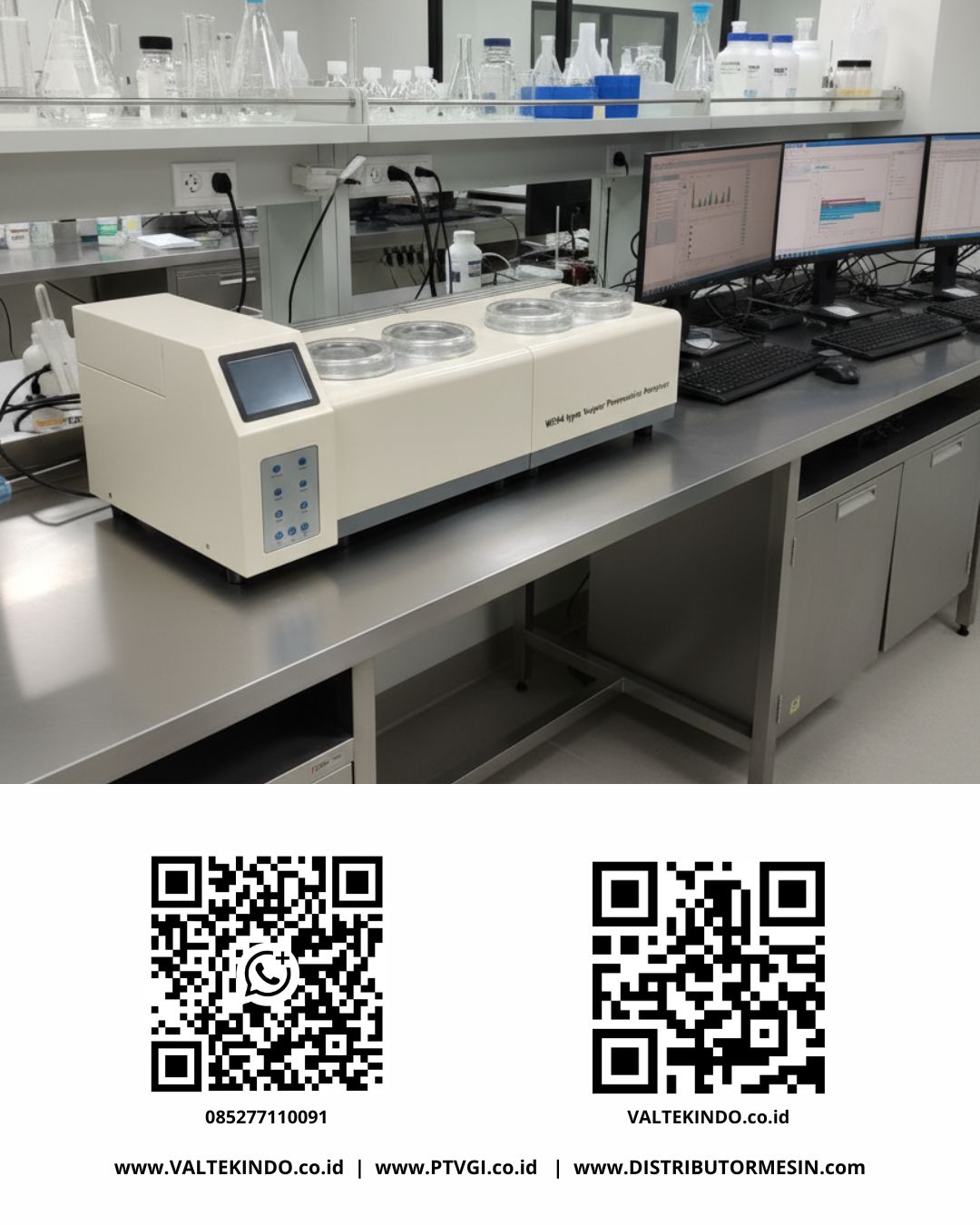
This is where modern technology plays a role. For example, the solution offered by PT Valtekindo Global Intertek with its Water Vapor Permeation Analyzer (WVTR Tester) truly revolutionizes lab workflow.
This advanced machine is designed on the precise gravimetric principle, but its advantage lies in its design: it features four independent test chambers.
This is a game-changer. Labs are no longer limited to testing one sample at a time. They can run four different tests simultaneously. This feature, combined with a measurement accuracy of 0.001 g/m²/day and precise temp/humidity control, dramatically increases throughput and efficiency. This efficiency is a key value proposition emphasized by PT Valtekindo Global Intertek, accelerating product time-to-market.
Where it's Critical:
- Food Packaging: The most critical. Defines shelf life. The expert team at PT Valtekindo Global Intertek frequently consults with food manufacturers on this.
- Dry Products (Chips, Coffee): Need very low WVTR barriers to prevent moisture from getting in.
- Moist Products (Bread, Cheese): Need barriers to prevent moisture from getting out.
- Pharmaceuticals: Protecting tablets and capsules from humidity that can degrade the drug's potency.
- Electronics: Preventing corrosion on circuit boards and sensitive components.
Conclusion: Choosing the Right Test
Understanding the difference between air, water, and water vapor permeability is key to designing, testing, and validating high-performance products. You cannot use a raincoat's "waterproof" data to determine if that material is suitable for packaging biscuits.
Choosing the wrong test not only wastes lab time and money but also risks product failure, recalls, and brand reputation damage. Investing in the right test, and more importantly, in accurate and efficient testing equipment from PT Valtekindo Global Intertek, is fundamental.
Are you ready to improve the efficiency and accuracy of permeability testing in your lab?
For an in-depth consultation on your material testing needs, especially for Water Vapor Permeation Analysis (WVTR) with the highest efficiency using independent multi-chamber technology, the expert team at PT Valtekindo Global Intertek is ready to help.
Optimize Your Industry Today!
Achieve production efficiency and the highest quality standards with a trusted industrial machinery provider. Explore our wide selection of premium processing and testing equipment at:
Website : valtekindo.co.id
Wesbite : distributormesin.com
Consult your technical needs with our expert sales team:
WhatsApp 1: +62 852-2211-0091
WhatsApp 2: +62 852-7711-0091

Admin
AuthorAdmin is a writer on the Valtekindo website, providing informative content about High Quality Industrial Machinery and Testing Machines.
Related post:
- Pharmaceutical Factory Production Escalation Strategy: Why Investing in an Automatic Capsule Filling Machine is the Most Crucial Business Decision
- High-Precision Wire Cut EDM Technology in 2026: The Ultimate Solution for Mold Making, Stamping Dies, and Automotive Component Fabrication Without Thermal Distortion
- 2026 Automated Carton Sealer & Erector Investment Guide: End-of-Line Automation Strategies for Industrial Plant Efficiency