Don't Make the Wrong Purchase! 7 Characteristics of a Quality Mini Lathe That You Must Know
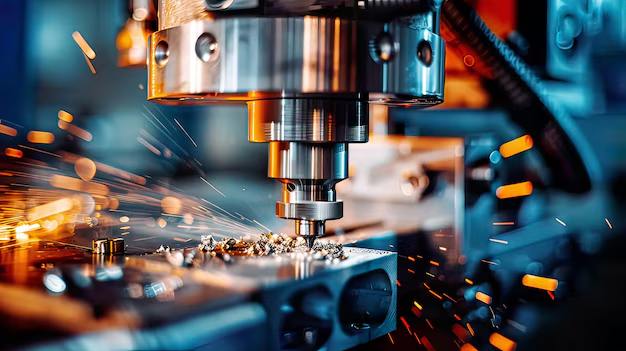
In the era of Industry 4.0 and the rise of the Do It Yourself (DIY) movement, a growing number of hobbyists, technicians, and small-scale workshop owners are turning to mini lathes. This tool offers a compact and affordable solution for a variety of precision projects, from creating small components, prototypes, and tool repairs to crafting art from metal and wood. However, the market is flooded with various brands and models, often leaving potential buyers confused.
Choosing the right mini lathe is a long-term investment. A wrong choice not only leads to financial loss but also results in suboptimal work and even safety risks. A machine that seems cheap initially can become more expensive to maintain due to frequent breakdowns or its inability to meet your project needs. So, how do you distinguish a quality mini lathe from a subpar one? This article will thoroughly explore the 7 key features of a quality mini lathe that you must know before making a purchase.
1. Solid Frame Material and Sturdy Construction
The first and most fundamental feature of a quality lathe is its material and construction. Don't be fooled by modern designs or attractive colors. The foundation of a lathe's precision lies in the stability of its frame.
High-quality mini lathes almost always use cast iron for major parts like the bed, headstock, and tailstock. Cast iron offers several superior advantages:
- High Rigidity: It can withstand heavy loads and cutting forces without bending or deforming.
- Natural Vibration Dampening: Its material properties effectively absorb vibrations generated during the lathing process. Minimal vibration is key to achieving a smooth and accurate surface finish.
- Thermal Stability: It does not easily expand or contract with temperature changes in the work environment.
A heavier machine tends to be more stable. When looking at specifications, pay attention to the total weight of the machine. A sturdy mini lathe typically weighs over 40-50 kg. Lighter constructions made from low-quality metal alloys will vibrate easily, produce rough work, and wear out quickly.
2. Reliable and Durable Motor (Brushless Motor)
The heart of every lathe is its drive motor. The power and reliability of the motor determine the machine's ability to consistently cut hard materials without losing power. For modern mini lathes, choose a machine that is equipped with a Brushless DC motor.
Compared to conventional brushed motors, brushless motors offer many advantages:
- High Efficiency: Less energy is wasted as heat, resulting in more optimal power output.
- Constant Torque: It can maintain stable torque (rotational force) even at low speeds, which is crucial when working with tough materials or during the threading process.
- Minimal Maintenance: There are no carbon brushes that need periodic replacement, making it more durable and maintenance-free.
- Quieter Operation: The machine operates much more quietly and with less vibration.
Pay attention to the motor power listed in the specifications, usually in Watts (W). For working with metals like mild steel, aluminum, and brass, a motor with a minimum power of 550W is sufficient. However, for greater flexibility, a machine with 800W to 1100W will deliver far superior performance.
3. Machining Capacity and Precision Level
Every lathe has limits on the size of the workpiece it can handle. Understanding these capacity specifications is crucial to ensure the machine you buy fits the scale of your projects. There are three main parameters to consider:
- Swing Over Bed: This is the maximum diameter of a workpiece that can rotate over the machine's bed without interference. The larger the number, the larger the diameter of the material you can work on.
- Distance Between Centers: This is the maximum length of a workpiece that can be mounted between the chuck and the tailstock. It determines how long of a shaft or workpiece you can turn.
- Spindle Bore (Hole Through Spindle): This is the diameter of the hole that passes through the main spindle. This measurement is important if you plan to work on long workpieces by feeding them through the headstock.
A quality mini lathe will provide clear precision figures for its moving components, such as the cross slide and compound slide. This level of precision ensures you can make highly accurate cuts, down to the micrometer.
4. Variable Speed Control Feature
The ability to flexibly adjust the spindle's rotational speed is a mandatory feature for a modern mini lathe. Different materials and machining processes (e.g., roughing, finishing, drilling, threading) require different speeds for optimal results.
A quality machine will be equipped with a digital control panel and a potentiometer (rotary knob) that allows you to precisely set the RPM (Rotations Per Minute). Avoid machines that only offer 2-3 fixed speed settings using a belt and pulley system. An electronic variable speed system is far more practical and efficient. An ideal speed range is typically between 50 RPM and 2500 RPM. Low speeds are vital for safety when starting on large workpieces or when threading, while high speeds are necessary for achieving a very fine finish on small-diameter materials.
5. Comprehensive Threading Capabilities
One of the crucial functions of a lathe is its ability to create threads, both metric (mm) and imperial (inch/TPI). A versatile mini lathe must be capable of doing both.
A key feature of a machine competent in threading is the inclusion of a complete set of change gears. These gears are arranged in specific configurations to synchronize the spindle's rotation with the carriage's movement, thereby producing threads with an accurate pitch. Ensure the seller provides a gear configuration chart for various standard thread sizes. This capability will open up a vast range of project possibilities, from making custom bolts and nuts to repairing machine parts with worn threads.
6. Standard Accessory Package
A quality mini lathe is usually offered with a standard accessory package sufficient to get started. This indicates that the manufacturer is not cutting corners and understands the basic needs of the user. Some essential accessories that should be included are:
- 3-Jaw Chuck: The standard chuck for clamping cylindrical workpieces.
- Chuck Key and Tool Post Wrench.
- Set of Change Gears: For threading.
- Dead Center and Live Center: To support the end of a workpiece at the tailstock.
- Basic Set of Turning Tools: A few basic cutting tools to begin with.
- Chuck Guard: An important safety feature.
If all these accessories are included, you won't need to spend significant extra money just to start using the machine.
7. After-Sales Service and Spare Parts Availability
Last but not least is the support from the seller. A lathe is a precision mechanical device that may require adjustments, repairs, or component replacement in the future. Make sure you buy from a trusted distributor or company that provides clear after-sales service. Ask about the service warranty and the availability of spare parts like belts, gears, or electronic components. Buying from a reputable seller will give you peace of mind, knowing there is someone to contact if problems arise.
Optimize Your Industry Today!
Achieve production efficiency and the highest quality standards with a trusted industrial machinery provider. Explore our wide selection of premium processing and testing equipment at:
Website : valtekindo.co.id
Wesbite : distributormesin.com
Consult your technical needs with our expert sales team:
WhatsApp 1: +62 852-2211-0091
WhatsApp 2: +62 852-7711-0091

Admin
AuthorAdmin is a writer on the Valtekindo website, providing informative content about High Quality Industrial Machinery and Testing Machines.
Related post:
- Pharmaceutical Factory Production Escalation Strategy: Why Investing in an Automatic Capsule Filling Machine is the Most Crucial Business Decision
- High-Precision Wire Cut EDM Technology in 2026: The Ultimate Solution for Mold Making, Stamping Dies, and Automotive Component Fabrication Without Thermal Distortion
- 2026 Automated Carton Sealer & Erector Investment Guide: End-of-Line Automation Strategies for Industrial Plant Efficiency