Digital vs Offset Printing: Which is Best for Your Needs?
In an era where visual imagery is everything, choosing the right printing method is a crucial decision for any business. Whether for marketing materials, product packaging, books, or corporate branding, your printed matter is a physical representation of your brand's quality. The two main players in the printing industry today are digital printing and offset printing.
Both have their own distinct advantages and roles. Digital printing offers speed and flexibility, while offset printing is renowned for its premium quality and cost-efficiency at high volumes. But how do you know which is right for your project?
This article will comprehensively break down the fundamental differences between these two methods, analyze their pros and cons, and provide a case study using a modern offset machine to help you make the most profitable decision for your business.
What Is Digital Printing?
Digital printing is a modern method that works much like an advanced desktop printer or photocopier. It prints an image directly from a digital file (like a PDF or JPG) onto various media. This method uses liquid ink (inkjet) or toner (laser) and does not require the creation of a printing plate.
It's a relatively new technology compared to offset and has revolutionized the industry with its capability for "print-on-demand."
Advantages of Digital Printing:
- Fast Turnaround: With no plate-making or complex machine setup, digital printing is extremely fast. You can have a finished product within hours, or even minutes.
- Low Setup Cost: It is ideal for low-volume print runs. Printing 1, 50, or 100 copies is very economical because there are no expensive setup fees.
- Variable Data Printing (VDP): This is a unique advantage of digital. You can easily personalize each individual print. For example, printing 500 invitation letters where each letter has a different guest's name.
- Simple Process: Corrections or design changes can be made quickly in the middle of a print run without significant material loss.
Disadvantages of Digital Printing:
- Higher Cost per Unit for High Volumes: The cost to print the 1,000th sheet is the same as the first. The more you print, the total cost becomes significantly more expensive than offset.
- Media Limitations: Most digital presses are limited to A3+ paper sizes and have restrictions on paper thickness (grammage), often struggling with very thick stock (above 300 gsm) or paper with unique textures.
- Color Quality: While constantly improving, color consistency over a large run can sometimes vary. Furthermore, achieving precise Pantone (the industry color standard) color matching can be more difficult and expensive.
What Is Offset Printing?
Offset printing (or offset lithography) has been the gold standard in commercial printing for decades. It is a technique where an inked image is transferred (or "offset") from an aluminum plate to a rubber sheet (called a "blanket"), which then rolls the ink onto the paper surface.
The process is based on the fundamental principle that oil (ink) and water do not mix. The aluminum plate is treated to attract ink to the image areas and repel ink (using water) in the non-image areas.
Advantages of Offset Printing:
- Cost-Effective for High Volumes: This is its greatest strength. While the initial setup cost (plate making and machine setup) is high, the cost per unit drops dramatically as the quantity increases. Printing 5,000 or 100,000 copies is far cheaper per sheet with offset.
- Superior Quality and Detail: Offset printing produces exceptionally sharp, clean, and consistent images. The ink sinks into the paper perfectly, providing a rich and professional result.
- Best Color Accuracy: Offset is the king of color. You can use the Pantone Matching System (PMS), allowing for perfect, precise color matching for branding. You can also easily use specialty inks like metallic (gold, silver) or fluorescent.
- Media Flexibility: Offset presses can handle a massive range of paper types, textures, and thicknesses, from thin newsprint to thick cardboard for packaging.
Disadvantages of Offset Printing:
- High Initial Cost: It is not economical for short runs. The cost of plates and machine setup time makes printing under 500 copies very expensive.
- Longer Turnaround Time: The pre-press process (creating film and plates) and machine setup take time. Additionally, the wet ink on the prints sometimes requires drying time.
- Inflexible (Once Started): Once a plate is made, you cannot change the design. If there is a typo, you must create an entirely new plate from scratch.
Case Study: The Power of a Modern Offset Machine
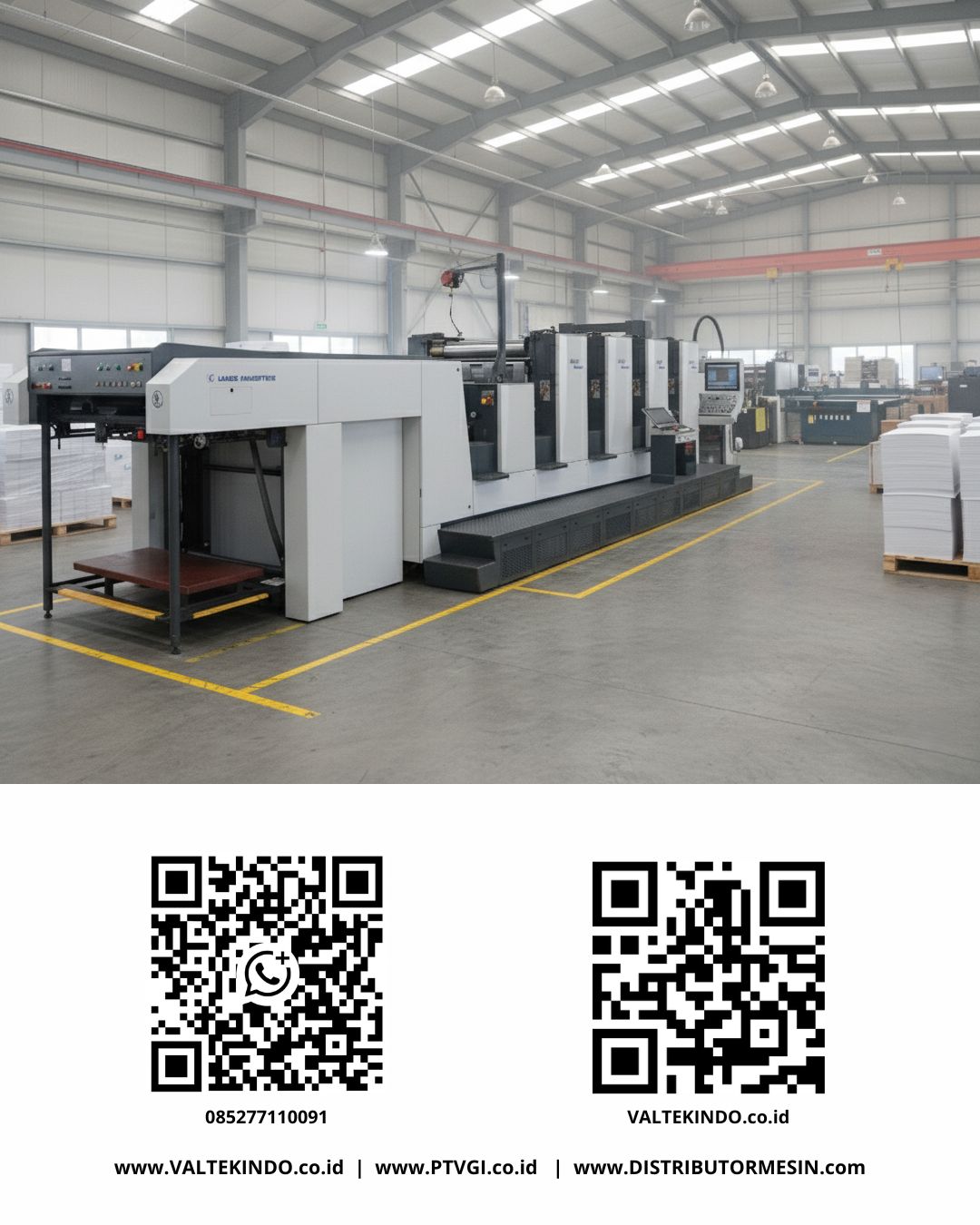
To understand why offset remains dominant in the large-scale printing industry, let's look at the specifications of a modern offset machine as an example. One industrial machine that illustrates this power is the Printing Paper Offset Machine 7 Color, distributed by Valtekindo.
Its specifications highlight the key differences that digital technology cannot compete with:
- 7-Color Capability: This isn't just CMYK (Cyan, Magenta, Yellow, Black). This machine has 7 printing units, meaning it can print CMYK plus 3 spot colors (e.g., 2 special Pantone colors for a logo and 1 varnish/protective coat) all in a single pass. This is crucial for premium product packaging and strict branding.
- Mass Production Speed: With a maximum speed of 12,000 sheets per hour (s/h), this machine is designed for non-stop production. In one hour, it can produce a print volume that might take a digital press days to complete.
- Superior Media Handling: This is a key differentiator. This machine can handle paper thicknesses from 0.04 mm (very thin) to 0.6 mm. A thickness of 0.6 mm is well beyond the capability of standard digital presses and is essential for producing folders, packaging boxes, and hardcover book covers.
- Large Print Size: With a maximum sheet size of 720 mm x 1030 mm, this press can print an area much larger than A1. This allows for printing large posters or arranging dozens of designs (like labels or business cards) on a single sheet, dramatically increasing efficiency.
A machine like this confirms that for industrial needs, high volume, and uncompromising quality, offset is the irreplaceable solution.
Which is Best for Your Needs?
Choosing between digital and offset depends entirely on your project's specific requirements.
Choose DIGITAL PRINTING if you:
- Need to print in small quantities (e.g., under 500 copies).
- Need an extremely fast turnaround time (print-on-demand).
- Require variable data personalization (VDP), such as different names or addresses.
- Are printing standard materials like proposals, event posters, or a small batch of business cards.
Choose OFFSET PRINTING if you:
- Need to print in large quantities (e.g., over 1,000 copies).
- Want the lowest possible cost per unit for mass production.
- Require the highest possible image quality, sharpness, and consistency.
- Are very concerned with color accuracy (needing Pantone/Spot colors).
- Are printing on very thick, textured, or oversized media (e.g., packaging, magazines, catalogs, or books).
Conclusion
Digital and offset printing are not competitors; they are two complementary technologies. Digital wins on short-term speed and flexibility, while offset is a strategic investment for long-term efficiency, quality, and business growth.
If your business relies on producing high-quality printed materials in large volumes—such as product packaging, labels, books, or large-scale promotional materials—then investing in offset printing technology is the smartest and most economical move.
Optimize Your Industry Today!
Achieve production efficiency and the highest quality standards with a trusted industrial machinery provider. Explore our wide selection of premium processing and testing equipment at:
Website : valtekindo.co.id
Wesbite : distributormesin.com
Consult your technical needs with our expert sales team:
WhatsApp 1: +62 852-2211-0091
WhatsApp 2: +62 852-7711-0091

Admin
AuthorAdmin is a writer on the Valtekindo website, providing informative content about High Quality Industrial Machinery and Testing Machines.
Related post:
- Pharmaceutical Factory Production Escalation Strategy: Why Investing in an Automatic Capsule Filling Machine is the Most Crucial Business Decision
- High-Precision Wire Cut EDM Technology in 2026: The Ultimate Solution for Mold Making, Stamping Dies, and Automotive Component Fabrication Without Thermal Distortion
- 2026 Automated Carton Sealer & Erector Investment Guide: End-of-Line Automation Strategies for Industrial Plant Efficiency