Automating Plastic Bag Production: Modern Machinery Solutions for Maximum Profit
In the modern pharmaceutical world, capsules are one of the most popular and widely accepted dosage forms. Their ability to mask unpleasant tastes and odors, provide accurate dosing, and ease of consumption makes them a favorite choice for both manufacturers and patients. But have you ever wondered how millions of capsules are produced daily with uniform precision?
The answer lies in the advanced technology known as the Capsule Filling Machine. This machine is the backbone of any capsule drug production line, working tirelessly to ensure every capsule is filled correctly, safely, and efficiently.
This article will thoroughly explore how a capsule filling machine works, its crucial role in the pharmaceutical industry, and its journey to the next stage: packaging—a critical step that also requires specialized machinery to maintain product quality until it reaches the consumer.
The Vital Role of Capsule Filling Machines in the Pharmaceutical Industry
Before we dive into its workings, it's important to understand why this machine is so fundamental. Its primary role in the pharmaceutical industry cannot be overstated and covers several critical aspects:
- Unmatched Dosing Precision: In pharmaceuticals, "almost" accurate is not an option. A difference of micrograms can alter a drug's efficacy or even harm a patient. Modern capsule filling machines are designed to deliver highly precise and consistent doses, far exceeding human capabilities.
- Efficiency and Production Speed: The global demand for medicine is massive. Automatic capsule filling machines can fill tens of thousands to hundreds of thousands of capsules per hour. This level of automation enables efficient mass production to meet market demand.
- Compliance with GMP Standards: The pharmaceutical industry is governed by strict Good Manufacturing Practices (GMP). These machines are designed to operate in cleanroom environments, minimizing cross-contamination and human contact, and ensuring every product is sterile and safe.
- Flexibility: Many modern machines can handle various capsule sizes (from size 00 to 5) and different types of filling materials, including powders, granules, pellets, or even liquids.
Dissecting the Workings of an Automatic Capsule Filling Machine
While manual and semi-automatic versions exist, industrial-scale production lines rely heavily on fully automatic capsule filling machines. The process, though complex, can be broken down into several core, sequential stages:
Stage 1: Capsule Orientation (Rectification)
The process begins by pouring thousands of empty capsules (which consist of a 'body' and a 'cap') into a hopper. From there, the capsules are fed into an orientation station. Here, a special mechanism "flips" and aligns each capsule so they all face the same direction (usually, body-down and cap-up).
Stage 2: Capsule Separation
Once oriented, the capsules are clamped into a holding ring. A vacuum system is then applied from below. This vacuum pulls the capsule body down, separating it from the cap which is held in the upper section. At this point, we have two separate halves ready to be filled.
Stage 3: Dosing (Filling)
This is the heart of the entire process. The open capsule bodies move to the filling station. There are several common filling methods:
- Tamping Pin (Dosing Disc) Method: This is the most common for powders. The drug powder is placed in a rotating "bed." A series of pins (tamping pins) will descend and compact the powder multiple times to form a solid "slug" of powder. This compacted slug is then pushed and transferred into the capsule body. This method ensures a very consistent density and dose.
- Dosator Method: This uses a special nozzle (dosator) equipped with a piston. The nozzle plunges into the powder bed and "picks up" the powder to a predetermined density. The powder is then transferred and ejected into the capsule body.
During this process, advanced sensors continuously monitor the powder level to ensure accurate filling and stop the machine if an anomaly occurs.
Stage 4: Closing & Locking
Once filled, the capsule bodies move to the next station where they are reunited with their caps. The upper holding ring (holding the caps) and the lower ring (holding the newly filled bodies) are brought together. Mechanical pins push the two halves together until they are tightly closed and permanently "locked."
Stage 5: Ejection
The fully filled and closed capsules are now pushed out of the holding rings and onto a conveyor belt or collection container. Any defective capsules (e.g., those that didn't separate or close properly) are automatically detected and ejected from the production line.
Stage 6: Cleaning/Polishing
As a final step, the finished capsules often pass through a polishing station. This is a system of rotating brushes or vacuum that cleans off any dust or drug powder that may have adhered to the outside of the capsule, ensuring a clean and professional final appearance.
From Filling to Packaging: The Next Crucial Stage
Once the capsules are successfully filled, the job is not yet finished. These capsules must now be protected from the environment—moisture, light, and physical contamination—to remain stable and safe until consumption. This is where primary packaging comes into play.
Without proper packaging, all the precision of the capsule filling machine would be wasted. One of the most effective and common primary packaging methods in the pharmaceutical industry is Strip Packing.
Strip packing is the process of sealing a product (like a capsule or tablet) between two layers of packaging material, typically aluminum foil (ALU/ALU) or a combination of aluminum and plastic (ALU/PE). Each capsule is sealed in an individual pouch, providing excellent protection.
To accomplish this, the industry no longer relies on the capsule filler, but on a different, specialized machine: the Strip Packing Machine.
This machine picks up the workflow where the capsule filling machine left off. The finished capsules or tablets are fed into the strip packing machine's hopper. The machine then automatically performs a series of complex tasks:
- Feeding: Dropping the capsules one by one into the mold.
- Sealing: Using heat and pressure to seal the capsules between two continuous-running foil reels.
- Batch Coding: Printing the batch number and expiration date onto the foil.
- Perforation & Cutting: Creating tear lines (perforations) between strips and cutting the strips into predetermined sizes (e.g., a strip of 10 capsules).
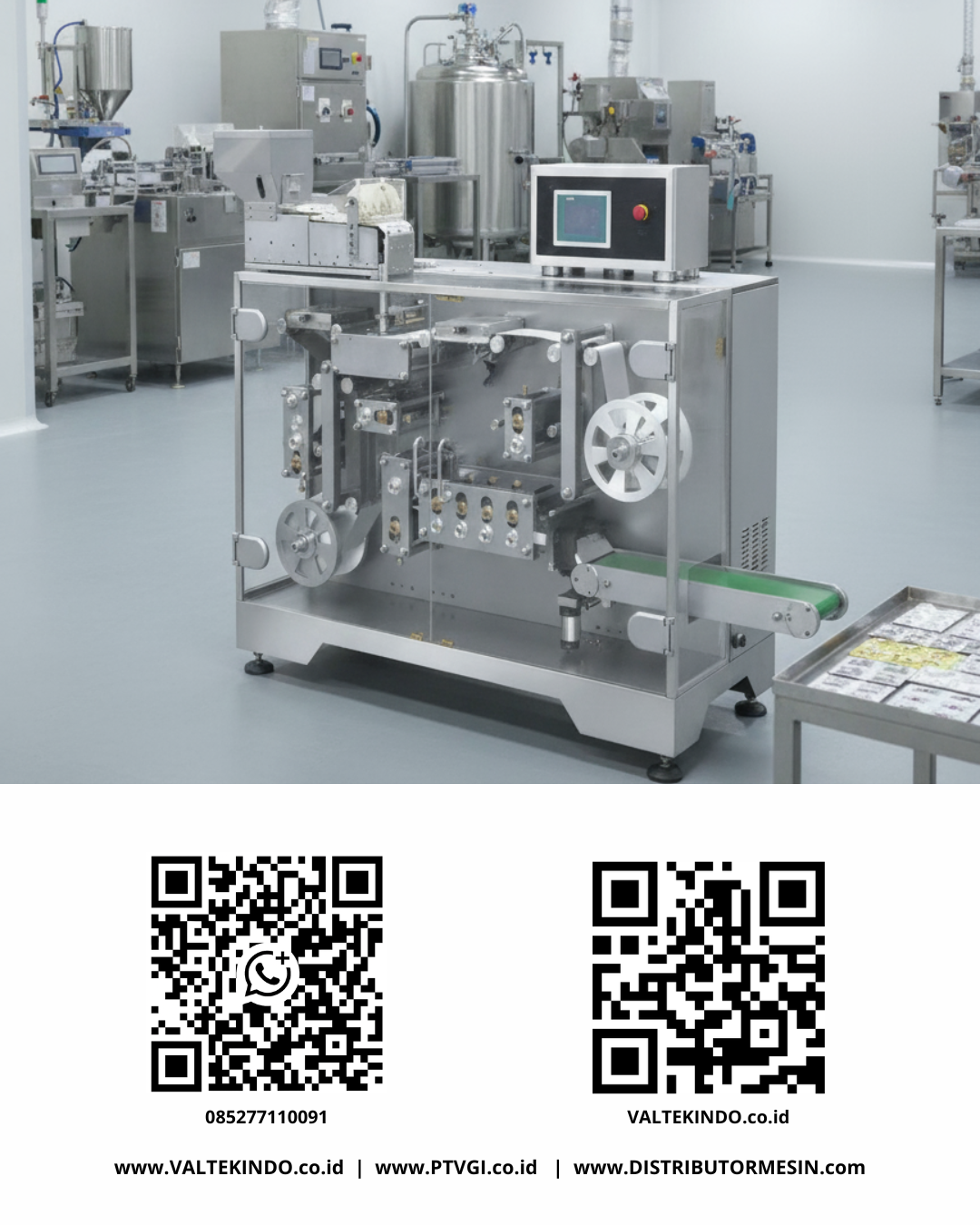
For industrial needs that demand high efficiency, machines like the Automatic Strip Packing Machine for Medicine, Capsules, and Tablets become the ideal solution. Based on its description, this Automatic Strip Packaging Machine is designed with an advanced structure for high efficiency, low noise, and easy operation.
The machine is equipped with vital modern features, such as optical monitoring devices to ensure each pocket is correctly filled and automatic counting. Most importantly, it can complete the entire process—from feeding into the strip, sealing, date coding, and cutting—in one high-speed, integrated operation.
Conclusion
The journey of a medicine from raw material to a consumable capsule is a complex symphony of automation. The Capsule Filling Machine is the primary player ensuring dose precision and safety. However, its role must be supported by the next-stage machine, the Strip Packing Machine, which protects the product and guarantees its integrity all the way to the patient's hands.
Investing in both types of machines—the filler and the packer—is not just about production speed. It is a commitment to quality, safety, and compliance with the highest pharmaceutical standards in the world.
Optimize Your Industry Today!
Achieve production efficiency and the highest quality standards with a trusted industrial machinery provider. Explore our wide selection of premium processing and testing equipment at:
Website : valtekindo.co.id
Wesbite : distributormesin.com
Consult your technical needs with our expert sales team:
WhatsApp 1: +62 852-2211-0091
WhatsApp 2: +62 852-7711-0091

Admin
AuthorAdmin is a writer on the Valtekindo website, providing informative content about High Quality Industrial Machinery and Testing Machines.
Related post:
- Pharmaceutical Factory Production Escalation Strategy: Why Investing in an Automatic Capsule Filling Machine is the Most Crucial Business Decision
- High-Precision Wire Cut EDM Technology in 2026: The Ultimate Solution for Mold Making, Stamping Dies, and Automotive Component Fabrication Without Thermal Distortion
- 2026 Automated Carton Sealer & Erector Investment Guide: End-of-Line Automation Strategies for Industrial Plant Efficiency